
A sheet has two sides. It seems a small truth, but here it changes everything.
In the chapel of relics at the Basilica of Saint Francis in Assisi, an irregular piece of parchment is preserved. The Praises of God Most High are on its reverse. On the other side is the blessing given to Brother Leo. These are not two papers later joined together. They are two prayers on the same object, known as the Chartula.
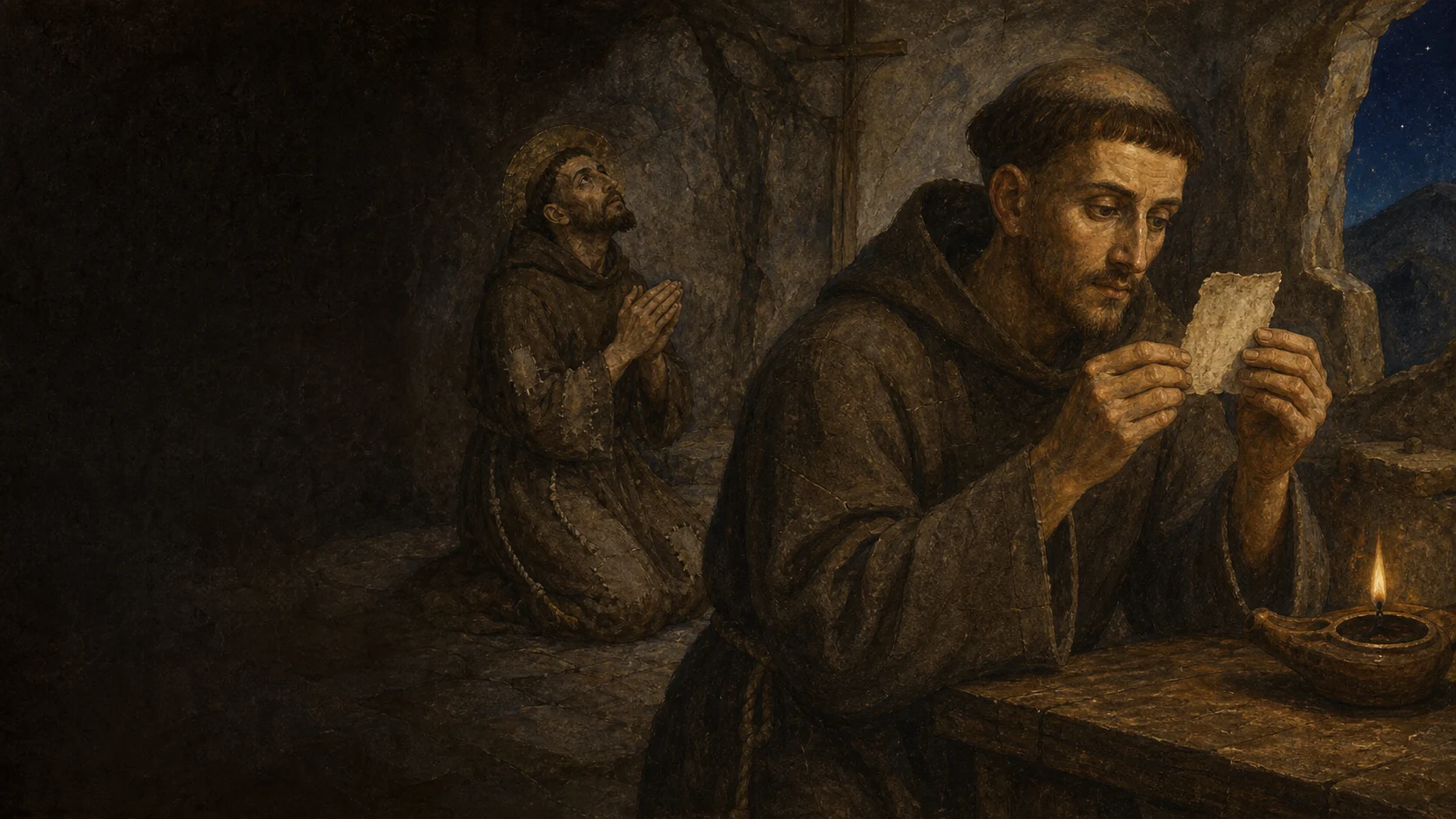
Leo preserved more than sentences. He preserved the sheet Francis touched and wrote during his stay on Mount La Verna in 1224. The parchment received folds, marks, and notes. Its material journey belongs to history as much as its words do.
The biographies relate that Francis underwent a profound experience there connected with the Passion of Christ, traditionally identified with his reception of the stigmata. Christian faith interprets the event supernaturally; history can study the early testimonies, date, place, and object, but it cannot measure a mystical experience as it measures the parchment’s width.
The mountain of stone and silence
La Verna lies in a mountainous part of Tuscany. Francis already knew the place and sought recollection there. In 1224, as the feast of Saint Michael the Archangel approached, he remained on the mountain for a period of fasting and prayer.
We can affirm the general setting. We do not know the exact sequence of every hour. The early hagiographical sources present the experience theologically: they wish to narrate Francis’s union with the crucified Christ. They are not a diary written that morning.
Brother Leo was nearby. A note that he added to the parchment connects the Chartula with the blessing received after the vision of the seraph and Christ’s wounds. This annotation has enormous value because Leo was Francis’s companion and the object’s custodian. At the same time, it is a devout interpretation of the event, not a photograph.
The Chartula lets us touch a point where testimony, faith, and matter meet. Tradition speaks of an immense experience. What appears before the eyes is humble: prepared skin, dark ink, irregular letters.
When adjectives are not enough
The Praises begin by affirming that God is holy, one, and the worker of wonders. Then the phrases run like water. God is strong, great, most high, almighty; God is love, charity, wisdom, and humility; God is beauty, gentleness, security, rest, joy, and hope.
This sequence is not an information sheet about God. Francis does not try to fit mystery inside definitions. He repeats “You are.” Each name opens a window and, before the reader can think everything has been understood, another appears.
In our own pastoral rendering, we can hear part of the movement this way: “You are the whole good, the greatest good. You are love and wisdom. You are humility and patience. You are rest, joy, and our hope.” These are brief echoes, not a replacement for the complete prayer.
Some names seem natural in prayer: holiness, strength, mercy. Others surprise. Calling God humility is profoundly Franciscan. For Francis, divine greatness has no need to crush. God bends down: in Jesus’s incarnation, in poverty, in the Eucharist, and in service.
Beauty appears too. Not beauty to be possessed, but recognized. On the mountain, amid stone and exhaustion, praise does not ignore pain. It discovers that pain has not received the last word.
A prayer made of Bible and memory
Francis did not write in isolation from Christian tradition. The Praises breathe the language of the Psalms, liturgy, and other biblical passages. “God of gods,” “Lord of heaven and earth,” “all good,” and many other echoes already lived in the Church’s prayer.
This does not make the text a simple copy. Imagine someone who knows many melodies and, at a decisive moment, sings in their own voice. Francis gathers received words, changes their rhythm, and places them within the repeated “You are.”
The structure is simple enough for a child to follow and deep enough for a theologian to continue studying. There is no explanation between one title and another. The reader is led to remain. Strength stands beside humility; riches beside sufficiency; beauty beside gentleness.
The God being praised is not a collection of separate qualities. All of them try to indicate the same mystery. That is why the prayer may look like a list from a distance but becomes contemplation when recited slowly.
The movement of prayer
Naming without imprisoning
Francis repeats “You are” because no name is enough by itself. The prayer does not end in a definition. It remains before God, like someone looking at the same flame from many angles and never managing to keep it in a hand.
The hand that wrote
Specialists study the Chartula as a document. They observe the direction of strokes, abbreviations, changes of ink, and different hands. The core of the prayers is recognized as Francis’s autograph. Brother Leo added explanations that help identify the object and its origin.
These notes are extraordinarily fortunate. Without them, we might have the text but not such a strong connection with Leo and La Verna. At the same time, the voices must be distinguished. The praise and blessing belong to Francis; the identifying notes are Leo’s testimony.
On the side bearing the blessing is a Tau, a sign Francis loved. Its stroke descends and is visually related to Leo’s name. Other features have required close material attention from palaeographers. Modern photographs, different lighting, and scientific examinations help reveal erasures, lines, and interventions invisible to an ordinary eye.
None of these studies destroys devotion. They show that the relic is not an idea floating in the air. It is an object that aged, was folded, and received care.
Why is the blessing on the other side?
Early biographies say that Leo was undergoing a temptation or affliction and wanted a few words from Francis. Without asking directly, he is said to have received the written sheet. The narrative emphasises the saint’s gentleness, his ability to perceive his companion’s need.
The general context may preserve a real memory. But we have no access to Leo’s secret thoughts. The phrase “without saying anything, he desired…” belongs to the hagiographical manner of telling. It shows the spiritual meaning the community recognized in the episode.
Materially, the relationship is beyond dispute: the Praises and the Blessing occupy the two sides of the same Chartula. It is therefore unhelpful to present one text as though the other were merely a detail.
The side with praise looks toward God. The side with the blessing directs words to Leo: may the Lord bless and keep him, show his face, have mercy, and give him peace. It is the blessing of Numbers 6, received from Scripture and made personal through the brother’s name.
Perhaps the sheet says something without new words: contemplating God and caring for someone are not competing tasks. The person who encounters God as goodness, gentleness, and security wants that goodness to reach a particular face.
This is not the Letter to Brother Leo
Another distinction must be preserved. A small autograph in Spoleto is called the Letter to Brother Leo. In it, Francis summarises a conversation on the road, entrusts a decision to his companion, and invites him to come if he needs consolation.
The Chartula is in Assisi. It bears the Praises and the Blessing. Both documents have Leo as recipient or custodian; both reveal closeness; both preserve Francis’s writing. Even so, they are different objects.
Confusing them impoverishes the history. A friendship cannot fit into one moment. There were road and mountain, counsel and blessing, freedom and consolation.
The parchment crosses the centuries
Leo kept the sheet. After his death, it remained within the tradition of the Sacro Convento in Assisi. Across the centuries, the Chartula was treated as a relic. Early conservation practices were not always the same as those of a modern museum; display, contact, and folds left marks.
Today, conservation and study must balance veneration with fragility. Ink is not eternal. The light that allows us to see can also cause damage. Digital images and facsimiles bring the object close to the public without requiring the original to be handled.
Its survival is almost improbable. Small parchments disappear easily. Wars, fires, damp, and simple neglect have destroyed entire libraries. The Chartula remained.
Yet its power does not come only from age. There are larger and more luxurious medieval documents. This sheet touches us because on it a suffering hand tried to say the unsayable and then turned the parchment over to bless a brother.
A prayer to be heard slowly
The Praises ask for nothing. There is no “give me,” “heal me,” or “solve this.” Francis remains in the recognition of God. This does not mean that he had no needs. La Verna was surrounded by physical pain, conflicts within the fraternity, and awareness of the Passion.
Precisely there, prayer becomes “You are.” Before looking at what is lacking, it looks at the One in whom it trusts. Repetition opens space in the heart.
For a young reader, the text may teach that praise is not flattering God to gain a prize. It is learning to notice. Strength can be humble. Riches can mean that God is enough. Joy can survive beside pain. Beauty can live on a worn sheet.
When we finish reading one side, we must remember that the other is still there. Turning the Chartula means moving from mystery to a name: Leo. The Most High does not make Francis forget the nearby brother. On the contrary, praise continues in a blessing of peace.
The sheet and its two voices
Sources for this chapter
- Franciscan Directory — Francis’s writings in LatinPrimary text. Collects the Latin original of the Praises and the blessing connected with the Chartula.
- CapDox — writings of Saint FrancisOpen historical edition for comparison of the text and editorial notes.
- Facsimile of the Assisi ChartulaMaterial witness. Identifies the two sides: Praises of God Most High and Blessing to Brother Leo.
- CFIT — recent studies of the autograph writingsPresents specialists’ material reassessment of the Chartula, including the work of Attilio Bartoli Langeli.
- Institute of Franciscan Studies — Francis’s autographAccessible description of the relic, its writing, the Tau, and Brother Leo’s notes.
- CapDox — chronology of Francis and the sourcesPlaces the stay at La Verna and the writings of the last years in context.
- Thomas of Celano — early lives of FrancisEarly hagiographical source. Helps explain how the La Verna experience was narrated in the initial tradition.
How we read this chapter: the Chartula’s existence, its two sides, Francis’s authorship, and Leo’s notes belong to documentary study. Its link with La Verna is ancient and strongly attested. Details about inner desires and the sequence of the experience come from hagiographical narratives and are presented as tradition, not modern observation. The short excerpts above are our own pastoral translations.