
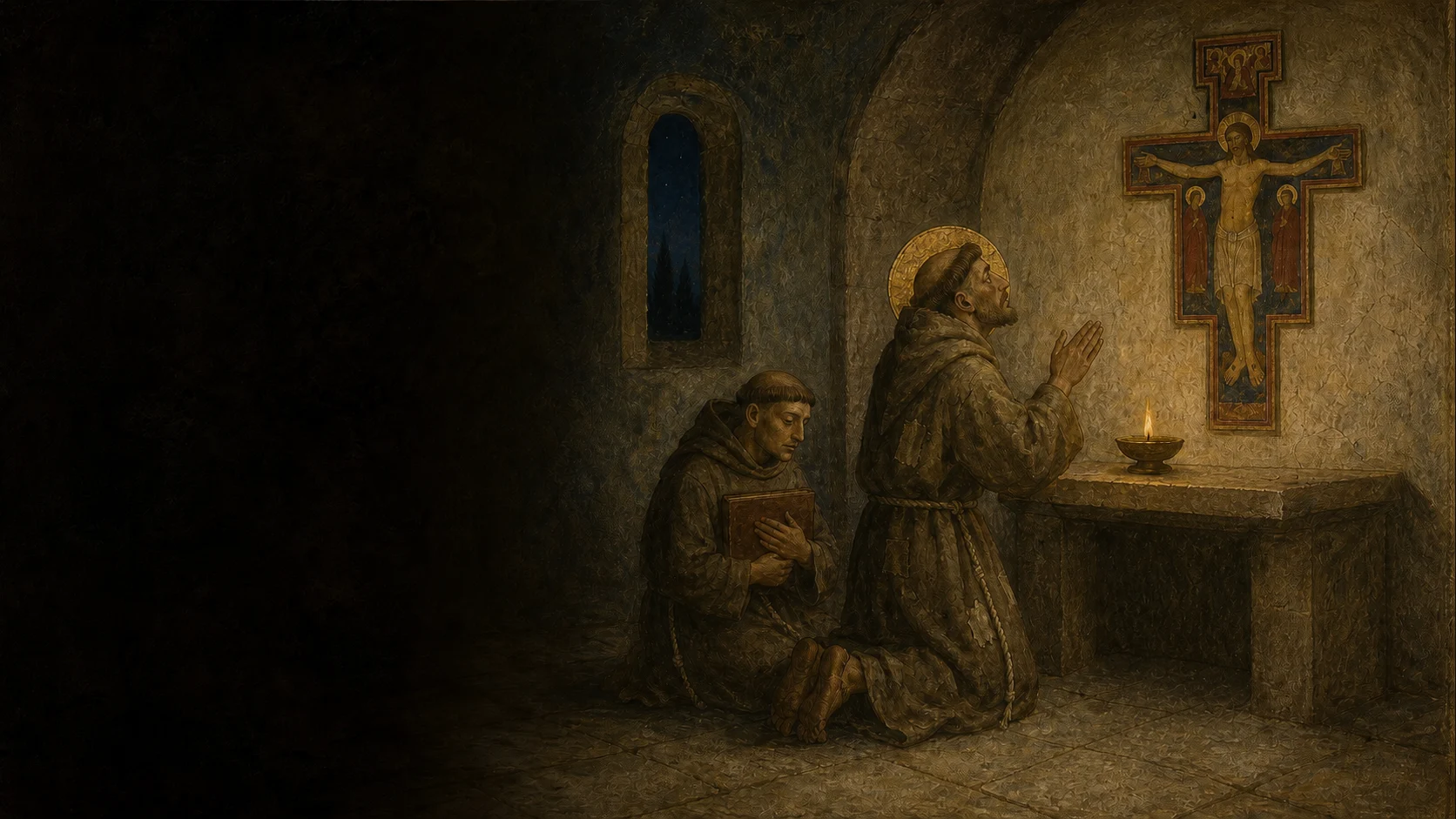
Before dawn, a bell might call the brothers. The floor was cold. The light was small. They opened the Psalter and gave voice to words Israel had prayed for centuries: fear, trust, persecution, praise, and thirst for God.
Francis lived within this rhythm. As a deacon and founder of a religious fraternity, he prayed the Church’s hours. But at some point—we know neither the date nor the desk—he began gathering biblical verses in his own way. He chose a line from one psalm, brought it close to another, added echoes from the liturgy, and formed fifteen new compositions.
The collection is known as the Office of the Passion of the Lord. The name may mislead anyone imagining a detailed dramatisation of the Way of the Cross. There are no fourteen stations and no narrative following every fall. Francis enters Christ’s prayer using words from the Bible.
It is like building a small chapel with stones taken from ancient buildings. The stones remain biblical; their new arrangement reveals another passage of light.
What an office was
In the Middle Ages, “office” did not mean employment. It was an order of prayer distributed through the hours of day and night. Matins or vigils, lauds, prime, terce, sext, none, vespers, and compline marked time. Names and customs varied across the centuries, but the central idea was simple: the day belongs to God.
The friars did not invent this practice. They inherited it from the Church. The Rule of 1223 directs clerics to pray the office according to the order of the Roman Church, while lay brothers were to pray a set number of Our Fathers.
The Office of the Passion is a devotion connected with this liturgical world. We should not present it as a universal replacement for the official office. It works as a private prayer arranged to accompany hours and seasons. The surviving rubrics—small directions about when to pray each part—show a careful structure.
Francis adapts the psalms to different periods: the cycle of the Passion and Easter, time through the year, and the season from Advent through Christmas and Epiphany. Scholars debate the precise history of this organisation. The collection may have grown in stages.
Fifteen voices composed of many voices
We call the pieces fifteen “psalms,” placing the word in quotation marks so as not to confuse them with the 150 biblical psalms. Each one is a mosaic.
Francis may have known many passages by heart. Repeated prayer inscribes phrases in the body: the mouth knows the way before the eyes find the line. This helps explain how distant verses could come together.
He did not choose only texts that mention suffering. He gathered abandonment and certainty, humiliation and glory, death and life. In one movement, the voice passes from the dust of death to confidence that the Father receives the Son. In another, the call to sing a new song announces God’s victory.
This alternation is essential. The Office does not end trapped in Good Friday. The Passion is read within the paschal mystery: Jesus suffers, dies, and rises. The cross is not erased; it is crossed.
Who is speaking?
In some passages, Christ himself seems to pray to the Father. In others, the community contemplates what God has done. At moments, the voice widens and invites earth, peoples, and creatures to praise.
It is not always possible to place a perfect label on every verse. The Bible itself permits shifts of voice; Francis’s collage intensifies them. The worshipper may begin by listening to Jesus and end by discovering themselves within the Church that responds.
The scholar Leonard Lehmann showed how the text reveals Francis’s Christological spirituality: the Son lives turned toward the Father, in the activity of the Spirit, and leads creation into praise. The Passion is not only physical pain. It is relationship, loving obedience, and trust.
For a twelve-year-old reader, we might compare it with a letter made from familiar sentences. Imagine selecting lines someone you love has already spoken and arranging them so that they express a new conversation. The words keep their origin, but the selection tells us something about the person who gathered them.
Not watching from afar
Praying from within Jesus’s trust
Francis does not turn the Passion into a spectacle. He seeks the Son’s prayer within pain. Those who pray the Office do not merely observe: they learn to say with Christ that the Father remains present even when the night seems closed.
Mary at the beginning of the prayer
The collection is accompanied by an antiphon dedicated to the Virgin Mary. An antiphon is a short text prayed before or after a psalm. Here Francis greets Mary as daughter and servant of the Father, mother of Jesus, and spouse of the Holy Spirit, surrounded by the saints.
The language is dense. Mary appears entirely within her relationship with the triune God. The prayer treats her neither as an isolated figure nor as a goddess. She is a chosen creature, inhabited by grace, and placed within Christ’s history.
This antiphon helps explain why the Office of the “Passion” includes incarnation, birth, and glory. For Francis, crib and cross belong to the same humble love. The one who becomes little in Bethlehem gives himself in the Passion.
There are different editorial ways of presenting the antiphon and rubrics. Readers should remember that a modern book organises punctuation, titles, and references that a medieval manuscript does not provide in the same way.
Assisi Codex 338
The most important manuscript for many of Francis’s writings is Codex 338, preserved in the old collection of the Municipal Library at the Sacro Convento in Assisi. It is not Francis’s personal notebook. It is a medieval volume gathering copies of several texts.
In it we find, among other works, the Rule of 1223, the Testament, the Admonitions, letters, the Canticle, and the Office of the Passion. Critical editions have relied especially on this witness for the Office.
“Copy” does not mean falsehood. Before printing, copying was the normal way for a text to survive. Critical scholarship compares manuscripts, identifies scribal errors, and tries to approach the earliest attainable form.
The material original of the Office written or dictated by Francis has not reached us. Its authenticity rests on the textual tradition and on consistency with his vocabulary and spirituality, examined by generations of scholars.
Did Francis copy every verse from a book?
We do not know how the composition took place. Perhaps a Psalter was before him at some moments; perhaps he remembered passages during prayer and later had them recorded; perhaps both. No witness describes the complete process.
It is dangerous to paint a scene and then treat it as a document. This chapter’s image shows a possible vigil, not the proven instant when the Office was born.
Nor can we say that all fifteen “psalms” were assembled in one week. The complexity of the cycles and rubrics led scholars to consider a process of development. The general dating remains cautious: the text is usually placed in Francis’s spiritual maturity, without a precise calendar.
This uncertainty does not weaken the writing. It prevents us from inventing certainty where the manuscript is silent.
The Passion seen with paschal eyes
Some devotions concentrate so intensely on suffering that they seem to forget the resurrection. Francis’s Office does not. Even when the voice descends into fear and persecution, signs of trust appear. Several compositions relate directly to new life, ascension, praise, and the coming of the Lord.
In a brief echo in our own translation, one piece sings: “Sing a new song to the Lord, for he has done wonders.” The sentence comes from the language of the psalms, but Francis places it within his paschal journey.
The Christ of the Office is the poor and obedient Son, but not a defeated one. He trusts the Father. His victory is not that of an army humiliating opponents; it is the victory of love passing through death.
The text can therefore accompany people who suffer. It does not promise that pain will disappear immediately. It offers ancient words when a person can no longer find their own. By borrowing Christ’s voice, the worshipper discovers that their night is not solitary.
Praying without owning the words
Francis received almost everything he uses. The verses belong to Scripture and the liturgy. His creativity does not consist in pretending to have begun from nothing. He listens, selects, and serves.
There is something deeply Franciscan in this. Just as a Friar Minor does not wish to own houses and riches, the writer need not own every word. He can receive it, let it pass through the heart, and return it as prayer.
The Office also teaches us to read the Bible relationally. A verse of lament speaks with another of hope. A sentence of suffering meets another of praise. No one line is required to carry the whole Christian mystery alone.
At the end, we stand before quiet work. Fifteen small constructions, made without luxury, crossed codices and centuries. When the lamp goes out, the words continue marking the hours: night, dawn, midday, evening. In each one, Francis seeks the same presence—Christ who prays to the Father and leads his brothers from Passion into life.
Psalms, codices, and study
Sources for this chapter
- Porziuncola Project — St. Francis’ Office of the PassionText of the Office. Presents the fifteen compositions, antiphon, and rubrics based on the editorial tradition of Assisi Codex 338.
- Dominic Monti, OFM — the Office and the ResurrectionSpecialist Franciscan overview. Explains the biblical collage and the writing’s paschal dimension.
- CFIT — Francis marks the hour of Jesus’s deathShows how one composition is prayed in the context of Good Friday without separating cross and trust.
- Michael Blastic — study of the Office of the Passion in The CordFranciscan academic study. Analyses the selection of psalms and the journey through suffering, death, and resurrection.
- Analecta TOR — studies of the Office’s ChristologyDiscusses the structure of the hours and the Resurrection’s presence in several compositions.
- CapDox — chronology of the writingsRecords the necessary caution: the Office’s exact date cannot be determined.
- BeWeb — bibliographical record for Codex 338Manuscript witness. Identifies the medieval volume preserved in the old collection at Assisi.
How we read this chapter: the composition of fifteen “psalms,” their biblical materials, and transmission in Codex 338 are documented. The nocturnal scene is a possible visual reconstruction. We do not know in which hermitage, on what date, or by what process Francis gathered each verse. The brief echoes in English are our own pastoral translations, not extensive reproductions of a modern edition.