
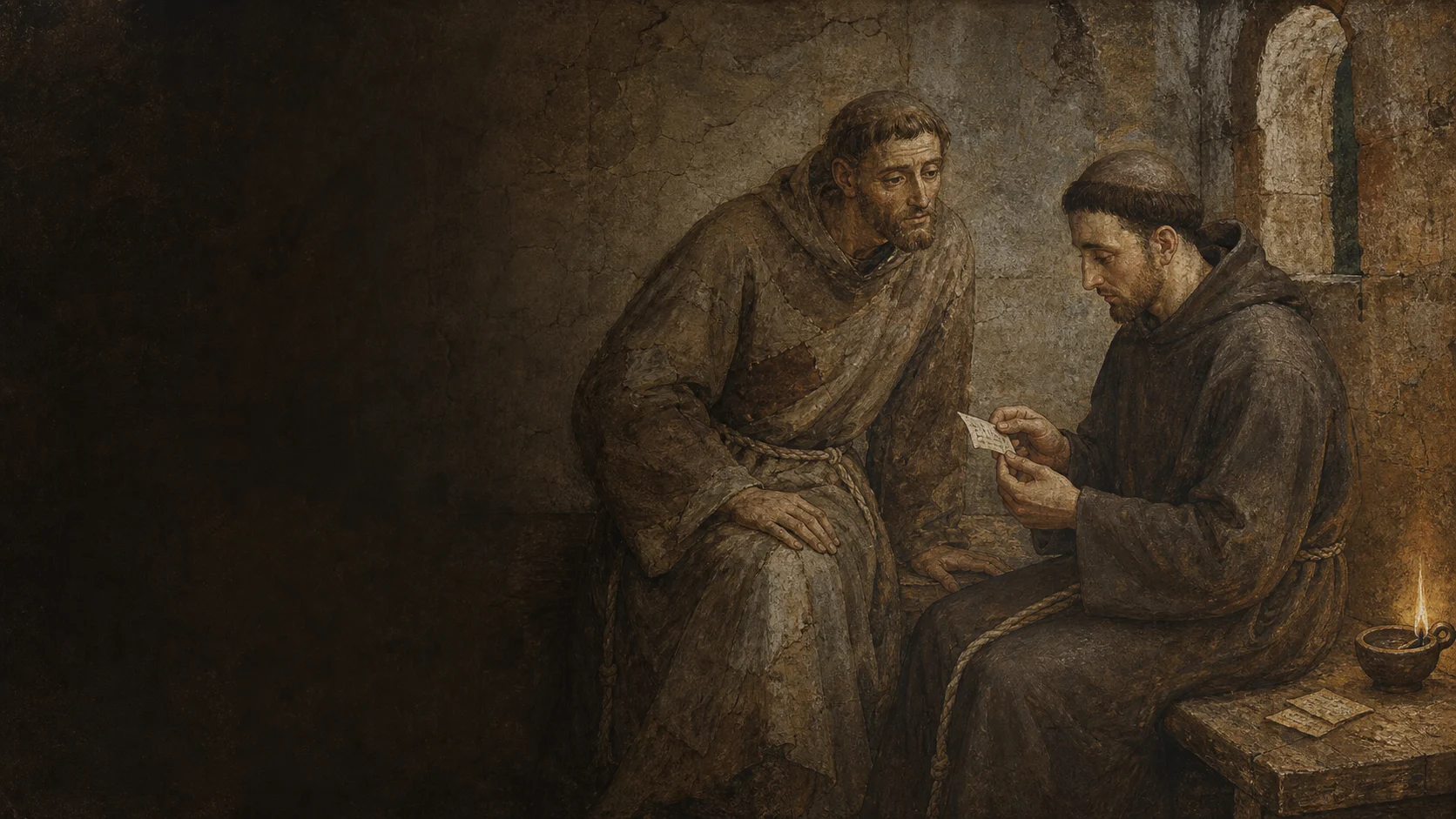
The parchment measures only 125 by 55 millimetres. It is smaller than many mobile phones. It has no illustration, seal, or solemn title. On one side are nineteen crowded lines; on the other, nothing. The handwriting is uncertain and sometimes almost stumbles. Precisely because it is so small, this piece of prepared skin from eight centuries ago brings us very close to two people.
One is Francis. The other is Brother Leo, his companion, secretary, and friend.
This is not the famous blessing that begins by asking the Lord to bless and keep Leo. That blessing is on a different sheet, the Chartula of La Verna, together with the Praises of God Most High. Here we have another object and another occasion: a note of counsel now kept in Spoleto Cathedral.
The page does not tell us where the two men were. The text itself, however, recalls a conversation “on the road.” We may imagine dust, stones, and footsteps; we cannot state which road it was, what season it was, or what Leo had asked. What survived is the brief reply.
An original, not merely a copy
Most of Francis’s writings reached us in copies made by scribes. That was normal. An important text passed from one codex to another, and each copy could introduce small differences. The note to Leo is extraordinary because scholars recognize it as an autograph: it was written in Francis’s own hand.
His writing is not beautiful like that of a professional copyist. A researcher can observe the shape of the letters, the way the space is used, and the corrections. The script is the simple kind learned by someone who could write but did not make a living from writing. Giulia Ammannati describes a tired execution and difficult alignment. This fits Francis’s last years, when disease of the eyes and other suffering made every task more burdensome.
For this reason, a date after 1224—probably between 1225 and 1226—is considered very plausible. This is a palaeographical conclusion, based on material study of the writing. The note contains no date saying “I wrote this today.”
Small retouches by Brother Leo can also be seen. The companion seems to have gone back over certain letters to make them clearer. This makes the object still more moving, but it should be described precisely: it is not an untouched page that fell ready-made out of the past. It is a sheet that was used, kept, and cared for.
“As a mother”
Francis begins by calling Leo his brother. Soon afterward, he says that he will speak as a mother. The shift is small and powerful.
In Franciscan writings, motherhood is not sentimental decoration. In the Rule for Hermitages, some brothers act as mothers and others, for a time, as sons. In the Earlier Rule, the friars are invited to love and nourish one another even more than a mother cares for her child. The image means practical attention, patience, and responsibility.
Francis does not say, “I am your superior and have decided everything already.” Nor does he abandon Leo with a cold phrase. He offers counsel with affection. This is authority that wants to help another person recognize the way before God.
Leo seems troubled. We do not know exactly why. Perhaps he sought a decision, suffered from scruples—the fear of making a mistake even when one wants to do good—or simply wanted to hear the counsel again. Any more detailed explanation would be hypothetical. The note lets us see a need for guidance; it does not reveal the problem.
The freedom of one who wants to follow
The letter’s center is surprising. Francis gives Leo no list. He tells him to do whatever seems best for pleasing the Lord God and following Christ’s footprints and poverty.
This does not mean “do anything you like.” There are three lights for discernment: pleasing God, following Christ, and choosing evangelical poverty. Freedom is born within this direction. Leo receives no permission to flee the Gospel; he receives trust to act without depending on a new answer at every step.
A change can be perceived in the manuscript itself. The construction of the text seems to have been adjusted as Francis wrote. Scholars debate how to read some interventions and what their precise sequence was. The final form, however, opens space for Leo’s decision.
Perhaps this is why the little note remains current. We often want a holy person to decide everything for us. It would be easier to receive a clear order, carry it out, and then say, “I only obeyed.” Francis offers something more demanding: a conscience before God, accompanied by affection and trust.
The gentleness of obedience
Counsel that does not imprison
The letter does not put Leo inside a spiritual cage. It gives him direction and, at the same time, room to grow. Here, obedience does not mean ceasing to think. It means learning to choose in the light of the Gospel.
“If you need to, come”
After offering freedom, Francis adds a final sentence. If Leo needs to come to him for the sake of his soul or for some other consolation, and if he wishes to come, then he should come.
There is no contradiction. First: “You can decide.” Then: “My door remains open.” Mature friendship does not make a friend dependent, but neither does it disappear when the friend still needs help.
We should not turn this line into a theatrical dialogue we do not possess. We do not know whether Leo immediately went to find Francis, kept the letter in his habit, or wept as he read it. We know that he preserved it. That physical gesture says much: among so many fragile objects that could become wet, burn, or be lost on journeys, the note survived.
Centuries later, it appears connected with Spoleto. The full history of each transfer is not perfectly illuminated. Records and studies let us trace its presence, but there are intervals in which the object’s route cannot be narrated step by step. Historical honesty also means leaving a room dark when we do not have the key.
Two sheets that must not be confused
Brother Leo kept at least two material witnesses directly associated with Francis. The similarity of their recipient causes confusion:
- the Letter to Brother Leo, now in Spoleto, summarises counsel given on the road and ends by offering consolation;
- the Chartula, now in Assisi, bears the Praises of God Most High on one side and the blessing intended for Leo on the other.
Both are autographs connected with the companions’ closeness. But they are not the front and back of one sheet. They were not necessarily written in the same place or on the same day. Combining them would erase exactly what makes each special.
On the Chartula, the La Verna tradition and material signs tell a story of prayer and blessing. In the Spoleto letter, the voice belongs to someone continuing a conversation. One object says, “May the Lord bless you.” The other says, in essence, “Seek what best leads you to God; and if you still need me, come.”
Tired and living handwriting
Looking at the facsimile differs from reading a printed edition. In the edition, lines are straight and words clean. On the parchment, the hand appears. There are hesitation, lack of space, and reinforced letters. Physical fragility does not diminish the content; it gives the content a body.
Francis was not a character who lived only in frescoes. His eye hurt. His hand grew tired. He had to find a small piece of parchment and record what was essential. Perhaps someone prepared the pen; perhaps not. We do not know. What we can say is that writing cost him effort.
This changes the way we hear the letter. It is not an easy phrase cast off by someone comfortable. A sick man uses his limited strength to keep a brother from remaining trapped in indecision. He chooses words of trust.
What the note teaches without deciding for us
The text is short, but it is not a formula for decisions. It does not answer which school to choose, how to resolve a quarrel, or when to change jobs. It would be wrong to tear it from its world and use it as an oracle.
It offers something deeper. First, a Christian decision must look toward God and the footprints of Jesus. Second, poverty is not only a lack of things: it is freedom from possession, power, and the need to control everything. Third, a person can seek counsel without handing another person responsibility for their life. Finally, anyone who offers counsel must keep open the possibility of welcoming the person again.
Leo received only a few lines. A modern reader might expect a treatise. But friendship had already done the longer part: they had spoken on the road. The letter does not replace the journey; it preserves its core.
Some enormous documents leave us far from their authors. This one almost fits between two fingers and places us beside a lamp. Eight centuries later, we can still hear Francis’s tired voice saying to a troubled brother: follow the good you recognize before God. And if you need consolation, come.
Parchment and witnesses
Sources for this chapter
- Letter to Brother Leo — Capuchin MuseumLatin text and Portuguese translation. Allows readers to check its brevity, greeting, counsel, and final invitation.
- Giulia Ammannati — La lettera autografa di Francesco d’Assisi a frate LeonePalaeographical study. Analyses dimensions, script, probable date, and Leo’s interventions.
- Autografi dei Letterati Italiani — record for the Spoleto manuscriptScientific catalog of the autograph. Location, material description, and identified retouches.
- CapDox — The Writings of Saint Francis of AssisiOpen historical edition of the writings, useful for textual comparison and editorial tradition.
- Facsimile collection of the Franciscan autographsMaterially distinguishes the Spoleto Letter from the Chartula preserved in Assisi.
- CapDox — chronology of Francis, Clare, and the sourcesPlaces Francis’s last years and the cautious dating of the writings in context.
How we read this chapter: the note’s content, dimensions, and autograph character are documented. The road is mentioned in the text itself, but its location and Leo’s question are unknown. The scenes of dust, lamplight, and reading are literary setting, not recorded facts. The brief rendering above is our own pastoral translation from the Latin text.