
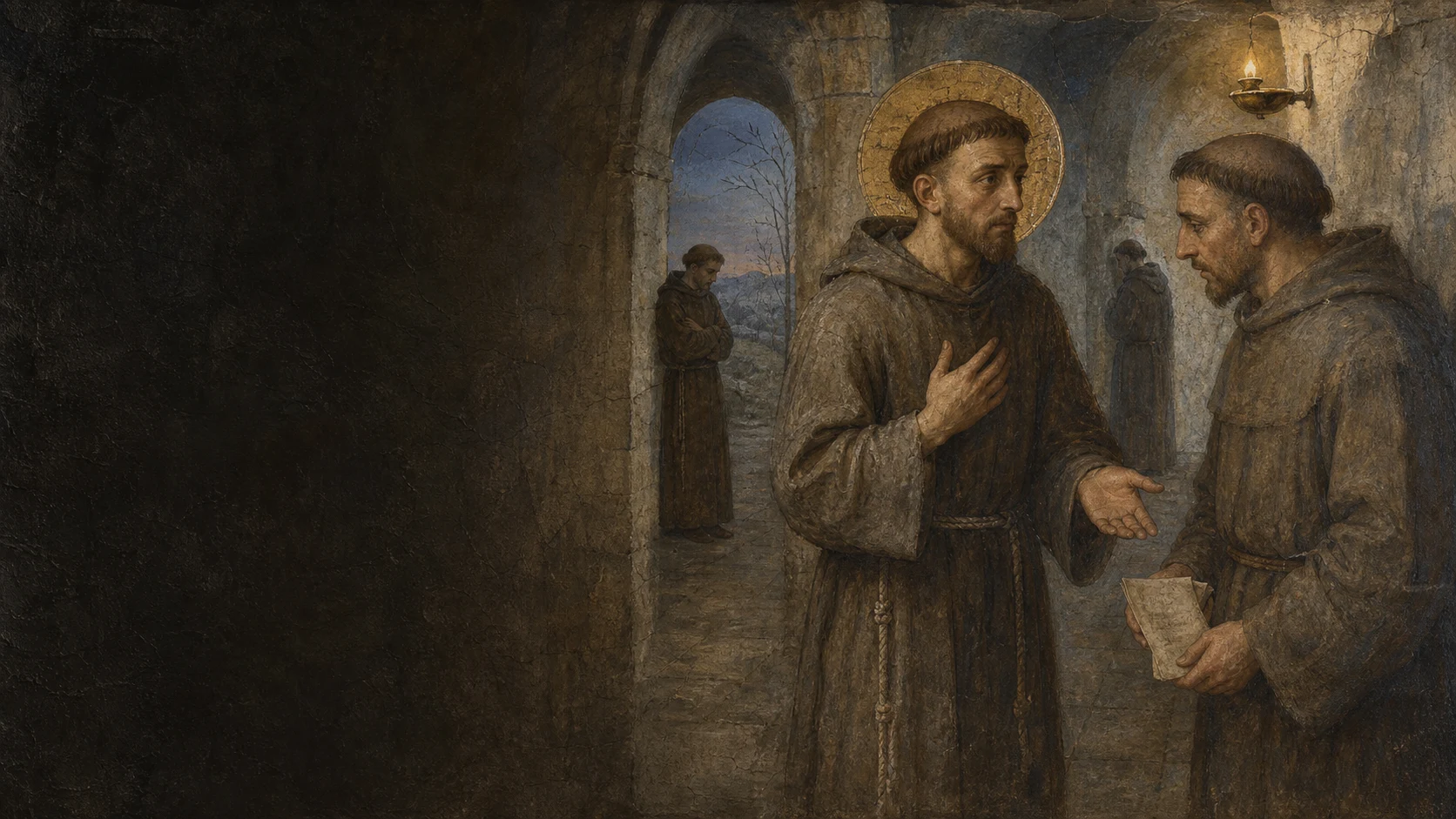
A weary man at the door
A minister arrives with a closed expression. He governs brothers, hears complaints, and tries to settle quarrels. Perhaps he dreams of a hermitage where no one will interrupt him. Perhaps he has written to Francis that certain friars sin repeatedly and make his task almost impossible.
This scene grows from clues, not from a chronicle. The Letter to a Minister begins in the middle of a conversation: “Concerning the matter of your soul, I say to you…” We do not possess the question sent beforehand. Nor do we know the recipient’s name with certainty.
Some early writers imagined Brother Elias. The complete text does not confirm this. Its ending suggests that the minister would attend a chapter with his brothers, which may point to a provincial minister. Prudence requires us to call him simply what Francis called him: minister.
The answer he received is short, personal, and uncomfortable. Francis does not offer him a hiding place. He says that the difficulties themselves must become grace.
What the letter does not tell us
We do not know what sin prompted the consultation. “Sin” can cover many situations. It would be irresponsible to invent a specific crime. Nor do we know whether the minister had truly decided to abandon government for a hermitage. Francis says that he should regard his difficulties as grace, even more than a hermit’s life. This may answer an expressed wish or merely use the hermitage as a comparison.
The first friars knew the attraction of solitude. Francis composed a short Rule for hermitages and sought secluded places. Silence was good. Yet it could become escape when the difficult brother waited outside.
The letter does not despise contemplation. It asks whether God may be hidden precisely in the tiring task.
Its text survives in several important manuscripts, including the Ognissanti and Saint Isidore codices, and in partial witnesses or summaries. Modern scholarship recovered the complete form after early editions had transmitted only abbreviated versions. Its authenticity is now firmly recognized.
Everything that hinders can become grace
Francis begins with a radical statement: the things that hinder the minister from loving the Lord—brothers and other difficulties—are to be received as grace. He must not wish them different before obeying this call.
This can be misunderstood. Francis does not teach that someone must remain unprotected in the face of abuse or violence. The thirteenth century did not possess our language of safety, trauma, and institutional responsibility. Using the letter to force a victim to endure danger would betray the mercy it proclaims.
The recipient is an authority with a duty to care and correct. Francis speaks to someone who holds power over others, not to a defenceless person whom he orders to remain silent.
For this minister, grace is not in the brother’s sin. Sin does not become good. Grace lies in the possibility of responding without hatred, vanity, or revenge. The obstacle reveals the person he is becoming.
Eyes that demand nothing
Francis asks the minister to love those who cause him difficulty and demand nothing else from them “except what the Lord gives you.” He then adds a very concrete test: no brother should leave his presence without having found mercy in his eyes.
Not only in the verdict. In the eyes.
A person can pronounce correct words with a humiliating look. Someone can forgive theatrically, making the other feel a permanent debt. Francis wants to reach this hidden space.
At the same time, he does not say that the minister must approve everything. Mercy is not the absence of truth. The rest of the letter concerns brothers who have sinned mortally and a form of correction. What changes is the purpose: discipline exists to restore, not to crush.
A helpful image is that of a medieval physician, although the resources of medicine were limited. The physician cleans a wound because he wants to save the limb, not because he hates the body. Correction without a desire to heal becomes punishment for punishment’s sake.
“Even if he sinned a thousand times”
The best-remembered passage says that if a brother were to sin a thousand times before the minister’s eyes, the minister should love him more than he loves Francis, so as to draw him to the Lord. The comparison is startling: care for the wounded brother comes before the desire to remain near the founder. One thousand is not a legal count. It means: even when repetition has exhausted you.
Francis also asks the minister to announce to the brothers that they can receive mercy. The door must not be hidden.
This does not eliminate consequences. A brother who causes harm may need to be removed from an office, supervised, or referred to a competent authority. The medieval text concerns a religious fraternity and does not answer every modern situation. Its light does not replace prudence.
The point is that a person is not reduced to the worst act they have committed. Even when trust must be rebuilt slowly, dignity does not disappear.
For a twelve-year-old reader, think of a quarrel at school. Forgiving does not mean pretending it never happened or remaining alone with someone who hurts you. It means seeking help, telling the truth, and refusing to turn the other person into a monster beyond return.
A rule born inside a letter
In the second part, Francis asks the minister to bring a proposal to the chapter about how to treat a brother who has sinned gravely. The text has a complicated history. It seems to contain a short norm intended for the fraternity, perhaps a draft direction that Francis wanted discussed.
The brother was to obey, not be subjected to a multitude of accusations, and receive accompaniment. Francis insists that he not be shamed. Priests were to act mercifully.
Some sentences have variants and interpretative difficulties. Franciscan institutions were still growing; rules and practices were discussed at chapters. The letter lets us see this workshop. A direction arises not in a remote room of lawyers, but from the concrete suffering of a superior and the brothers in his care.
The proposal may be connected with passages in the Earlier Rule, which direct the brothers to avoid anger and disturbance at another’s sin because these reactions obstruct love. The correspondence among the texts reinforces the unity of Francis’s thought.
Mercy is not weakness
In a culture of honor, a superior might imagine that authority depended on showing strength. If a brother challenged him, a gentle response could look like defeat. Francis reverses this logic.
The minister is strong when he does not allow another’s sin to govern his own heart. If he reacts with uncontrolled anger, the difficult brother controls him from afar. If he maintains truth and mercy, he regains freedom.
This mercy also requires patience with processes. People rarely change at the pace their superiors desire. The minister may want an immediate solution because he is tired. Francis calls him to remain.
Remaining does not mean doing everything alone. The fraternity has chapters, priests, guardians, and ministers. Care is communal. We need not impose on the text the modern idea of a leader secretly carrying every burden.
More than a hermitage
Why does Francis say that the minister should consider all this better than a hermitage? Because silence can reveal God, but so can the difficult brother. In a hermitage, a person faces his own heart. In conflict, he faces that heart while another voice protests before him.
Francis loved solitary places such as La Verna and the Carceri. There is no contempt here for cold stone, woodland, or prayer at night. There is an order of love: do not use God as an excuse to abandon the person entrusted to you.
Perhaps the minister expected permission to leave. He received a mission to stay. This is an inference, not a known fact. The letter allows us to feel the tension but not to hear the whole conversation.
The hand that wrote and the copies that remained
We do not possess the autograph. As with other writings, Francis may have dictated to a secretary. Manuscripts preserve the text in collections of his works. Early compilations also transmitted summaries, and for a time readers knew incomplete forms.
Comparing witnesses made it possible to recover the longer letter, including the connection between personal counsel and the normative proposal. That union matters. Without the first part, only a disciplinary rule would remain. Without the second, mercy might seem merely a feeling. Together they show eyes and structure, affection and responsibility.
Textual scholarship does not drive spirituality away. It restores a less truncated voice to the reader.
The minister returns to the corridor
In the imagined scene, the man folds the letter. The brothers remain difficult. The work has not lessened. No light has opened the ceiling.
But one question has changed: instead of “when will they become worthy of my care?” he must ask “how can I let mercy appear even in my eyes?”
The demand applies to anyone who cares for others: parents, teachers, leaders, older siblings. A person with authority may wish everyone else were perfect so as not to cause inconvenience. Francis does not permit that dream.
Nor does he make the fault insignificant. Sin wounds, conflicts exhaust, and correction is necessary. Yet failure does not have the last word.
The minister may not have received the hermitage he wanted. He received something harder: a corridor full of people, where every encounter could become a place of God.
The counsel preserved
Sources for this manuscript
- Letter to a Provincial Minister — IntraTextFranciscan text. Preserves the personal counsel and the proposed disciplinary direction.
- Paschal Robinson — The Writings of Saint FrancisHistorical edition. Discusses the recipient, manuscripts, early abbreviations, and recovery of the complete text.
- Noel Muscat, OFM — The Letters of Saint FrancisModern Franciscan study. Analyses the letter’s context, date, and teaching.
- Francis of Assisi: Early Documents, vol. 1Academic edition. Modern translation, introduction, and textual notes.
- Earlier Rule — Order of Friars MinorRelated normative writing. Chapters 5 and 7 concern correction, anger, and mercy among brothers.
- C. Knowles — The Writings of St Francis of AssisiAcademic research. Places the letter within the principal manuscript collections of the writings.
How we read this chapter: the letter’s authenticity is firm, but we do not know the minister’s name, the sin under discussion, or his original question. His desire to go to a hermitage is inferred from the reply and has been presented as a possibility. Applications concerning protection, abuse, and offices are responsible readings for today, not norms formulated literally in the thirteenth century.