In early autumn 1226, Francis could no longer walk as he once had. He was very ill, almost blind, and weakened by years of travel, fasting, and sickness. The brothers carried him. When he realized that death was approaching, he asked to return to the Porziuncola.
It was a deliberate choice. The little church of Saint Mary of the Angels stood on the plain below Assisi. There he had repaired walls, heard the Gospel, gathered his first companions, and watched the brotherhood grow. He did not want his life to end in the bishop’s palace or within the protected city. He wanted to return to the beginning.
On the evening of October 3, surrounded by brothers, Francis died. Franciscans call this moment the “Transitus”: a passing. The next day, his body was taken to Assisi.
The place and date are well supported by early sources. Around that central truth, each biographer preserved details: the bare ground, singing, the reading of the Gospel, a blessing, larks in the sky, a letter to Jacoba. Some appear early; others take shape over time. To enter that night, we need to distinguish the solid stone from the lights that memory added.
The chapel inside the basilica
Visitors today find a surprising sight: the tiny Porziuncola stands entirely inside the enormous Basilica of Saint Mary of the Angels. Construction of the basilica began in the sixteenth century, more than three hundred years after Francis. Its dome, great aisles, facades, and crowds belong to later history.
In 1226, the landscape was different. The chapel stood on the plain, surrounded by farmland, trees, paths, and the brothers’ simple shelters. Assisi could be seen high on the hillside. The name “Porziuncola” means something like a little portion of land.
Francis treasured the place, but he did not own it like a feudal lord. Tradition recalls that the Benedictines allowed him to use it, and the brothers kept up a gesture of thanks. The little portion taught that receiving a place was not the same as possessing it without limits.
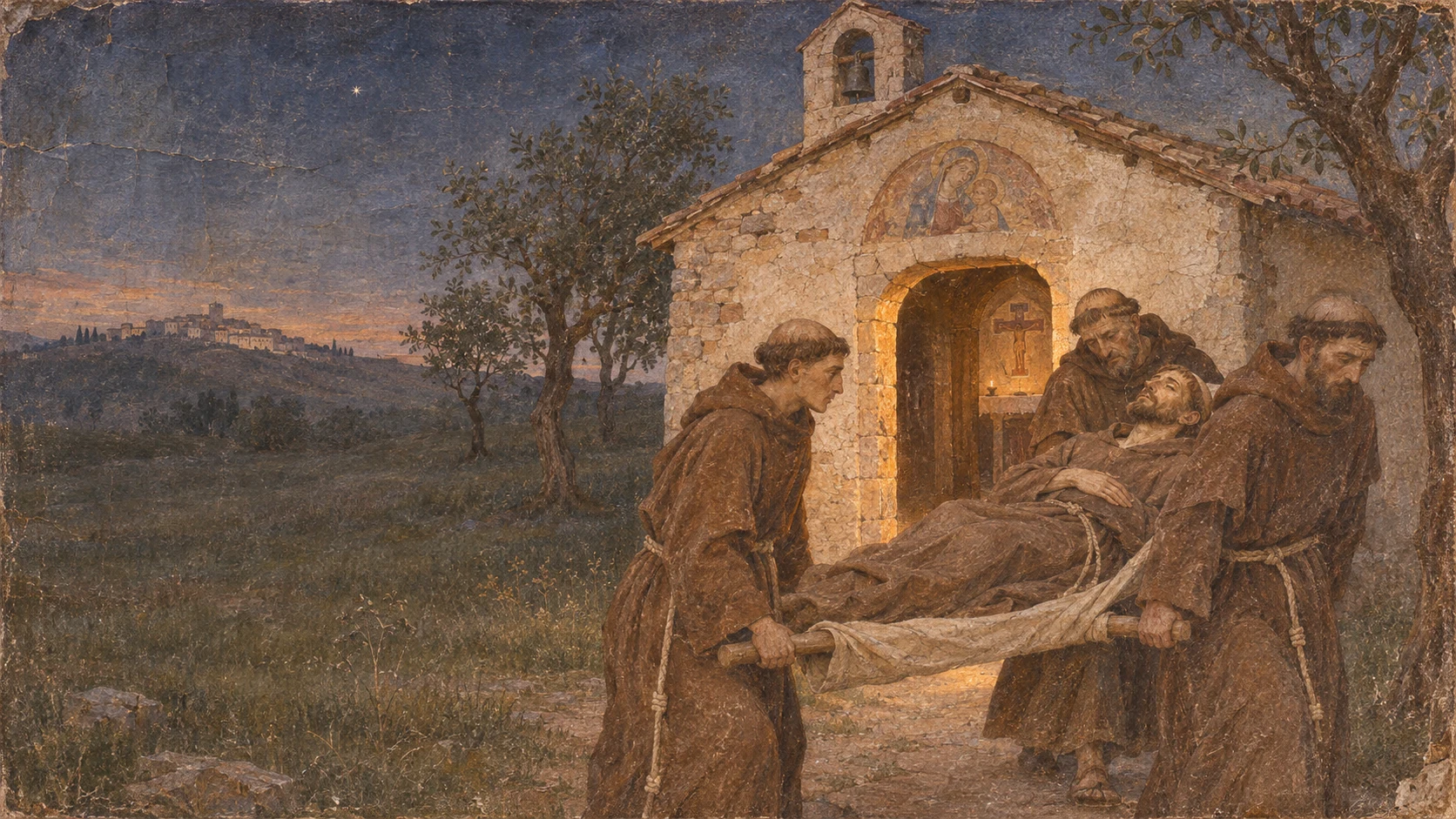
The building visible today keeps the shape of an old chapel, but it has received paintings, repairs, and decorations from other ages. Our pilgrimage’s image removes the later basilica and frescoes. It shows stone, plaster, roof tiles, and a lighted doorway. It is a reconstruction, not a complete archaeological plan.
Returning when the body no longer obeys
In his last years, Francis suffered greatly. Sources mention eye problems, fevers, stomach pains, and other illnesses. In 1224, he received wounds that his companions understood as stigmata, marks of Christ’s wounds. Medieval medical treatments could be painful. His ability to lead and travel had declined.
In 1226, he spent some time in Siena and was later taken to the area around Assisi. For safety, he stayed in the bishop’s palace. Umbria was troubled by conflicts, and a man already regarded as holy attracted attention even while alive. His body had religious and political importance.
Asking for the Porziuncola meant leaving the city’s protection. It was not a gesture against the bishop, who had welcomed him, but a choice rooted in memory. There, the movement did not look like an institution spread across Europe. Once again, it looked like a group of brothers on a little piece of land.
Some accounts say that, while being carried near Assisi, Francis asked to be turned toward the city and blessed it. The scene is early, but it does not appear in exactly the same way in every text. Our artwork places Assisi far away, on the left. It does not show a particular blessing. It lets the city remain present as something he sees and leaves behind.
No one went through that night alone
Paintings often place Francis at the center and turn the brothers into a frame. Yet they were the ones who carried him, settled him, listened, and stayed. The founder’s death was also a community’s fear: who are we when he is gone?
The sources preserve names such as Leo, Angelo, and Rufino, but the lists and their roles vary. We cannot safely draw an exact photograph of the room. We can say that brothers were with him and received words of blessing and encouragement to persevere.
Weakness changed their relationships. Francis, who had crossed roads and battlefields, needed to be turned, washed, and fed. The man who had cared for the sick became sick himself. That did not erase his dignity. It gave others the chance to practice the same mercy.
Our scene shows three friars beside the litter used to carry him. The number is a visual choice. It does not mean that only three took part in the return. The central gesture lies in the arms that support him without turning the person they carry into an object.
The bare earth
Thomas of Celano recounts that Francis asked to be placed naked on the bare ground. Other sources repeat the gesture. He wanted to meet death without owning even his clothes, like someone giving everything back.
The nakedness in the medieval story is not a spectacle. It speaks of poverty, vulnerability, and likeness to Christ. Out of respect, our artwork chooses an earlier moment and shows him clothed. No image needs to expose his body to convey his frailty.
There is another important detail: a brother is said to have lent him a tunic, cord, and simple clothing, ordering him to accept them in obedience. Francis could therefore die without calling what he wore his property. Even at the end, poverty did not mean rejecting care for the body. It meant receiving without clinging.
For a reader today, the gesture need not become a literal rule. Sick people deserve blankets, medicine, privacy, and comfort. The spiritual meaning lies in not confusing our lives with the things we collect. In death, everyone finally receives life as a gift that no strength can hold on to.
Words around the silence
The accounts say that Francis sang or asked for the Canticle of the Creatures, including the verses about “Sister Bodily Death.” He is said to have recited Psalm 142 and asked for the Gospel of John to be read, at the passage where Jesus prepares to leave the world and return to the Father. He is also said to have blessed the brothers.
These elements appear in early traditions and fit his writings and spiritual life. Even so, we have neither a recording nor an official transcript. The authors shape his death into a Christian story, drawing Francis close to Jesus. A sentence quoted in a medieval biography may preserve remembered words, the language of worship, or the biographer’s interpretation.
That does not empty the scene of meaning. It shows how the community understood what it had lived through. The brothers did not call death an easy victory. They wept. At the same time, they sang, because Francis had learned to include even life’s ending within the brotherhood of creation.
Calling death a sister does not mean seeking it, hastening it, or saying that pain is good. Francis accepted care and sought treatment. The expression means that when death could no longer be avoided, it did not have to be treated as a power greater than God.
Jacoba, the sweets, and the open door
A beloved tradition says that Francis wanted to see Jacoba of Settesoli, his Roman friend, and asked for cloth, candles, and an almond sweet he enjoyed. Before the letter was sent, she is said to have arrived bringing exactly those things. Despite rules of separation, the brothers let her enter and began calling her “Brother Jacoba.”
The account appears in Franciscan sources and shows a tangible friendship: someone knew the taste that comforted a sick man. But the details vary, and they do not all belong to the earliest account. We do not know the exact time of her arrival, nor can we confirm that she miraculously anticipated the letter.
The story deserves to be told as an early tradition, rather than as proof of foretelling the future. Its heart is human. The man who preached great ideas also wanted to see a friend again. Holiness did not erase affection, memory, or taste.
Jacoba also keeps the final night from being told as an exclusively male world. Women supported Francis and the brothers with friendship, hospitality, and resources, even when the documents gave them less space.
The larks and the unusual hour
Celano says that larks flew above the roof at dusk, singing as though they recognized the friend of all creatures. Larks are usually associated with daylight, which makes the hour special in the story.
We cannot verify the birds’ behavior that night. The companions may have kept a real memory. The biographer may also have used creation to answer Francis’s canticle. In either case, the larks belong to the Franciscan way of telling a story: a person’s death does not take place outside the animal world, the air, and the changing light.
Our artwork does not include a miraculous flock. There is only the sky, a first star, and dark trees. Their absence leaves room for readers to decide how to listen to the tradition.
What happened afterward
On the morning of October 4, the body was carried in procession to Assisi. It passed San Damiano, where Clare and the sisters could say goodbye, and was buried in the church of Saint George. Two years later, Francis was canonized, officially recognized as a saint. Later, his remains were moved to the new basilica built in his honor.
The Porziuncola remained the heart of the Franciscan family. Beside it, the Chapel of the Transitus marks the space associated with his death. The present complex preserves a true memory, but its appearance brings together centuries of art and architecture.
The danger of a great shrine is that it can hide the smallness that came first. Beauty can help, as long as visitors seek the little chapel within the enormous nave and notice the scale. The center is not the largest building. It is the little portion that has been preserved.
Francis returned because that place held a beginning, not because it belonged to him. He died surrounded by others, not alone. He left words, but he also left questions that no succession of leaders fully resolves: how can we grow without forgetting poverty? How can we protect a memory without imprisoning it? How can we love a teacher while continuing to follow the Gospel he pointed toward?
In the painting, the brothers are still arriving. Death has not yet come. There is effort in their hands, weariness in his face, and ordinary warmth in the doorway. We chose this moment because the passing begins before the final breath: it begins when someone accepts being carried back to the place where he learned to walk.
The little portion and the last night
Sources for this pilgrimage
- Shrine of the Porziuncola — texts of the TransitusSources and worship at the site. Brings together Franciscan passages about the request to return, the Canticle, the Gospel of John, and the death on October 3.
- Shrine of the Porziuncola — Chapel of the TransitusOfficial heritage account. Identifies the revered space and explains its connection with the little chapel and Francis's death.
- Order of Friars Minor — chronology of FrancisInstitutional reference. Places the final illness, the return in September, the death on the evening of October 3, and the burial on October 4 in context.
- OFM — history of the Porziuncola's preservationArchitectural history. Helps distinguish the little medieval church from the much later basilica that now surrounds it.
- Medieval Sourcebook — early lives of FrancisMedieval sources in translation. Allows readers to compare Celano, Bonaventure, and other accounts of the last days.
- Franciscan Institute — guide to the early sourcesHistorical method. Explains the scholarly collection of Franciscan documents and the dates of the different biographies.
- Order of Friars Minor Capuchin — centenary of the TransitusFranciscan memory. Presents the meaning of “Transitus” and the tradition shared by the different branches of the Order.
How we read this place: the date, return, and death at the Porziuncola belong to the secure historical core. The bare ground, the readings, Jacoba, and the larks have early support of varying strength and should be presented as tradition when they cannot be confirmed. The painted arrival is a historically plausible reconstruction, without the later basilica.