
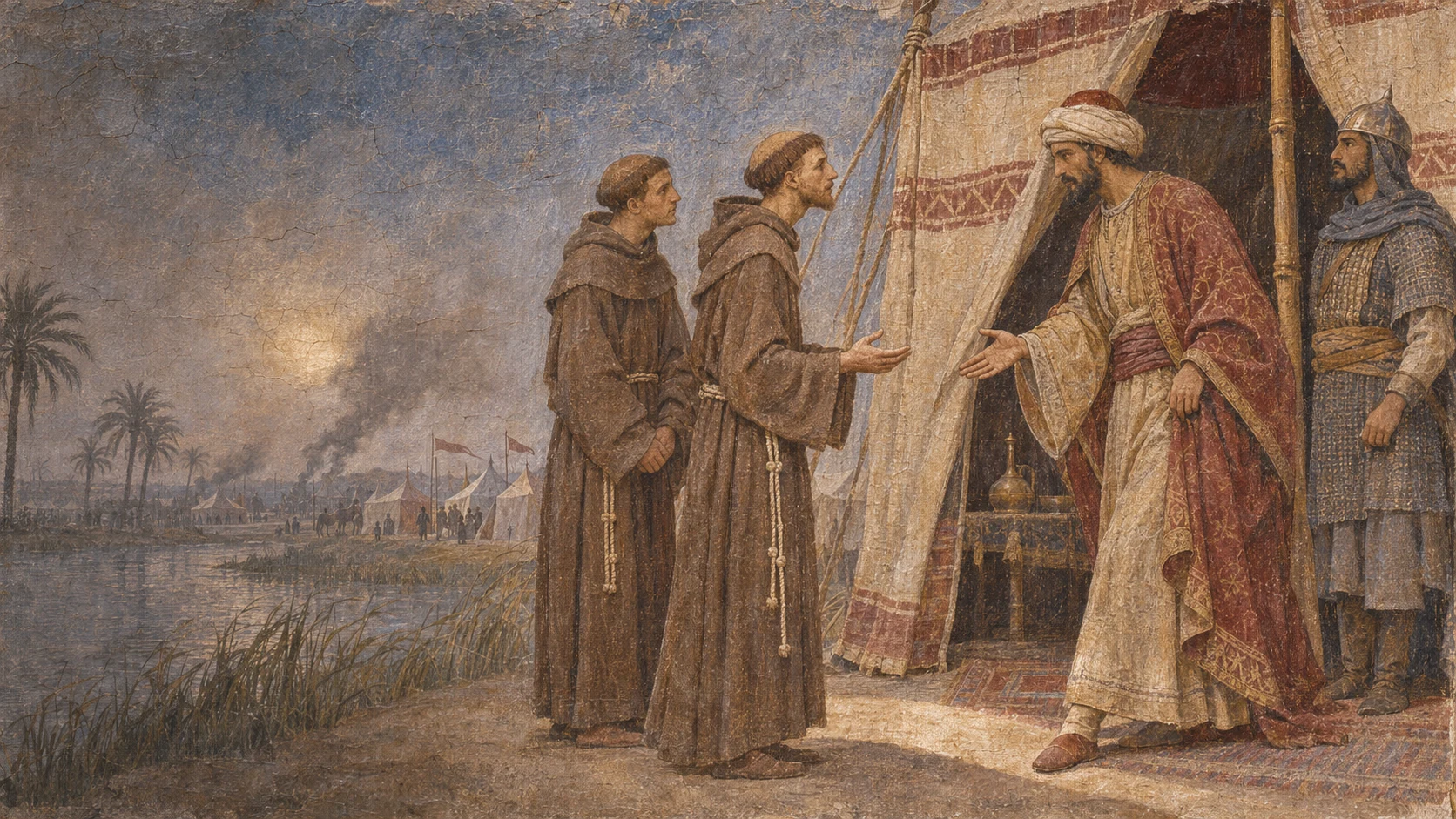
In 1219, the air near Damietta smelled of water, animals, smoke, and sickness. On one side of the Nile were Christian forces from Europe. On the other was the army of the Ayyubid sultan al-Malik al-Kamil. Between the camps lay fear, dead bodies, and men ready to kill before asking a name.
This was where Francis crossed the lines.
He carried no sword. A companion, usually identified in the sources as Brother Illuminato, went with him. The two came before the sultan of Egypt and returned alive to the Christian camp. This much stands on firm historical ground: different Christian accounts written close to the time confirm the meeting.
Almost everything we would like to know remains uncertain. What were the first words? How long did they stay? Did the sultan offer gifts? Did Francis try to convert him? Did they speak about peace? No scribe recorded the conversation. Later stories filled the silence with fire, challenges, and perfectly prepared speeches.
Damietta asks for two kinds of courage: the courage to cross over to another person, and the courage not to invent what that person said.
A city everyone wanted to hold
Damietta stood in a strategic position in the Nile Delta. Controlling it could open the way into other parts of Egypt. The Fifth Crusade, called by the pope, brought Christian fighters together with the aim of taking the city and weakening Muslim power.
The siege began in 1218. This was not a tidy struggle between two simple groups. Within the crusader camp there were rival leaders, political interests, merchants, pilgrims, soldiers from different regions, and Eastern Christians. The Ayyubid side also had its alliances and tensions. Al-Kamil ruled Egypt and needed to defend his territory, family, and authority.
In late August 1219, shortly before Francis’s visit, a major battle ended in immense suffering. Sources describe bodies and confusion. Disease spread through the camp. The word “crusade” sometimes reaches us wrapped in heroic paintings; on the ground, it meant hunger, amputations, and families whose children would never come home.
Francis was not visiting a religious conference organized in safety. He entered a war zone.
Why was he there?
Francis’s own writings do not recount the journey. His later Rule speaks of brothers who wished to go “among Saracens and other non-Christians.” It offers two paths: living peacefully, without arguments, or proclaiming the faith when they judged that doing so would please God. The text shows that, for him, a humble presence and sharing his religious beliefs were not opposites.
The biographies say that Francis wanted to proclaim Christ and even face martyrdom, death for his faith. This makes sense within medieval spiritual life. We should not turn him simply into a modern diplomat who traveled to negotiate a treaty. Nor should we reduce him to someone seeking to provoke others into killing him.
Several wishes may have existed together: to preach, to meet people on the other side, to obey the Gospel, to seek peace, and to risk his own life. Human beings rarely act for a single reason, and the sources were written by authors with different aims.
Jacques de Vitry, bishop of Acre and a participant in the crusade, wrote about the Friars Minor early on. His account helps confirm the setting and the brothers’ activities. Other chroniclers and biographers recorded the visit to the sultan. Their agreement about the meeting matters; the differences in their details call for care.
The crossing
We do not know exactly where Francis crossed or who first stopped him. Guards probably questioned him and escorted him under watch. A poor man coming from the enemy camp and saying he wanted to speak about God might be a spy, a madman, a messenger, or a monk.
Some accounts say he was insulted or beaten. That is possible at a military boundary, but the severity varies from source to source. The artwork chooses the next moment: the cautious arrival at al-Kamil’s tent rather than the violence.
The sultan was about forty years old. He was an experienced ruler, a nephew of Saladin, surrounded by legal experts, scholars, officers, and servants. He was not an exotic figure waiting for a European to explain civilization to him. He governed a sophisticated society and was familiar with religious debate.
Francis, too, was not yet the peaceful figure we see in modern gardens. He was a medieval Christian, convinced of the truth of his faith and arriving from the side of an armed expedition, though he himself was unarmed. The greatness of the meeting begins when we allow both men to be real.
What might have been said
The Christian sources agree that al-Kamil listened to him. Celano writes briefly; Bonaventure, decades later, builds a fuller scene. In that version, Francis proposes entering a fire with Muslim scholars to prove the truth of his faith. The sultan is said to refuse the test and offer gifts, which Francis declines.
The famous trial by fire does not appear in the earliest accounts of the meeting. It should therefore not be told as fact. It belongs to the way later authors wanted to show Francis’s courage and holiness. Painters loved the scene because flames make visible a debate of which no written record survives.
Nor do we have a known Muslim account describing Francis. This silence does not prove that the visit never happened. To the sultan’s chroniclers, receiving a foreign religious man during an enormous conflict may not have seemed a central event. But the absence limits our ability to recover al-Kamil’s perspective.
We do not know whether they spoke through an interpreter. We do not know whether they discussed passages from the Bible and the Quran, shared food, or talked for hours or days. Any dialogue placed in quotation marks would be a modern invention.
What the outcome allows us to say is small and extraordinary: the sultan did not order Francis killed. The visitor was heard and allowed to return.
Al-Kamil was also seeking a way out
During the campaign, al-Kamil offered peace terms to the crusaders, including the return of Jerusalem in exchange for their withdrawal from Egypt. Crusader leaders rejected proposals at different times. This does not mean the meeting with Francis produced those offers; they belonged to the sultan’s political strategy and the wider war.
It is tempting to turn the two men into secret negotiators who almost ended the crusade. There is no evidence for that. The visit may have happened during a truce or negotiations, which would have made crossing easier. Even so, the documents do not present Francis as an authorized representative of the Christian army.
Respecting this difference protects both the history and the power of his action. He did not need to stop the whole war to show another way of meeting an opponent. Crossing unarmed already broke the camp’s way of thinking: the man on the other side would be more than a target.
Soon afterward, in November 1219, the crusaders took Damietta. In 1221, their campaign ended in disaster, and the city was handed back. The visit did not change the visible military outcome. Its meaning grew in a different way, through the centuries.
Neither a conversion tale nor a picture of modern dialogue
Al-Kamil did not convert to Christianity. He remained a Muslim sultan. Francis did not abandon his faith, either, or say that all differences were unimportant. Using the meeting as a secret conversion story disrespects the sultan. Using it as though the two had signed a twenty-first-century religious declaration disrespects the Middle Ages.
What we can recognize is hospitality amid war. Al-Kamil welcomed a vulnerable person from the enemy camp. Francis put his body where his words about brotherhood could come at a high price. Neither man had to stop being himself for the conversation to happen.
That is no small lesson. True dialogue does not require pretending to agree. It requires letting the other person remain human even when differences remain.
We must also avoid painting every crusader as a monster and every Ayyubid as perfect, or the reverse. Armies commit violence; governments make calculations; individuals have limited choices. History loses truth when it gives all the purity to one side.
The place has changed; the crossing remains
Today’s Damietta has no spot securely identified as the site of the meeting tent. The Nile’s course, its banks, buildings, and landscapes have changed. The siege covered a wide area. No plaque can safely say, “The two men stood right here.”
That is why this pilgrimage does not depend on a relic. The place is the dangerous strip between camps. It is the distance that turns a person into a category: crusader, Saracen, unbeliever, enemy.
In the artwork, the Nile and the smoke are on the left; the welcome takes place on the right. Francis does not kneel before power, and al-Kamil does not bow before the visitor. Neither dominates the composition. The lighted space is between them.
That light does not represent a recorded miracle. It is ordinary light passing through dust — the kind any soldier might have seen. The scene’s hope must be ordinary too: a guard does not raise his weapon, a ruler listens, a friar speaks without protection.
Damietta does not give us the words. Perhaps that is a difficult gift. Without a ready-made speech to memorize, we have to ask the question again: what would it mean today to cross the distance to someone we have learned to fear?
Francis returned alive. The war continued. Both sentences belong to the same truth. One meeting did not solve the world’s problems, but it proved that the world of war is never the only possible world.
Two camps, many versions
Sources for this pilgrimage
- Jacques de Vitry and the earliest accounts — scholarly chapter published by BrillEarly source and analysis. Examines the bishop who took part in the crusade and places the meeting among the earliest Christian records.
- Order of Friars Minor — Francis and the Sultan, 1219–2019Franciscan historical dossier. Brings together the context of the Fifth Crusade, sources, interpretations, and cautions about later details.
- Fareed Z. Munir — “Sultan al-Kamil and Saint Francis”Interfaith academic study. Places al-Kamil back within Ayyubid history and draws attention to the predominance of Christian accounts.
- Marjan Salmič — the meeting in light of the historical sourcesComparative research. Critically assesses the accounts and the story's development over time.
- John Tolan — “Saint Francis and the Sultan”History of interpretation. Shows how different ages reshaped the meeting according to their own concerns.
- OFM — chronology of Saint FrancisInstitutional reference. Places the journey to Egypt in 1219 within Francis's life and the history of the Order.
- OFM Justice, Peace and Integrity of Creation — “Spirit of Assisi”Contemporary Franciscan interpretation. Distinguishes the medieval event from its later use as an inspiration for dialogue and peace.
How we read this place: Francis's presence at Damietta and his audience with al-Kamil are well supported. We do not know the exact conversation or a precise archaeological location. The trial by fire and full speeches come from later versions. Our image reconstructs a possible welcome without depicting conversion, submission, or triumph.