
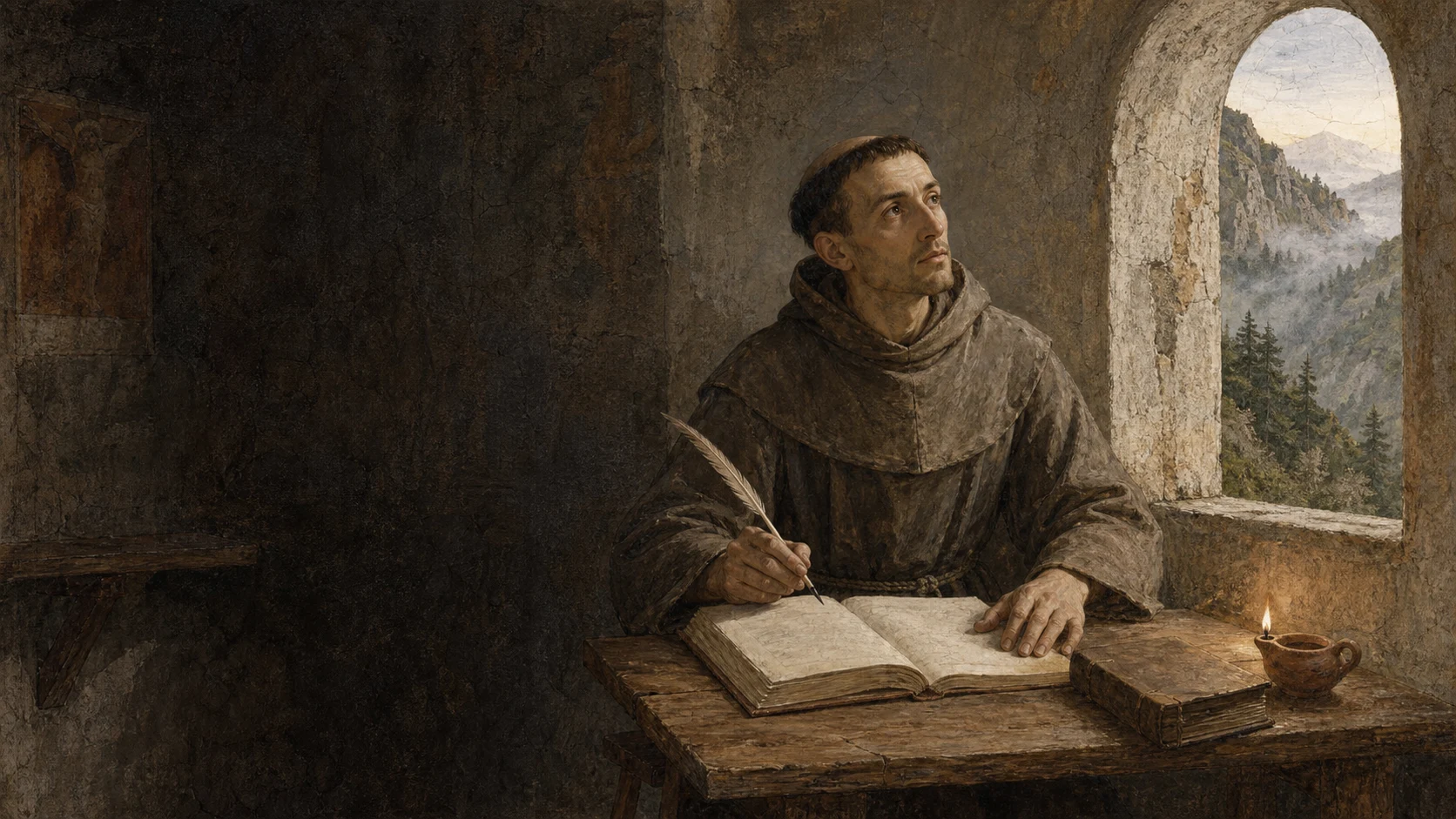
Bonaventure lifts his pen and looks through the window.
Outside, the rock of La Verna rises among trees and mist. Thirty-five years earlier, Francis had been on that mountain. Now the man seated before the codex carries another kind of weight: schools, journeys, disputes, and thousands of brothers scattered across many countries.
He has come seeking peace.
The pages on the table do not yet bear the title by which they will cross the centuries: Itinerarium mentis in Deum, The Journey of the Mind to God.
Bonaventure does not imagine a staircase hidden in the clouds. He looks at the mountain and recognises a path that passes through the world, enters the heart, rises through thought, and ends in a silence no explanation can possess.
Before following that path, we need to meet the friar holding the pen.
The Boy About Whom We Know Little
Bonaventure was born in Bagnoregio, an Italian town built on a hill of volcanic rock. His birth is dated to sometime between about 1217 and 1221. His name was Giovanni, or John, and he was the son of Giovanni di Fidanza. Other family details are disputed.
He left one important memory of his own. In the prologue to his Major Legend of Saint Francis, he wrote that as a boy he had been snatched from the “jaws of death” through the invocation and merits of Francis. It is autobiographical testimony, although it does not allow us to reconstruct the illness or explain how the healing occurred.
A later story says Francis saw the healed boy and exclaimed, “O buona ventura!”—“O good fortune!”—giving him the name Bonaventure. The scene is beautiful, but it does not appear in the author’s own direct account. Nor do we know whether he met Francis in person. It must therefore be treated as tradition, not certain fact.
The boy who survived grew up. The next decisive landscape was not a mountain but a city of students.
Paris: A Forest of Questions
Around 1235, Giovanni arrived in Paris, the main university center of Latin Europe. There he studied the arts: logic, language, philosophy, and the works of Aristotle that were transforming medieval debates.
He then entered the Friars Minor, probably in 1243, and moved on to theology. He studied with Franciscan masters, including Alexander of Hales. He commented on the Bible and Peter Lombard’s Sentences, a book used to organize major Christian questions.
A medieval class was not a room with a projector. The master read a passage, raised objections, compared authorities, and replied. Students copied extensively, debated, and trained their memories.
Bonaventure became skilled at this work. But Paris was also a place of conflict. Some secular teachers accused the mendicant friars of occupying places at the university without following the same rules. The dispute involved theology, power, jobs, and different models of religious life.
In 1257, after papal intervention, Bonaventure and the Dominican Thomas Aquinas were recognized among the university’s masters. That same year, however, Bonaventure received a task that would draw him away from a normal academic career.
When the Teacher Received a Whole Family
On 2 February 1257, Bonaventure was elected minister general of the Order of Friars Minor.
The fraternity was no longer the small group that could gather around Francis. It had provinces, friaries, schools, missionaries, preachers, and pastoral responsibilities. There were also disputes about poverty. Some wished to preserve a strict form of the beginnings; others considered buildings, books, and structures necessary for service and study.
Bonaventure did not solve everything with one sentence. He visited communities, wrote letters, corrected abuses, and tried to preserve poverty within an Order that had grown.
At the General Chapter of Narbonne in 1260, constitutions were approved that gathered and organized earlier regulations. They addressed clothing, work, formation, travel, discipline, and government. Bonaventure sought a shared form for brothers living in very different circumstances.
This explains why he is sometimes called the “second founder”. The title is later and may exaggerate, but it recognises his enormous influence.
Organisation also carries a danger: confusing unity with uniformity. Bonaventure’s history contains both.
The Man Who Wrote Francis
The same chapter requested a new life of Saint Francis. Bonaventure worked with earlier biographies and available memories. He presented the Major Legend in 1263; it became the official narrative used by the Order.
This work is an early and important source, written by a Franciscan who lived close to the generation of the first companions. But it is a hagiography: its purpose is to show a holy life and offer a spiritual model. It does not ask the same questions as a modern biography.
In 1266, the General Chapter ordered the earlier lives removed from circulation and their copies destroyed. It was a medieval way of establishing an official text, but it caused a loss. Fortunately, some manuscripts of Thomas of Celano’s works and other traditions survived beyond that control.
Today we can read Bonaventure without erasing the voices he reorganised.
His image of Francis helps us understand his own thought: visible life can become a sign of invisible reality; creation points to the Creator; knowledge must transform the person who knows.
Rest at La Verna
In 1259, two years after his election, Bonaventure withdrew for a time to La Verna. He says so in the prologue to the Journey. He went to the mountain seeking peace of spirit and reflecting on “the mind’s ascents to God”.
There he remembered the six-winged seraph Francis had contemplated at La Verna. Bonaventure does not say that he had the same vision. He used the six wings as the pattern for six stages of contemplation, followed by a seventh moment of rest.
That difference matters. The work was born in a place sacred to Franciscans, but it is not the diary of a fantastic vision. It is a text of prayer and thought, constructed with immense care.
And “mind” does not mean only the brain or intellect. The Latin word mens includes the inner person: memory, understanding, desire, and love.
The First Steps: Looking Outward
The journey begins with the world we touch.
For Bonaventure, creatures are vestiges, like footprints. A leaf is not God. A star is not God. But existence, beauty, order, and life can awaken the question of their source.
In the first two steps, we learn to look at the world and notice how it enters us through the senses. Sight receives color; hearing receives sound; memory preserves; understanding seeks relationships.
This is not abandoning Earth to rise into heaven. It begins by paying attention.
Francis sang of the sun, water, and fire as siblings. Bonaventure gives theological language to that intuition: the whole universe can act as a book. But the book of creation must be read humbly. Whoever destroys the page to possess it has not understood the message.
Then Entering Within
In the following steps, the journey turns inward.
Bonaventure observes that a person can remember, understand, and choose. These abilities do not prove that we are perfect. They reveal that we are not merely objects pushed from side to side.
Entering the mind does not mean becoming trapped in self-absorption. It means noticing questions such as these:
- What does my memory feed?
- Does my intelligence seek truth or merely victory?
- Is my will learning to love what is good?
The traveler discovers an image of God within, but also disorder, fear, and selfishness. The journey is therefore not a technique for superior people. It needs grace, conversion, and help.
Knowing yourself means opening a door, not building a throne.
Above Us: Unity, Goodness, and Christ
In the fifth and sixth steps, Bonaventure invites thought to consider God as the source of all that exists and as goodness that communicates itself. He uses difficult philosophical arguments and contemplates the Christian mystery of the Trinity.
For a twelve-year-old reader, we can retain this: God would not be one more object within the universe, like the mountain’s largest stone. God would be the source through which the mountain, the gaze, and the very ability to ask questions exist.
At the center of the path is Christ. For Bonaventure, we do not reach God by accumulating ideas until we become unbeatable. Christ unites Creator and creation, divine and human, suffering and love. He is the way and the passage.
Reason advances until it recognises its limit. This does not humiliate the intellect. A window does not fail because it cannot hold the entire mountain; it fulfils its purpose when it allows us to see it.
The Seventh Moment: When the Pen Stops
The final chapter speaks of rest, ecstasy, and passage. Words grow shorter before what they try to express.
Bonaventure does not tell us to discard study. He was himself one of the most learned men of his century. He says that reading without desire, investigation without wonder, and understanding without love do not complete the journey.
There is a difference between knowing the composition of bread and feeding someone who is hungry.
For him, wisdom is not merely possessing information. It is experiencing the good and allowing yourself to be transformed. Study prepares the eyes; contemplation learns to see; love places the feet back on the road.
The mountain of the soul therefore does not end far from other people. Bonaventure returned from La Verna to government, travel, and the Order’s conflicts.
Silence would have to make his service more truthful.
From the Habit to the Red That Came Later
In 1273, many years after the Journey, Pope Gregory X appointed Bonaventure cardinal and bishop of Albano. Later art therefore often shows him with a red hat and robes.
Those symbols do not belong to the scene at La Verna in 1259. There he was minister general and a friar in a poor habit.
As a cardinal, he helped prepare the Second Council of Lyon. He died during the council on 15 July 1274. He was canonised in 1482 and recognized as a Doctor of the Church at the end of the sixteenth century. He became known as the Seraphic Doctor, for his theology shaped by love and the image of the seraph.
His life moved from little Bagnoregio to great Paris; from the university classroom to the roads; from government to the stone cell; from the open codex to silence.
He did not choose between intelligence and contemplation. He spent his life trying to let each correct the other.
To Keep in Your Heart
You do not need to climb a mountain to begin Bonaventure’s journey.
Pause before a created thing: a tree, a cloud, someone’s face. Observe before naming it. Then enter within and notice what that presence awakens. Finally, ask how this way of seeing can make you more grateful and caring.
Study something difficult without using knowledge to humiliate. Pray without using prayer to escape a task. And allow moments when you do not need to win a debate or fill the silence.
Bonaventure’s pen stops before the window.
Not because he has finished learning.
Because some truths need room to breathe.
Sources and paths for further reading
How We Know Bonaventure
- Itinerarium mentis in Deum — Bonaventure's textA translation of the primary text, including the prologue in which the author dates the work to 1259, locates his search for peace at La Verna, and explains the image of the six wings.
- Stanford Encyclopedia of Philosophy — BonaventureAn up-to-date academic study by Timothy Noone and R. E. Houser on chronology, works, Paris, philosophy, and government of the Order.
- Order of Friars Minor — St Bonaventure of BagnoregioA Franciscan overview of his education, teaching, the Constitutions of Narbonne, lives of Francis, and work as minister general.
- Benedict XVI — audience on BonaventureA reading of the relationship among Francis, history, government of the Order, and the Journey conceived at La Verna.
- Library of Congress — Major LegendA digitised copy of Bonaventure's work on Francis, begun at the Order's request in the 1260s.
- Albert T. Haase — critical study of the Major LegendAcademic research on the work's composition from earlier sources and its approval as the official narrative.
Bonaventure's works are primary sources for his thought and, in some prologues, for personal memories. The Major Legend is Bonaventure's own work, but it is a biography of Francis, not of its author. Modern chronologies depend on university records, chapters of the Order, and papal documents. The exclamation “O buona ventura” belongs to later tradition and has not been used as a historical explanation of his name.