
The wall is still breathing
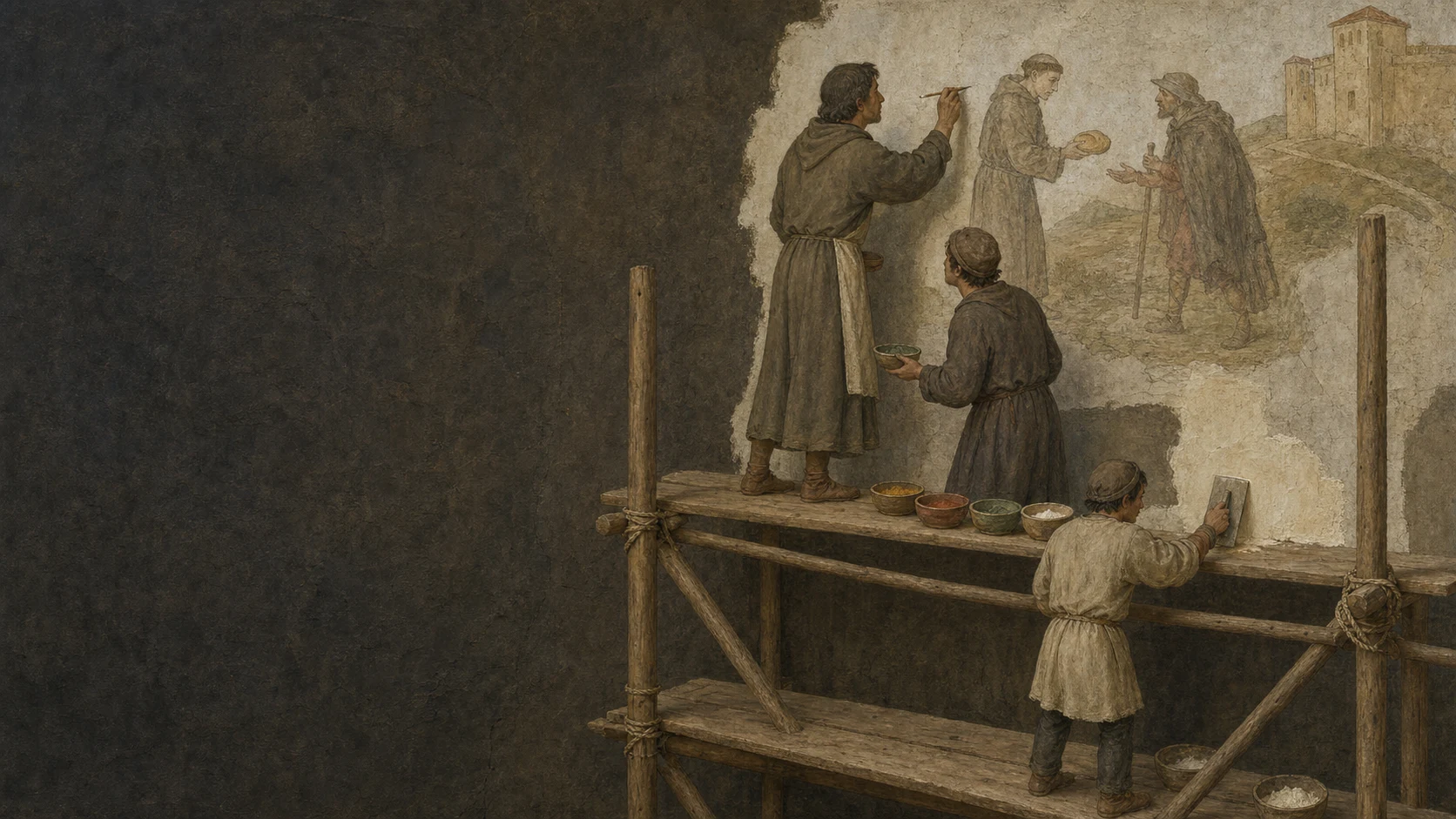
An assistant climbs with a bowl of pigment. Above him, a painter touches his brush to the damp plaster. The wall drinks in the color.
There is little time for hesitation. When the surface dries, that portion of the work will be finished. Beside him, another man mixes lime and sand. On the ground, small containers hold red earths, ochres and greens. Dust settles on hands, habits and planks.
This scene is a reconstruction. We do not know the name or position of every worker on any given morning in the Basilica of Assisi. But marks studied on the walls reveal the order of the work, the size of the areas painted in a day and the presence of teams working on scaffolding.
The frescoes that now seem silent were born on a noisy building site.
A church over a tomb
Francis died in 1226 and was declared a saint in 1228. That same year, construction began on the basilica intended to house his body. It rose on the hillside of Assisi like two churches placed one above the other: the lower church, low and secluded, and the upper church, tall and full of light.
Once the walls were ready, they received an extensive program of painting. Artists from different regions and generations worked there. Cimabue, Jacopo Torriti and several masters known only by names coined by scholars—such as the Isaac Master, the Master of the Capture and the Saint Cecilia Master—appear in discussions of the ensemble.
Along the lower part of the upper nave runs a sequence of 28 stories of Saint Francis. Visitors can follow them as they walk: his youth, his renunciation of possessions, the approval of his form of life, his preaching, the stigmata, his death and miracles attributed to the saint.
It is like entering a story that occupies the entire architecture.
The book chosen for the wall
The painters did not decide on their own which episodes would be shown. The cycle mainly follows the Major Legend, the biography of Francis written by Bonaventure of Bagnoregio and officially adopted by the Order in 1266.
This matters because an image never chooses colors alone. It also chooses what to remember.
By the time the walls were painted, the Friars Minor had spread across many countries. They had schools, friaries and responsibilities that had not existed at the beginning. The figure of Francis had to unite a fraternity much larger than the small group at the Portiuncula.
The scenes present the saint as someone profoundly united with Christ and recognized by the Church. The confirmation of the Rule, the preaching before the pope and the stigmata are not episodes placed at random. Together, they form a visual explanation of who Francis was to be for new generations.
The program was Franciscan, but also papal and public. The basilica received friars, clergy, nobles, local residents and pilgrims. Each person arrived with different knowledge.
Images were not an easy book
Medieval paintings are sometimes described simply as “the Bible of the illiterate”. It sounds convincing, but it is far too limited.
A painted wall did not speak on its own. Sermons, celebrations, prayers, feasts and explanations helped people recognize the events. Latin captions appeared beneath the scenes, although not everyone could read them. Those who had already heard the story found gestures and faces able to bring it back to mind.
The painters organized each episode to guide the eyes. A hand points. Two faces meet. A doorway separates groups. A building shows where the action takes place. Francis’s body leans, kneels or embraces, and the movement helps the viewer understand even before anyone reads a sentence.
The figures seem to occupy space. Feet meet the ground. Fabrics gain weight. Some people turn their backs to us, like real people gathered around an event. Painted architecture creates rooms, churches and squares.
This was not the sudden birth of “modern” art, nor the work of a genius who awoke alone with a new idea. Painters in Tuscany and Rome were already seeking volume, emotion and space. At Assisi, different experiences met and acquired extraordinary narrative force.
Painting while the wall is fresh
The name fresco comes from the idea of painting on fresh plaster. The technique demanded planning.
First, the wall received a rough layer of lime-and-sand mortar called the arriccio. The composition could be sketched on it, often with a reddish pigment. Next came a fine, smooth layer, the intonaco, but only over the area the team could paint before it dried.
This daily portion is called a giornata: a “day’s work”. Mineral pigments were mixed with water and applied to the damp plaster. As the lime dried and hardened, the color became part of the surface.
The painter had to know exactly where to begin. Faces and hands might receive small, careful giornate. Larger backgrounds allowed more extensive areas. If any plaster remained unpainted, the unused portion had to be cut away and another prepared the following day.
Not every color worked well on wet lime. Certain blues, details and retouching were applied to the dry wall with a substance that helped the pigment adhere. This a secco painting was more fragile. Centuries of damp and dust carried parts of it away, making some scenes appear less intense today than when they were new.
No one painted a church alone
Imagine the size of the nave, the height of the walls and the deadline given to the artists. One man alone could not prepare mortar, carry water, grind pigments, draw, paint figures, execute ornament and move scaffolding without help.
The workshop was a working community. A master or group of masters planned. Assistants transferred drawings and executed sections. Apprentices prepared materials. Labourers built platforms and kept the plaster ready. Roles could change according to each person’s experience.
This does not mean that everyone painted in the same way. A face might be entrusted to the most experienced hand; a decorative border to another. Sometimes the person in charge drew the composition and assistants executed it. In other areas, different workshop leaders appear to have organized their own teams.
The marks of the giornate and of the sections corresponding to the levels of scaffolding help researchers discern these changes. Technique tells a story that written documents have lost.
Behind every visible saint stand many invisible workers.
So was it Giotto?
For centuries, the 28 stories were presented as the work of Giotto di Bondone. The tradition did not arise from nothing. Early authors associated Giotto with Franciscan works in Assisi, and the scenes have important connections with works linked to him and his workshop.
But no contract survives saying, “Giotto painted these 28 scenes, in these years, with these assistants.” The early sources do not securely identify each wall. Moreover, differences in drawing, technique and manner of painting suggest multiple hands.
Scholars therefore disagree. Some argue that a young Giotto designed or directed much of the cycle with a large workshop. Others assign its principal direction to painters from the Roman artistic milieu, connecting certain solutions with Pietro Cavallini and anonymous masters. Still other proposals divide the episodes among several teams.
The debate is not simply an argument over a signature. It changes the way we imagine medieval art. If we look for a lone genius, we may fail to see the building site, the partnerships and the shared knowledge.
The most honest course is to say: the cycle is traditionally associated with Giotto, but its authorship and the participation of different workshops remain debated.
The title of this chapter therefore uses the plural deliberately: Giotto and the painters of Assisi.
When Francis’s life became space
The artists did more than decorate a church. They gave a memory a body.
Francis had walked through real streets in Assisi, entered churches and spoken with people he knew. In the paintings, his story happens again in places that seem habitable. The viewer sees not merely a distant sign of holiness, but a conversation, a conflict, a wait, an embrace.
This closeness also organises the message. Poverty appears in clothing and gestures; obedience, in encounters with authorities; fraternity, in groups; union with Christ, in the stigmata. Art selects and interprets. It is not a photograph of Francis’s life.
Those who contemplate the cycle encounter the interpretation the Order wished to offer at the end of the 13th century, many decades after the saint’s death. The images are therefore precious witnesses both to Francis and to the Franciscans who came after him.
The last bowl of color
Let us return to the scaffolding.
The plaster is beginning to lose the sheen of moisture. The painter finishes a fold in the habit and lowers his arm. Another worker is already preparing the surface for the next day. Far below, no one can see every brushstroke up close; from a distance, however, they come together as a face.
Perhaps Giotto drew that figure. Perhaps a Roman master directed that section of the wall. Perhaps the hand belonged to an assistant whose name we will never know.
Uncertainty does not diminish the beauty. It restores the murmur of the workshop to the painting.
For centuries, pilgrims walked beneath those scenes. They saw pigments bound to lime, but also a story bound to stone. The wall taught that the life of a poor man could occupy an entire basilica without ceasing to point toward something greater than himself.
The painters left. The scaffolding disappeared. Each day’s work was hidden beneath the next.
And on the ancient wall, Francis still walks.
Beneath the layers of lime
Sources for this chapter
- Ministry of Culture — Basilica of Saint FrancisInstitutional description of the monument. Identifies the 28 episodes, their relationship with the Major Legend and the participation attributed to Giotto and other masters.
- Metropolitan Museum of Art — Italian painting of the Later Middle AgesTechnical overview. Explains *arriccio*, preparatory drawing, *intonaco*, pigments on wet lime, *giornate* and painting on dry plaster.
- A. Dal Fovo and others — medieval Italian wall paintingsScientific and historical study. Examines techniques, materials and the importance of the visible days’ work at Assisi.
- Bruno Zanardi — Giotto and the Saint Francis cycleAcademic study of the attribution. Summarises the long dispute between the Giotto hypothesis and proposals connected with the Roman artistic milieu.
- Harvard I Tatti — The Life of Saint FrancisResearch archive. Presents the ensemble of 28 scenes in the upper church as a foundational work of medieval visual narrative.
- UNESCO — Assisi World Heritage nominationHistorical dossier on the complex. Connects the cycle with Bonaventure’s biography, the Franciscan program and the different hands proposed for the basilica.
How to read this chapter: the work on scaffolding, the preparation of the wall and the days’ work are reconstructed from technical studies, not from a daily workshop chronicle. The existence of the cycle, its 28 episodes and its principal connection with the Major Legend are secure. The exact date, direction of the worksite and hand responsible for each scene remain debated. “Giotto” therefore appears here as a traditional attribution and possible leader, never as certainty that he painted everything alone.