
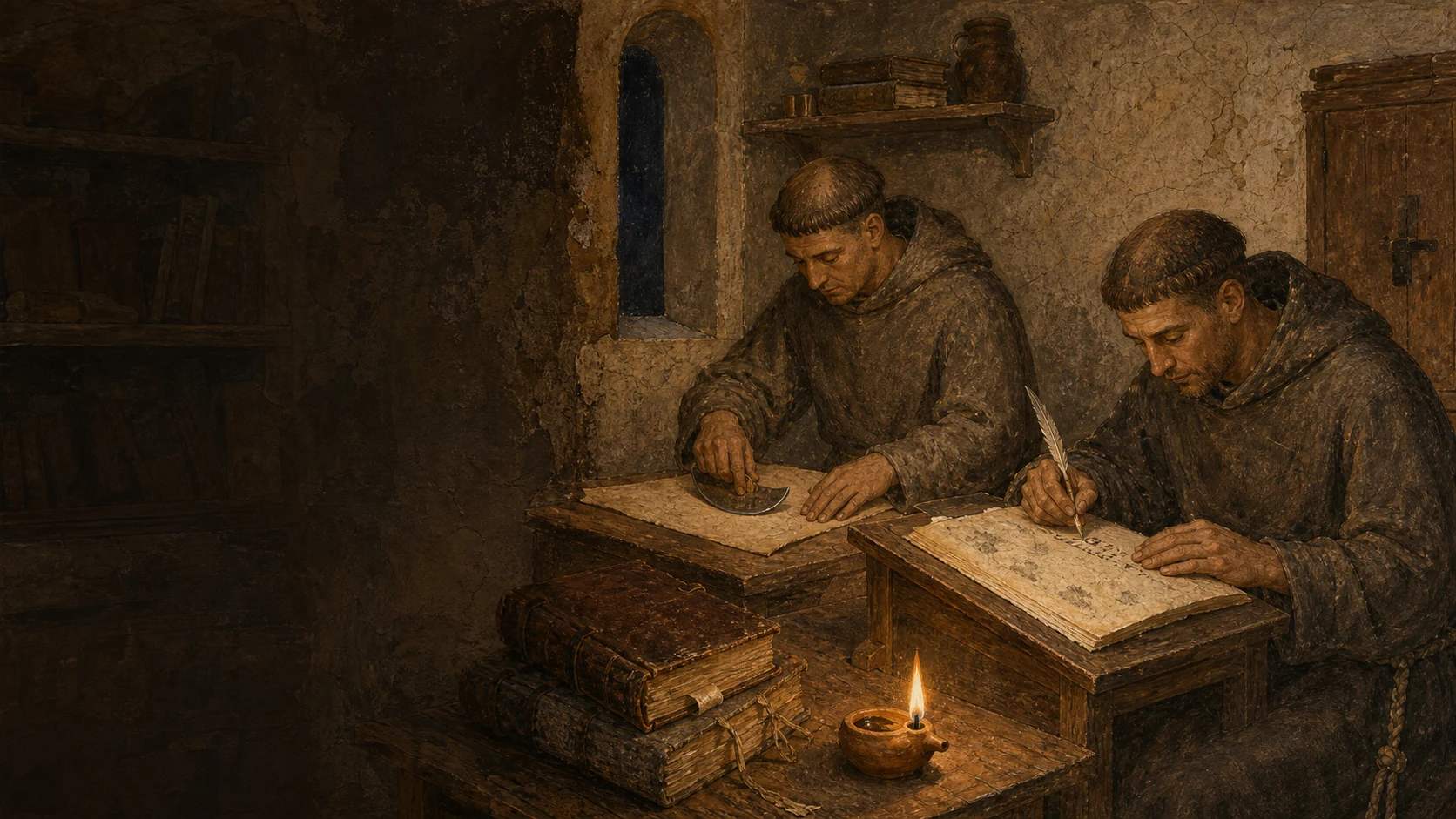
The flame of the oil lamp is small. When the oil moves, the friars’ shadows move across the wall as well.
One brother holds a trimmed quill and touches its tip to the leaf. He is not copying quickly. He adds a short note in the margin, where another hand has already left marks. Beside him, a second friar passes a curved blade over a sheet of parchment. The sound is low, like sand scraping wood.
There are no endless shelves, no gold covering every letter, no row of identical monks. There is the smell of prepared skin, burnt oil, leather and ink. There is work.
And there is a question: how did brothers who chose poverty end up surrounded by books?
Friars are not monks
Before opening any codex, we need to correct a common image. Franciscans are friars, not monks.
A medieval monk normally belonged to a stable monastery organized for a communal life of prayer and work. This does not mean that monks never went out or that all monasteries were alike. But the stability of a house was an important part of the monastic ideal.
The Friars Minor began as mendicants. “Friar” comes from a word meaning brother. They traveled, preached, cared for people in towns and depended on work and alms. A brother might be sent from Assisi to Paris and then to another house. Not every friar was a priest; many were lay brothers.
This is another reason why it is dangerous to imagine that every Franciscan friary had a scriptorium, an organized room for copying books like the famous workshops of certain monasteries. Some friaries had writing spaces, libraries and workshops. Others kept a few volumes in a cupboard or chest. In many cases, books were commissioned, bought, received as gifts or produced by outside professionals.
The scene by the oil lamp is possible. It is not a photograph of every friary.
Francis before the written word
Francis called himself simple and unlearned. This does not mean that he was unable to read. As a merchant’s son, he knew the world of accounts, songs and letters. His writings reveal the help of secretaries, but also a personal and careful relationship with words.
In the Testament, he orders sacred texts found in unworthy places to be gathered up. He asks that theologians and those who transmit the divine word be respected. The man of poverty did not treat a page bearing Scripture as rubbish.
At the same time, he feared knowledge used to rise above others.
The Rule of 1223 allows clerical friars to have the breviaries needed to pray the Office. Later, it instructs brothers who did not know letters not to be anxious to learn them. The sentence is not an order against all schooling. It protects a fraternity in which the illiterate brother was worth no less than the scholar.
The first concern was not to form an order of teachers. It was to live the Gospel.
When the fraternity needed to study
The small community grew quickly. Within a few decades, the friars were crossing countries, preaching to crowds, hearing confessions and debating with masters in university towns.
Good intentions were not enough for these tasks. A preacher needed to know the Bible. A priest needed to learn theology and guide people without inventing answers. Poverty did not remove responsibility.
Anthony, educated among the Augustinian canons in Portugal, became one of the brothers’ first teachers. Francis approved his teaching on one condition: that study should not extinguish the spirit of prayer and devotion.
That condition became a kind of thread stretched through Franciscan history. On one side stood the genuine need to learn. On the other, the danger of turning books, titles and arguments into wealth for the ego.
Houses of study, known as studia, appeared in centers such as Bologna, Paris and Oxford. They were not schools for all friars in the same way. They trained readers, preachers and masters. In the 13th century, names such as Alexander of Hales, Bonaventure, Roger Bacon and John Duns Scotus helped place the Franciscans at the center of Europe’s great intellectual conversations.
This happened very quickly. It also provoked debate. A codex could cost more than many months of food. How should a poor order use one?
A book without making it a private treasure
The friars developed rules to distinguish use from ownership. A brother might need a book, but he should not treat it as a personal trophy. Benefactors, institutions or the community could provide volumes. Ministers decided on loans and retrieved books when a friar died or changed his role.
In practice, everything was more complicated. There were donations, bequests, purchases for common use, long-term loans and books that accompanied preachers for years. There was also criticism of friars who accumulated too many volumes.
The surviving pages show how they were used. There are corrections, tiny drawn hands pointing to passages, attention marks, abbreviations and comments in the margins. A preacher might collect passages for a sermon. Another organized material for confessions. Smaller notebooks functioned as portable libraries.
There was no single kind of “Franciscan book”. Some were large liturgical volumes for communal reading. Others were small and durable for the road. There were Bibles, commentaries, sermon collections, works of theology, law, philosophy and natural science.
The format followed the task.
How a manuscript came into being
Before printing, making a book required many people and materials. The process varied by place, period, price and type of volume. Not every stage took place in the same building.
To produce parchment, animal skins were cleaned, soaked in a lime solution, stretched on a frame and scraped with a curved blade. As they dried under tension, they became firm sheets. Imperfections, holes and differences in color could remain visible.
The sheets were cut and folded into gatherings. Small holes and ruled lines guided the writing. The scribe trimmed a quill, prepared the ink and moved forward line by line. One widely used ink mixed substances extracted from oak galls with iron salts, although other recipes existed.
Next might come the rubricator, responsible for headings or marks in red, and the illuminator if the project included decoration. Not every book received images. Most did not resemble a royal treasure filled with gold.
Finally, the gatherings were sewn together. Wooden boards, leather, cords and clasps protected the text block. Producing a codex meant creating, page by page, an object with a body.
From the 13th and 14th centuries onward, paper appeared increasingly in European books. It was cheaper than parchment and became important for study notebooks and compilations. Even so, parchment and paper continued to coexist.
Some friars really did copy, correct, gather or annotate manuscripts. But it would be false to say that every Franciscan book was born from a Franciscan quill. Urban craftspeople, professional scribes, university members and donors took part in this history.
A library could fit inside a cupboard
When we hear “library”, we imagine an entire room. In a small friary, it might have been only a collection kept in chests, niches or cupboards. The volumes could be placed in one friar’s care and issued as needed.
Houses connected with universities developed larger collections. Some had books chained to desks for consultation and others available for loan. The chain was not a punishment: it kept a rare object from disappearing while leaving the reader enough room to open it.
Size varied greatly. Research on Padua shows that the Conventual Franciscan library at Saint Anthony held more than a thousand manuscripts around 1450. This was an extraordinary case linked to an important center of study, not the measure of every friary. In the same city, a later Observant house held a smaller collection and many personal compilation notebooks.
Inventories help us reconstruct shelves that no longer exist. Chain marks, old labels, ownership notes and worn margins tell us how books circulated.
A medieval library was not silent like ours. One person read in a low voice; another dictated; pages rustled; a chair scraped the floor. Knowledge had sound as well.
What was preserved—and what disappeared
A manuscript can cross eight hundred years, but its survival was never guaranteed.
Fire, damp, insects, wars and neglect destroyed collections. Religious reforms and the closure of friaries scattered books through markets and libraries. Bookbinders cut up old leaves to strengthen new covers. People erased the signs of former owners or separated a volume into parts.
Other codices survived precisely because they traveled. They were rebound, donated to a city, collected by scholars or kept in public institutions. Today, they may be far from the friary where they were read.
Preservation does not mean keeping everything intact. Sometimes only a leaf remains, a fragment hidden in a spine or a description of a book in an inventory.
Historians therefore avoid saying, “The Franciscans read only this” or “Every friary did that”. What has reached us is an uneven portion. Wealthy houses left more traces; small libraries may have disappeared almost completely.
Every absence is also part of the story.
To keep in your heart
Francis did not want wisdom to become a ladder from which to look down on others. Nor did he teach his brothers to despise the written word. He asked that prayer should remain alight within study.
That ancient tension reaches us too.
A book can become an ornament, a source of pride or a forgotten pile. It can also cross centuries so that a distant voice may speak to a child not yet born.
When you study, remember the many hidden hands behind what you read: those who researched, wrote, revised, printed, transported and preserved it. On a screen, remember those who programmed, digitised and made the text accessible too.
Choose an important page today. Read it slowly. Make a note that will help you return to the idea, without damaging a book that is not yours. Then explain what you have learned to someone in simple words.
Franciscan knowledge does not end on the shelf.
It goes out through the door to serve.
Sources and paths for further reading
Where these pages come from
- Testament of Saint Francis — Order of Friars MinorA direct source on Francis’s respect for divine words, theologians, work and the simplicity of the first fraternity.
- Rule of Saint Francis, 1223 — Order of Friars MinorThe text of the Rule on clerics’ breviaries, study by brothers without letters, preaching and the priority of prayer.
- Janet Burton — The Mendicant OrdersA Cambridge University Press study distinguishing the friars’ itinerant mendicant life from monastic stability.
- René Hernández Vera — Franciscan Books and Their ReadersA detailed academic review of the study of manuscripts, regulations, libraries, chains, loans and annotations in the friaries of Padua.
- Franciscan Books and Their Readers — RoutledgeRené Hernández’s study of books written, read and used by Franciscans from the 13th to the 15th centuries, with attention to material form and the diversity of collections.
- The Making of a Medieval Manuscript — Getty MuseumA museum presentation of the stages of preparing parchment, writing, painting and binding.
Normative documents tell us how the Order wished to organize books and study; the codices themselves reveal more varied practices. The example of Padua belongs chiefly to the 14th and 15th centuries and has not been projected backwards onto the first fraternity. “Scriptorium” has been used only for genuinely organized workshops, not as an automatic name for any place where a friar wrote.
Historical note: manuscript production varied greatly between regions and centuries. Parchment, paper, inks, the division of labor and methods of binding did not follow a single recipe. Friars could write and prepare materials, but many volumes were purchased, donated or produced by outside professionals; not every friary had its own library or copying workshop.