A Small Horse Before an Enormous Road
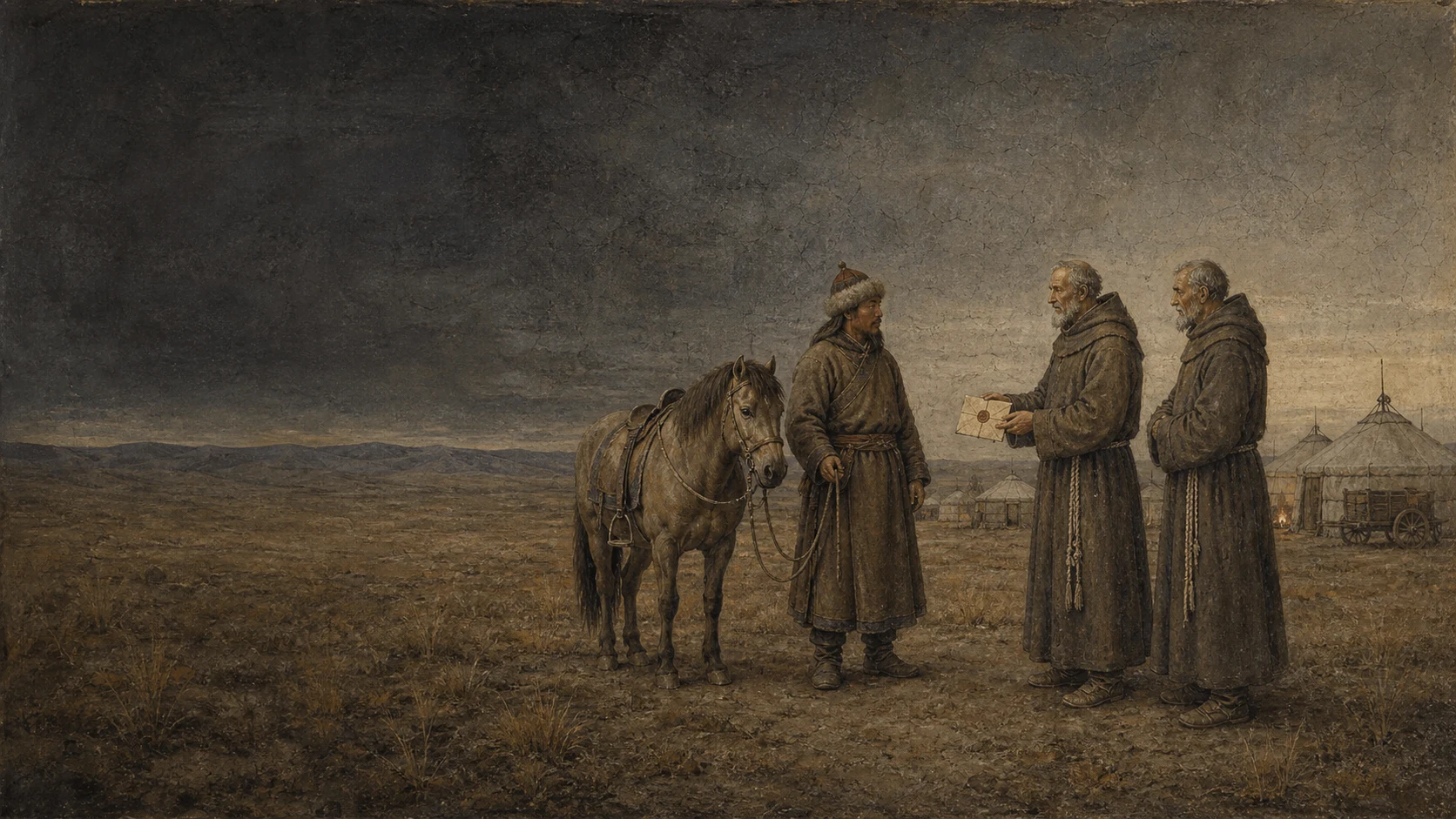
The wind runs without meeting a wall. It bends the dry grass and beats against the travelers’ woolen habits. To the right, two friars wait before a man mounted on a short, sturdy horse. Farther away, felt tents form a camp so large that it looks like a city capable of moving on.
One friar holds a letter. The other listens. Neither is there by chance.
This opening is an artistic reconstruction. The travel account does not describe a single encounter with these exact positions and gestures. But its elements belong to the world John of Plano Carpini knew: the steppe, horses changed along the route, messengers, tents, and the need to speak through several languages.
John did not go east to see landscapes. The pope sent him because Europe was afraid.
After the Armies Disappeared
In 1241, Mongol forces destroyed armies in Poland and Hungary. Cities were burned. Families were killed or taken away. Then, almost as quickly as they had arrived, the large contingents withdrew eastward.
Europeans did not know whether they would return.
In 1245, during the Council of Lyon, Pope Innocent IV decided to send messengers. One was John of Plano Carpini, an Italian Friar Minor and early companion of Francis. John was already elderly for such a punishing journey—probably close to sixty—and knew how the fraternity was organized in different countries.
He left Lyon on 16 April 1245. The letter Cum non solum asked for the attacks to cease, enquired about Mongol intentions, and spoke of peace. Another presented the Christian faith.
John was a diplomatic envoy of the pope, charged with delivering messages, obtaining a reply, and observing a power Europe barely understood.
Benedict Takes to the Road
The mission continued through Bohemia and Poland. In Breslau—now Wrocław—Benedict the Pole joined the party, a friar able to help with Slavic languages. He was not a silent supporting figure. He became a companion, interpreter, and witness to the journey.
Another brother, Stephen of Bohemia, fell ill and had to remain in Kyiv. John too became so ill that he believed he was close to death. Even so, he wrote that he was carried in a cart through cold and snow so that the mission would not be interrupted.
Those words come from the traveler. The reality was already harsh: unsafe roads, devastated territories, and the obligation to continue when the body demanded rest.
In Kyiv, residents gave them important advice. Horses from the west would die because they did not know how to find grass under the snow as steppe horses did. The friars changed mounts and came to depend on Mongol authorities and relay stations to continue.
They also learned that an envoy without gifts could be treated with contempt. With donations received along the way, they bought furs to offer. In that diplomatic world, gifts communicated respect and rank.
Letters Cross Languages
In February 1246, John and Benedict left Kyiv and reached the first Mongol encampments. Armed men appeared at sunset and asked who they were. The travelers replied: envoys of the pope.
At every encounter, they had to repeat their mission. Each leader could send them on to the next or make them wait. Before Batu, the powerful ruler of the empire’s western lands, the letters had to be translated.
John records a chain of languages: Latin, Ruthenian, a language he calls “Saracen”—probably Persian—and Mongolian. A sentence could pass through several mouths before reaching its recipient.
How much of a message remains unchanged after so many translations? The friars checked what they could, but did not control every word.
Before the audience with Batu, they were told to pass between two fires. Their hosts explained that this was a purification against poison or evil intent. The friars resisted at first and then agreed, provided the gesture did not mean abandoning their faith.
It was a delicate negotiation between customs that could easily be misunderstood.
Snow in June
Batu ordered the envoys to go to the great khan. From then on, the road grew even longer. They traveled east across the steppes, accompanied by Mongol guides and changing horses to move quickly.
John describes broad rivers, lakes, plains, and mountain regions. On 29 June, he encountered snow and bitter cold in the land of the Naimans. It was summer on the calendar, but not in the travelers’ bodies.
They rose at dawn and rode until night. Sometimes they arrived too late to eat. At certain stages, they received in the morning the portion that should have been their evening meal. During Lent, they said they lived mainly on millet with salt and water; they melted snow in a pot to drink.
Messengers, herders, merchants, and soldiers traveled through those lands. The Mongol network of horses, guides, and authorities made the crossing possible. Without it, the friars would not have arrived.
The steppe was not empty. John crossed regions inhabited by many peoples, some recently conquered. He saw ruins, organized camps, and an administration capable of moving people across thousands of kilometres.
The City That Moved
On 22 July 1246, the travelers reached the great camp where the new sovereign would be chosen. Scholars still debate its exact location; it is not safe simply to say that John entered the city of Karakorum. He reached the imperial court assembled in the region of Mongolia.
Felt tents, carts, horses, and envoys from many places covered the landscape. The election of Güyük, a grandson of Genghis Khan, brought the empire’s leaders together in a quriltai, a political assembly.
The friar observed things he admired: discipline, endurance, and certain customs of solidarity within the community. He also wrote fearfully about military strategies and rule over conquered peoples.
His gaze was attentive but not neutral. He calls the Mongols by the European name “Tartars”, judges religions by Christian standards, and sometimes repeats information he heard without verifying it. Some pages include fantastic peoples inherited from old European stories. When he says “I saw”, his voice carries weight. When he says “we were told”, we need to preserve the distance.
Before Güyük
The friars waited for weeks. They could not simply deliver the letter and leave. Protocol, translation, and the sovereign’s election determined the timing.
When they entered Güyük’s tent, they were searched and warned not to touch the threshold. They saw representatives bringing cloth, furs, horses, and other gifts. John and Benedict had already spent almost everything they possessed.
Güyük’s reply rejected the papal warning and demanded that the pope and the rulers of the West come and submit. The letter, written in Persian and bearing a seal in Mongol characters, still exists in the Vatican archives.
The mission did not produce the peace Innocent IV wanted. Nor did it convert the great khan. Its result was more sober: it opened direct communication and brought back information that had previously arrived as rumour.
On 13 November 1246, the envoys began their return. Once again they faced winter and distance. John returned to Lyon in November 1247, more than two years after leaving.
The Book That Returned with Them
John wrote the History of the Mongols Whom We Call Tartars. It is not merely a diary. He organises what he learned about territory, customs, government, religion, warfare, and travel. He also warns Christians about the possibility of another invasion.
Benedict left a related testimony, known through a version recorded from his spoken account. We should therefore not tell the mission as though one Italian had understood all the languages and roads alone. The work grew from a shared journey and from many intermediaries whose names have almost disappeared.
Between 1253 and 1255, William of Rubruck reached the court of Möngke. Connected with King Louis IX of France, he wished to visit Christians and speak about the faith. His mission was not John’s; even so, the court treated him as an ambassador.
The two texts allow us to compare observations. They also reveal their authors: thirteenth-century Latin friars, curious and courageous, yet carrying the fears, beliefs, and limitations of their own world.
What Remained of the Steppe
John and Benedict did not “discover” the Mongols. Peoples already lived and governed in those lands. The friars returned with a direct European account.
There is a Franciscan lesson in this story, but it needs no invented splendour. The friars arrived in weakness, depended on foreigners, and discovered that observing is different from understanding completely.
When we encounter an unfamiliar people, we may begin by describing everything in our own words. Then, if we are humble, we realize that we also need to learn theirs.
In the image, the letter remains closed for a moment. The messenger holds the reins. The travelers listen before continuing.
The hardest distance may not have been between Lyon and Mongolia. It was the distance between two visions of the world—and no road by itself could erase it.
Voices from the journey
Sources for This Chapter
- John of Plano Carpini — The Journey to the Court of Güyük KhanFirst-hand account of the 1245–1247 mission. W. W. Rockhill's English translation, made available and annotated by the University of Washington's Silk Road Seattle project.
- John of Plano Carpini — History of the MongolsComplete translation of the treatise. It makes it possible to distinguish the travel narrative from chapters of description, strategy, and second-hand information.
- Innocent IV — Cum non solum, 1245Contemporary diplomatic letter. It asks for an end to the invasions, enquires about Mongol intentions, and identifies the friars as bearers of the message.
- Dizionario Biografico degli Italiani — Giovanni da Pian del CarpineModern historical study. It reconstructs the itinerary, translations, audience, Güyük's reply, and the writing of the Historia Mongalorum.
- Boleslaw Szcześniak — the mission of John and BenedictAcademic article. It recovers Benedict the Pole's role and shows that the journey also involved negotiations in Poland and Ruthenia.
- William of Rubruck — Journey to the Eastern RegionsAnother first-hand Franciscan account, from 1253–1255. It provides a comparison without confusing William's mission with John's papal embassy.
How to read this chapter: the dates, main route, hunger, translations, court, and diplomatic reply come from thirteenth-century accounts and documents. The opening scene combines attested elements but is reconstructed. John witnessed much directly, yet he wrote as a Christian envoy concerned about another invasion; he also recorded rumours and judgements from his time. His observations are therefore presented as valuable, not as a complete or neutral view of the Mongol peoples.