
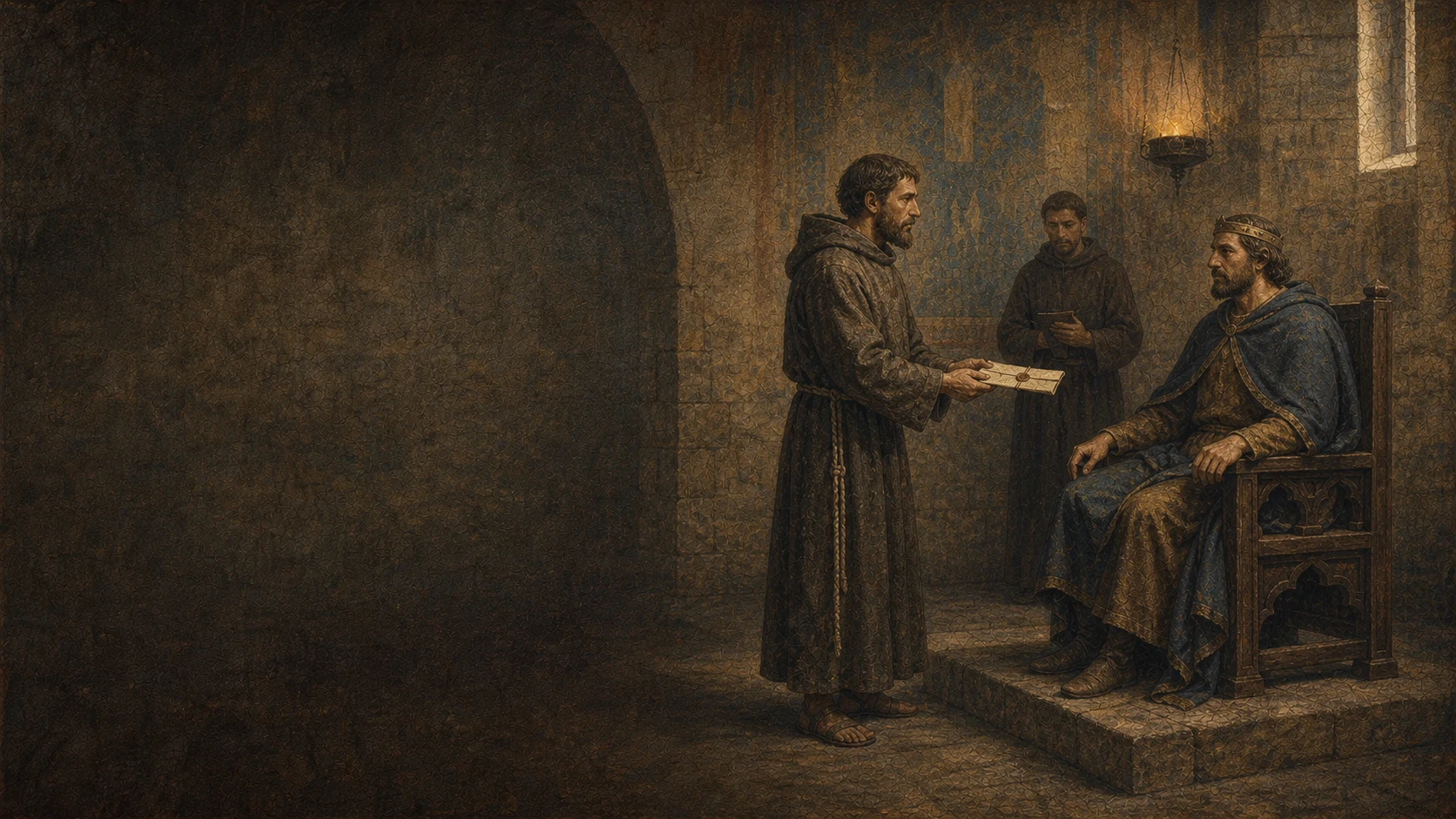
The doors are high. The hall is cold. Guards watch a man wrapped in worn wool.
He carries no sword. He brings a letter.
Ahead, a ruler is surrounded by people able to order imprisonment, wars, taxes, and journeys. The friar seems small in that space. But he does not kneel like a slave or enter as a conqueror. He was sent to speak.
In the thirteenth century, men and women of the Franciscan family appeared before the powerful. Some asked for peace. Others carried messages or defended poverty. They were not always understood. They did not always win.
Their story is not one of the pure poor confronting rulers who were always evil. It is harder: poverty drawing near to power and discovering that power could also use it.
The Court Was a Machine
A medieval court was not merely a king on a throne. It was a moving household filled with relatives, clergy, soldiers, scribes, and visitors. Offices were distributed there, disputes judged, and alliances planned.
Entering that world required permission. Clothing signalled rank. A seal authenticated a letter. A wrong gesture could look like an insult. When a friar appeared in sandals and an undyed habit, his simplicity became a message before he spoke.
But the habit did not make him automatically right. Friars could serve the projects of kings and popes. They could misunderstand other peoples. They could wish to convert those who did not want conversion. We must therefore ask in every episode: who sent this person, what did this person want, and who wrote the account?
Agnes of Prague Refuses the Path Prepared for Her
Agnes was born into Bohemia’s royal family. From childhood, her marriage was planned as a political instrument. A princess could unite territories, secure agreements, and produce heirs. Her life belonged largely to other people’s plans.
In the 1230s, Agnes chose another path. In Prague, she founded a hospital and a monastery connected with Clare’s movement and the friars. She entered this community in 1234. Clare’s first letter to Agnes celebrates her preference for the “poor Christ” over proposals of an imperial marriage.
We need not invent a scene in which Agnes shouts before an emperor. The letters themselves are enough. They show a woman of royal blood using her position to refuse an expected role and build a new religious house.
Then another dispute began. Agnes wanted her community to live without permanent property, according to the poverty practiced at San Damiano. Pope Gregory IX considered this model risky for a women’s monastery. Papal letters tried to secure income and connect the hospital with the sisters’ support.
Agnes asked, insisted, and negotiated. Clare encouraged her to stand firm. In 1238, the pope granted the Prague community a form of the Privilege of Poverty: the right not to be forced to own property.
The situation is full of tension. Agnes could create the hospital and monastery only because she had resources, connections, and royal blood. She then used that power to ask for the right not to depend on wealth. Franciscan poverty entered the court through someone who knew it from within.
John Crosses the World with a Letter
In 1241, Mongol armies had defeated European forces in Poland and Hungary. Cities were destroyed and thousands died. In Latin Europe, almost no one clearly understood who these conquerors were or whether they would return.
In 1245, Pope Innocent IV sent the Franciscan John of Plano Carpini east. John was no longer young. With companions, he traveled through extreme cold, immense distances, and checkpoints. He carried papal letters asking for an end to the attacks and presenting the Christian faith.
In 1246 he reached the great assembly where Güyük was proclaimed khan. The court did not resemble a European hall. It was an imperial camp surrounded by princes, envoys, and peoples from many regions. John needed interpreters and patience to pass through protocols he did not understand.
We do not possess a complete transcript of a private conversation between the friar and Güyük. We have something better: the letters, John’s report, and the khan’s official reply.
Güyük did not accept the papal order to convert and make peace on Rome’s terms. His reply demanded that the pope and Western rulers come and submit. Each side believed it spoke from the highest authority. The letter intended to open peace revealed the depth of the gulf.
John returned in 1247 and wrote the History of the Mongols. He described customs, government, war, and his journey. The text contains careful observation, military fear, and the prejudices of a Latin Christian of his time. It is not a neutral photograph. It is the report of an envoy who wanted to inform the Church and prepare Europe.
The poor friar had stood before the most powerful man in a vast region. He did not win a debate. He brought back knowledge—and a letter showing that the other empire also considered itself the center of the world.
William Discovers He Was Not an Ambassador
A few years later, another Franciscan traveled to Mongol lands. William of Rubruck, from Flanders, had accompanied King Louis IX’s crusade. He left with the king’s support in 1253.
His purpose was religious and pastoral, but his connection with Louis created confusion. At different times, Mongol authorities treated him as an official envoy of the French king. William insisted that he had not come to promise an alliance or offer submission. In a world of courts, traveling with a royal letter could turn a missionary into a diplomat against his wishes.
He reached the court of the great khan Möngke. He observed Christians of Eastern traditions, Muslims, Buddhists, and followers of Mongol beliefs. He recorded interpreters, ceremonies, food, and religious disputes. In 1254, he took part in a court-organized debate among representatives of different religions.
The account does not end in a spectacular conversion. Möngke did not become Christian. William returned and sent Louis IX a detailed description of the journey. His writing shows unusual curiosity, but also the limits of a medieval European who judged other traditions through his own faith.
Compared with John, William paid greater attention to everyday life and religious differences. Both texts, however, were produced near power. Kings and popes wanted news. Knowledge of roads, rulers, and armies was itself a form of power.
The propertyless friar could carry information valuable to those who commanded armies.
Eudes Rigaud Between Two Kings
Not all Franciscans before the powerful remained simple travelers. Eudes, or Odo, Rigaud entered the Order, studied, and taught theology in Paris. In 1248 he became archbishop of Rouen. He was now a senior Church official, with authority, income, and responsibilities very different from those of an itinerant brother.
Eudes maintained a close relationship with Louis IX of France. He took part in negotiations leading to the 1259 Treaty of Paris between Louis and Henry III of England. The agreement sought to end a long territorial dispute. The following year, Eudes was sent to England.
Here the Franciscan tension appears in full. A man formed in the order of the “lesser brothers” stood at the center of diplomacy between kings. His education, religious reputation, and office inspired the parties’ trust. But he no longer entered the hall only as a friar in sandals. He entered as an archbishop.
This does not mean he had betrayed his vocation. It means history had changed. Within a few decades, Franciscans moved from small groups on the roads to teachers, confessors, bishops, and negotiators. Such closeness could help build peace. It could also make the brothers comfortable in the seats of the powerful.
Louis IX and the Stories That Grew
Louis IX loved religious life and kept Franciscans near his court. Bonaventure preached before him several times, and his friendship with Eudes is well documented. The popular claim that Louis was a formal member of the Secular Franciscan Order, however, is not as secure as the relationships recorded in thirteenth-century sources.
The same caution applies to many famous scenes. Medieval preachers told of a friar rebuking a tyrant, a king descending from his throne, or one word converting an entire court. Some stories may preserve memory. Others were constructed to teach courage.
We do not need them to make this chapter powerful. A letter from Güyük, Rubruck’s report, Agnes’s correspondence, and Eudes’s diplomatic records already show extraordinary encounters.
Dignity Is Not Decoration
The easiest lesson would be to say that a poor habit defeats every crown. History does not permit so neat a sentence.
Agnes negotiated poverty using the strength of her royal name. John carried a message of peace alongside demands for conversion and returned with military information. William wanted to be a missionary but was received as a possible ambassador. Eudes helped two kings make an agreement while invested with an archbishop’s power.
In all of them, the Franciscan question remained alive: how can we draw near to power without belonging to it inwardly?
The answer is not to pretend weakness. A friar before a ruler has equal human dignity. He need not crawl. Nor need he turn poverty into moral superiority. He must speak truthfully, recognize his mission’s limits, and remember who will suffer the consequences of decisions made in the hall.
The courts disappeared or became ruins. The letters remained.
They show that peace rarely began with a perfect sentence. It required journeys, translations, refusals, reports, and negotiations. Some failed. Others opened a small space between powers.
The worn habit was not magical. Its value depended on its wearer: whether he entered to please the king, replace him, or recall with quiet firmness that no throne makes one life more human than another.
Stones of evidence
Sources for This Story
- Clare's First Letter to Agnes of Prague — Epistolae, Columbia UniversityA 1234 text documenting Agnes's choice and rejection of an imperial marriage.
- Saint Agnes of Bohemia — ReligionsAn academic study of the hospital, Prague monastery, and Agnes's negotiations with Gregory IX.
- Historia Mongalorum, John of Plano Carpini — University of SienaAn edition of the Franciscan envoy's account of reaching Güyük's court in 1246.
- William of Rubruck's account — University of WashingtonAn annotated translation of the itinerary sent to Louis IX after the journey to Möngke's court.
- William of Rubruck — Encyclopaedia IranicaAn academic overview of the mission, manuscript, and limits of its diplomatic character.
- “Saint Louis et saint François” — PerséeA study of the documented relationships among Louis IX, Eudes Rigaud, Bonaventure, and Franciscan memory.
How we read the sources: no dialogue has been invented. Letters and travel accounts are close to the events, but reflect their authors' aims, fears, and prejudices. Later traditions about kings belonging to the Order or tyrants defeated by a single sentence are not used as evidence.