
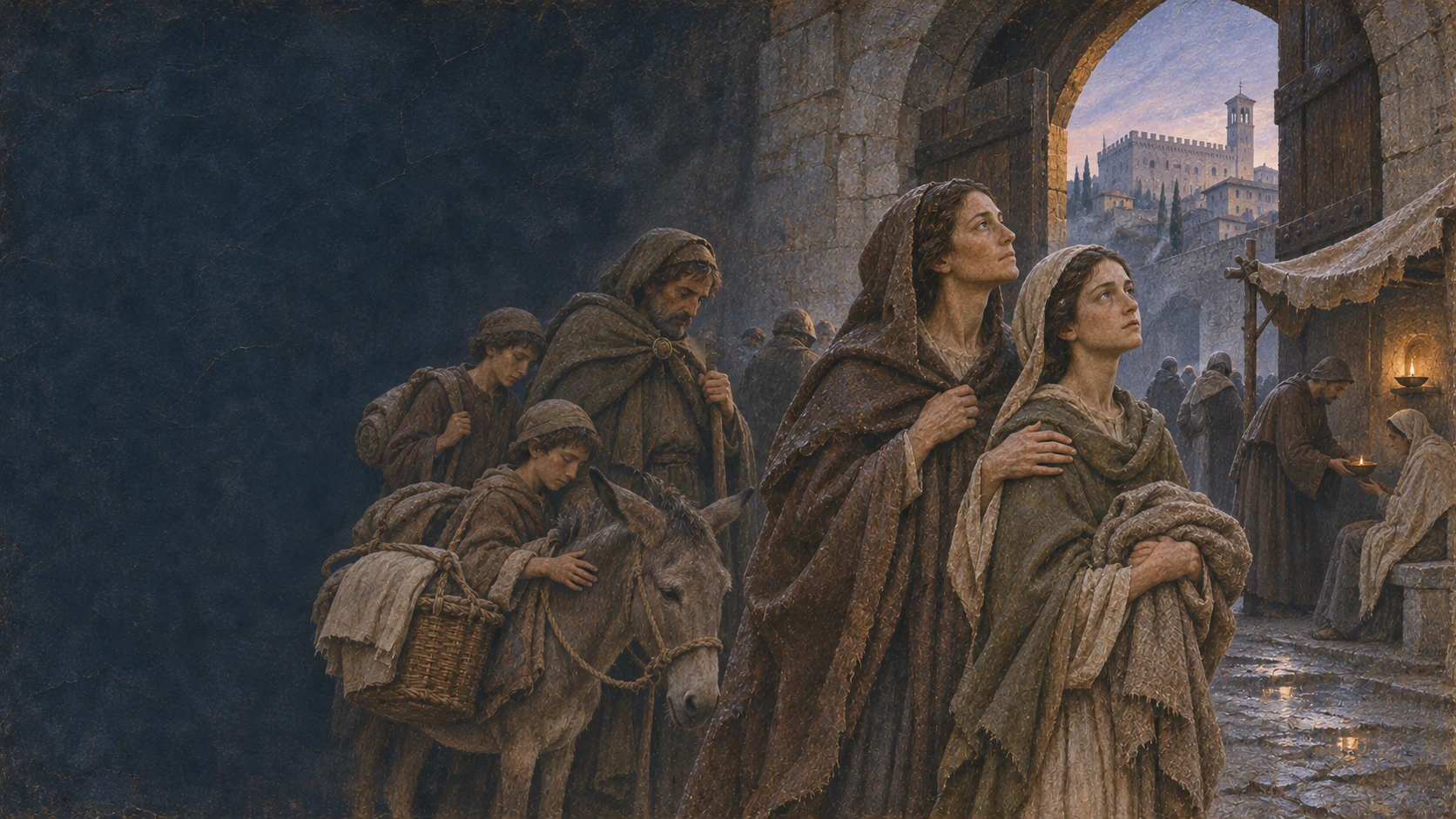
A child learns early the path between the bed and the door. He knows where the light enters, which step creaks and from which window the valley can be seen. Then, one morning, the adults say you have to leave.
It was probably so, without the clarity that the books have, that Clare left Assisi. The communal revolt had reached the noble families. The Offreduccio sought protection in Perugia, a powerful and rival city. Clare spent part of her childhood or adolescence away from the house in which she was born.
Why Perugia
Perugia was within reach, but it belonged to another political camp. There the exiled nobles of Assisi could find relatives, allies and security. They were not refugees without resources. An aristocratic network offered shelter. Still, leaving the city itself meant depending on the hospitality of others and expecting changes that no one controlled.
Sources do not say where Clare lived. Historians propose family connections and noble environments. It is likely that life probably still included servants, prayers, domestic learning and preparation for marriage. It would be wrong to imagine absolute misery. It would also be wrong to call that a comfortable journey.
Exile changes the position of a person. In Assisi, the surname opened doors. In Perugia, the family was a guest and part of a political problem coming from outside.
The town on the other side
In 1202, Assisi went to war with Perugia. The battle of Collestrada ended with the defeat of the Assisians and the capture of combatants, among them Francis. While he endured imprisonment, Clare may have been within the walls of the victorious city.
“Could” is an important word. We have no record that places her before the prisoners, nor any reason to suppose that she knew the name of Pietro Bernardone’s son. Any encounter would be invention. However, historical proximity reveals the complexity of that world: two lives that would then converge were then separated by class, city and war.
For Clare, the victory of Perugia did not simply mean victory. Her hometown had lost; her family allies had won. Exiles live this kind of division. Security and longing can point to opposite sides.
What a girl learns without choosing
We do not know what exact age Clare was when leaving, because even her birth year is given as from 1193 to 1194. She was young enough to be formed by displacement. She learned that walls do not guarantee permanence and that a powerful family may need to flee.
This experience does not alone explain her vocation. Many children have gone through conflicts and have not founded religious communities. But exile could make some concrete questions: what remains when a house is lost? Who are we when titles do not control the day? What is the point of accumulating if a dispute obliges a family to leave everything?
These questions are our formulations. Clare did not write them at that time. Later, however, she would choose a life without property and call Christ a mirror in which one sees poverty, humility and love. Experience does not prove choice but offers its human ground.
Women on the move
We often imagine medieval women always immobile. Ortolana, Clare’s mother, made pilgrimages to Rome, Gargano and the Holy Land. Exile took her daughters out of Assisi. Bona de Guelfuccio would accompany Clare in discreet encounters. Women’s lives faced strict limits, but they were not motionless.
Travel depended on protection and social position. A noble girl did not walk free and alone in Italy. She moved as part of an extended household: relatives, servants, animals, luggage, alliances. Her mobility was real and watched at the same time.
In the image of this chapter, Ortolana puts her hand on Clare’s shoulder. We do not know if this gesture happened. It represents a probable function: in strange territory, the women of the family helped to maintain continuity, prayer, food, clothing and memory.
An education away from home
There is no school curriculum of Clare. The Legend describes her as pious from she was little, generous with the poor and inclined to prayer. Hagiographies often show the adult holiness already present in childhood; therefore they should be read with respect and literary attention.
A young woman of her class could learn prayers, psalms, tasks of domestic administration, sewing and expected behaviors of a future noble wife. Scholars debate how much Latin Clare knew. Her later writings reveal biblical and theological culture, but were produced in a community environment, with liturgy, preachers and possible writing assistants.
Perugia could also enlarge her world. In a larger city, she would hear other accents, news and devotions. Again, we do not have a documented scene. What we can say is that medieval formation took place through coexistence, not just through books.
Returning does not erase the departure
Covenants between Assisi groups gradually allowed the return of the exiles. The family probably returned in the early years of the thirteenth century. The house could be repaired; the experience could not.
Returning does not mean resuming exactly what existed. Political relations had changed. The commune had gained strength. Nobles needed to negotiate their place. Clare returned older, approaching the age at which marriage and inheritance would become urgent decisions.
Tradition says that she refused marriage proposals. The Process preserves testimony about her will to remain a virgin and serve God. We do not know how many proposals there were or what was said in every family conversation. We know that the direction of her life began to conflict with the expected future.
Exile and poverty are not the same
It is important not to confuse imposed suffering with chosen poverty. In exile, the family wanted to regain security and property. In San Damiano, Clare would voluntarily defend the renunciation of communal property. One experience is not a copy of the other.
Nor should we romanticize the loss. Those who are expelled from home need not be grateful for the lesson. Displacement can leave fear and wounds. Clare’s greatness would not be in finding it beautiful to lose, but in transforming the perception of frailty into a freedom that did not depend on having.
When she asked the pope for the Privilege of Poverty, she was not playing with vulnerability. She knew that material security was valuable. Precisely for this reason her insistence was radical and required concrete networks of care.
What silence teaches the historian
The Clarian sources were written to remember a saint, confirm virtues and guide a community. They were not produced to answer all the questions of a modern biography. Exile appears more as context than as a story narrated in detail.
This chapter therefore keeps five layers visible. Political documents show the conflict. Academic research reconstructs the displacement. Hagiography presents a holy youth. Testimony speaks of the conduct remembered decades later. Art and narrative give form to what is likely, announcing its limits.
This discipline does not cool the story. On the contrary: it prevents us from replacing Clare with a character created to satisfy our desire for perfect scenes.
Learn to live another way
Years later, Clare would leave Assisi again, this time by her own decision. She would pass through San Paolo delle Abbadesse and Sant’Angelo di Panzo until arriving in San Damiano. The childhood exile had been a flight with the family; the adult exit would be a break with the expectations of the family.
In both cases there was a door, a road and an uncertain house, but the second journey had an inner direction that was hers.
Perhaps exile had taught her that a house can be lost. San Damiano would teach that a house can also be created, not with towers to protect a name, but with a rule, a poor table and women who called each other sisters.
Perugia was not only an interval before the “true” life. It was one of the places that made Clare know the instability of the world. When she returned to Assisi, the city was the same hillside. The young woman who looked upon it was no longer the same girl.
Incomplete maps
Sources for this chapter
- Clarian SourcesOld sources. Allow you to check out what Process and Legend say — and don't say — about youth.
- Process of CanonizationTestimony. Keeps memories of relatives and companions, collected in 1253.
- Basilica of Saint Clare — historical profileLocal synthesis. Presents family chronology, exile and return with prudence.
- Guide to St. ClareDocumental corpus. Gather translations and bibliography to compare traditions.
- Letter for the Year of ClareOfficial reception. Summarize the context of exile in Perugia and the youth of Clare.
- The Cambridge Companion to Francis of AssisiAcademic context. Situation war, communes and the generation of Francis and Clare.
- Le social recruitment des ClarissesSocial history. Examines the aristocratic networks of the first sisters.
Level of certainty: exile is historically sustained; home, itinerary, maternal gestures and thoughts are declared reconstructions.