
Before Clare spoke to Francis, she heard of him.
Assisi was not large enough to hide for long the story of the son of a merchant who had returned his clothes to his father, cared for lepers, repaired churches and walked with companions dressed in poor clothing. Each person may have told it differently: madness, shame, holiness, courage.
We don’t know who first spoke Francis. name to Clare for the first time. Silence is precious. It prevents us from turning a process of discernment into an invented romantic scene.
The man the town was talking about
Francis was about twelve years older than Clare. His conversion had already taken shape when she approached him. He had gone through war, imprisonment, illness and conflict with his father. He gathered brothers and sought ecclesial approval for a life according to the Gospel.
Francis’ first biographies relate these episodes with hagiographic intent. They organize his life to show God’s action. Documents such as the Rule and the Testament bring us closer to their own voice, although they are also religious texts, not diaries.
Clare probably knew a mixture of fact and rumor. Some saw the brothers as sincere penitents; others could consider them irresponsible. They preached peace in a city that had learned to respond with weapons. They called themselves minors in a world attentive to honor.
Clare’s reputation
The meeting did not begin with an empty young woman waiting for a master to give her a destination. Witnesses in the Process recalled that Clare already prayed, fasted and shared food with the poor. Bona de Guelfuccio said she was secretly bringing food prepared by Clare.
These memories were given forty years later, in a process of canonization. They seek to demonstrate holiness from youth, a common pattern. Still, they come from women who knew her. They must be heard critically, not discarded.
The Legend states that Francis heard about Clare’s virtuous fame and wished to guide her. Thus, the ancient tradition describes mutual attention: she knew of his path; he knew of her desire. This is very different from affirming hidden passion.
How preaching reached her
Preaching took place in churches, squares and paths. Even if Clare was not present, words traveled. A maid could repeat a sentence. A relative returned indignant. A woman might say that the brothers had helped someone. The city was a network of voices.
In the noble house, the information passed through filters. Young women had supervised circulation. Listening to a preacher did not mean getting permission to meet him. So reliable companions would be important.
There is no reason to imagine Clare hiding behind every column where Francis spoke. The image of an indirect listening is more faithful to the social limits and gaps of the sources.
The Gospel gained feet
Clare knew stories about Jesus. What could surprise her was to see them translated into local choices: to touch those who all avoided, to work with their hands, not to carry weapons, not to accumulate money, to announce peace.
Francis did not invent the search for poverty. There were penitential movements, hermits, preachers and religious women in many cities. Some currents conflicted with the Church; others found recognized forms. Franciscan novelty was born within this larger field.
For Clare, the issue was not just to admire a holy man. It was to find out if the same Gospel could organize the life of a woman. At that point, the path was not yet ready. Francis had brothers; Clare needed to help create a female community with her own form.
The first meetings
The old Legend says that Francis visited her and Clare was also going to find him, rarely, to avoid rumors. The Process records Bona’s help. The sources agree that there was contact before leaving home, but do not offer a complete chronology or transcript of the conversations.
We can assume that they spoke of conversion, virginity, poverty and how she might leave the house. To suppose is not to quote. The exact language escapes. Clare’s later texts show that her understanding was not reduced to repeating Francis. She would develop her own images: mirror, mother, sister, bride, path, and choice.
There was also a difference in power. Francis was an adult man and a religious leader; Clare was young under family authority. Recognizing this does not diminish friendship. It helps to see the relationship without idealization. True discernment needed to make Clare more responsible for her choice, no less.
No invented romance
Modern culture likes to transform closeness between a man and a woman into romantic love. No ancient source supports a romance between Clare and Francis. Both use intense affective language because medieval spirituality did not separate love and religion from the way we sometimes do.
Denying romance does not cool the relationship. They shared trust, memory, and a demanding vision. Francis wrote to the sisters; Clare preserved her Form of Life and recalled the beginning. Spiritual friendship can be profound without being a secret marriage.
Inventing romance also steals something from Clare: it makes her decision to revolve around fascination with a man. Sources show that she chose Christ, a community, and a form of poverty. Francis was a mediator and brother, not a final destination.
The risk of hearing
For a noble young woman, admiring poverty had consequences. Her body, marriage, and inheritance were linked to family strategy. Refusing this future was not a particular taste comparable to choosing another garment. It could be understood as disobedience and loss of honor for the whole house.
Clare did not immediately announce her plans. Discretion does not prove shame. It may show prudence in the face of a predictable conflict. Bona accompanied her. Bishop Guido appears in tradition. The friars prepared to receive her. The personal decision needed a small network.
Listening to Francis meant testing whether words could become life. Clare did not leave at the first sentence that came into the ear. The time between news, encounters and Palm Sunday suggests maturing.
What Clare recognized
Years later, in the Testament attributed to her, Clare recalls that Francis prophesied the arrival of women to San Damiano and gave them a way of life. The text presents the vocation as the gift of the Father of mercies and community response.
Debates exist on the transmission and writing of some writings, but the memory of origin is consistent: Francis had decisive importance, and the women received a vocation that they then had to keep.
Perhaps Clare recognized in him not a model to copy in every detail, but proof that the social order was not destiny. The merchant’s son could become a lesser brother. The Offreduccio’s daughter could refuse the planned marriage. The Gospel could gain female feet.
The scene we don’t own
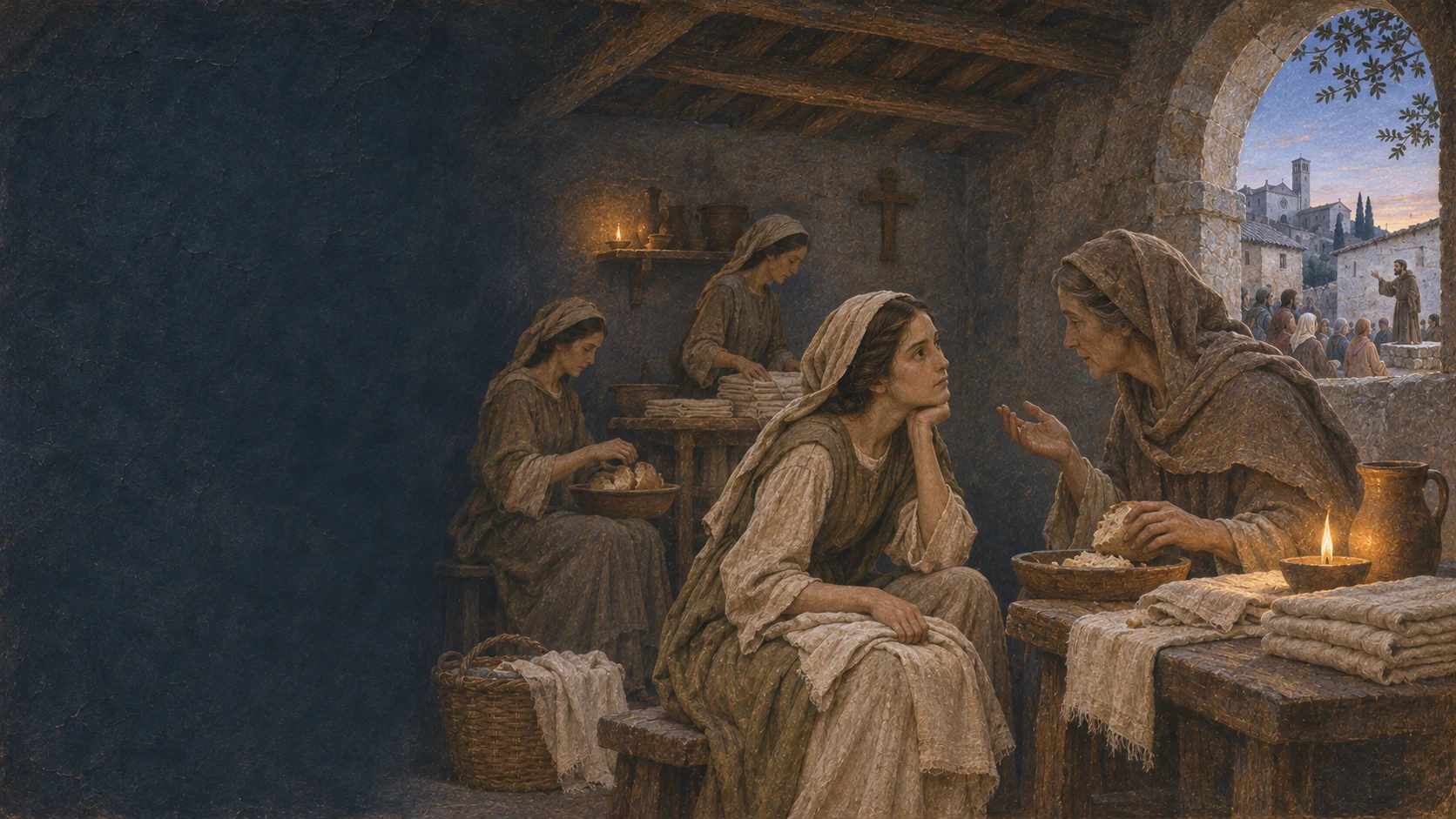
Our art shows Clare listening to a woman while Francis appears small, in the distance. He does not dominate the image. Among them there is bread, linen, other women and a wall. This recalls that the vocation arrived through a lifetime, not a magical look.
Perhaps the news came from a church, perhaps from Bona, perhaps from a relative who disapproved, we don’t know, uncertainty brings us closer to a human truth: decisive events often begin in conversations that no one thought to record.
Clare kept the news until it became a question, then she took the question to Francis, and when the night came to answer, she was the one who walked through the door.
Discernment was more than feeling
In Christian language, discernment means testing a desire: to observe its fruits, to listen to advice and to see whether it endures over time. Clare did not have a ready-made manual for her community. She needed to gather inner desire, the biblical word, guidance from Francis and some protection from the bishop.
This process explains the discretion of the first encounters. Silence was not an absence of thought. It was the space in which a will could mature before facing forces greater than it.
Voices checked
Sources for this chapter
- Process of CanonizationPrimary testimony. Bona and other women remember youth, charity and contacts.
- Clarian SourcesCorpus. Allows you to compare Process, Legend, Rule, Testament and Blessing.
- Guide to St. ClareDocuments and translations. Gather the relevant old texts.
- Writings of St. FrancisFranciscan voice. Offers the writings of Francis, distinct from later biographies.
- Letter for the Year of ClareOfficial synthesis. Narrates the meeting without reducing Clare to a passive disciple.
- The Cambridge Companion to Francis of AssisiAcademic research. Contextualizes conversion, preaching and penitential movements.
- A Companion to Clare of AssisiClarian studies. Analyzes agency, sources and relationship with Francis.
Level of certainty: contacts and advice belong to old memory; the first news, the messenger and the scenario are unknown.