
Assisi sat on a hillside, but inside its walls there were worlds in shock. Up above were fortified houses of noble families. Down below grew workshops, markets and the political strength of merchants and artisans. All heard the same bells. Not all agreed to obey the same people.
Clare was born into a noble family just when this balance began to collapse. Her childhood did not happen in a still city of postcard. Assisi of her first memory was a commune in formation: proud, restless and capable of violence.
The fall of an ancient power
Assisi was part of the territory linked to imperial power. In 1198, at a time of political change, inhabitants of the city attacked the imperial fortress, the Rocca. The action was not only against stones. It was a statement that the urban community intended to rule.
Then came attacks on the towers and houses of the nobles. Medieval towers served as defense, housing and demonstration of power. To overthrow them meant to weaken families that had dominated the territory for generations.
The Offreduccio, Clare’s relatives, belonged to this group. The ancient Legend presents her father as a knight and her household as noble. Historical studies link the family to the aristocratic environment affected by the revolt. We do not have a complete list of all that the family lost nor an account of anyone writing: “Clare saw this”. We must separate the documented event from the probable experience.
The maiores and the minores
Medieval sources employ words such as maiores and minores. They do not correspond perfectly to “rich” and “poor” but indicate differences in position. The maiores were associated with aristocratic power; the minores included urban groups that sought participation and protection.
Francis would later use the word “minor” for his brothers. It was not a neutral name. He chose to place himself among those who did not want to dominate. Clare would call her companions poor sisters and defend their right not to live from landed estates.
It would be easy to turn these choices into an automatic explanation: “they saw the class war and so they chose poverty.” Life does not work as an account. Faith, encounter, character, and circumstances mingle. Still, when Clare heard of humility, she knew how social greatness could hurt.
The fear inside the houses
A public revolt changes the private daily life. Doors are reinforced. Foods are saved. News arrives by the voice of servants, relatives and travelers. Children realize fear before understanding their motives.
We can imagine Clare hearing hurried steps in a hallway or adults talking low. This is reconstruction, not document. What we know is that her family left Assisi and sought security in Perugia, like other noble families. The displacement indicates that the danger was real enough to leave the house.
Nor should we tell only the pain of the nobles. The revolt was not born out of nothing. For a long time, aristocratic families controlled lands, obligations and violence. The inhabitants of the commune wanted another arrangement. An honest story supports the two truths: an unjust order could be contested, and the challenge could hurt people.
The battle that came after
In 1202, forces of Assisi and Perugia faced each other in Collesstrada. Francis, a young man from a merchant family who longed for knightly honor, fought for the side of Assisi and was captured. Clare, probably living with relatives exiled in Perugia, was linked to the other side of the division by her family.
This coincidence seems like ready romance: two young people in opposite camps who would then create a form of peace. But the sources do not say that they met then. We should not invent looks through the battlefield. The historical value is elsewhere: both were formed by the same urban wound from different social places.
Francis lived in prison and sickness. Clare lived in dislocation and family dependence. When they met years later, none of them needed an abstract class on pride, weapons or instability.
Peace is not decoration
In the stories of saints, “peace” may sound like a golden word written about blue sky. In Assisi, peace meant preventing revenge, accepting limits and rebuilding coexistence among people who had reason to distrust each other.
Francis greeted “the Lord give you peace.” Clare would close her blessing by asking the Lord to be with her sisters always. These words came from people who knew tense streets, fragile alliances and wounded families.
Franciscan peace is not pretending that conflict does not exist. It is refusing that the last word belongs to force. It helps to understand why poverty had public sense. Whoever renounces to rise on the other decreases one of the causes of violence.
Clare’s social place
Clare was not born outside the structures she later questioned. She received religious education and protection thanks to a privileged house. She had relatives, servants and marriage expectations. When she chose to leave, she took with her abilities learned in this world: discipline, knowledge of social relations and perhaps some familiarity with domestic administration.
She did not erase her origin. She transformed what she would do with it. At San Damiano, her authority should not function as a manor tower. The Rule she wrote calls the person responsible for the community of mother and servant of the sisters; it requires advice and care. The practice is never perfect, but the direction is clear.
Read Clare just as “princess who became poor” also deceives. Her family was not royalty, and religious poverty was not a fantasy chosen by a bored young woman. It implied losing protection, planned marriage, usable inheritance and recognized position.
What the documents leave unsaid
We don’t have Clare’s childhood diary. The Process of Canonization focuses on her holiness, miracles and later community life. The Legend organizes youth as providential preparation for holiness. Communal documents speak of powers, pacts and lands, not the fear of a girl.
That’s why we work with layers. Political document confirms the divided city. Ancient Hagiography preserves family origin. Witnesses recall Clare’s conduct. Tradition expands certain images. Narrative reconstruction brings these layers together without pretending to be evidence.
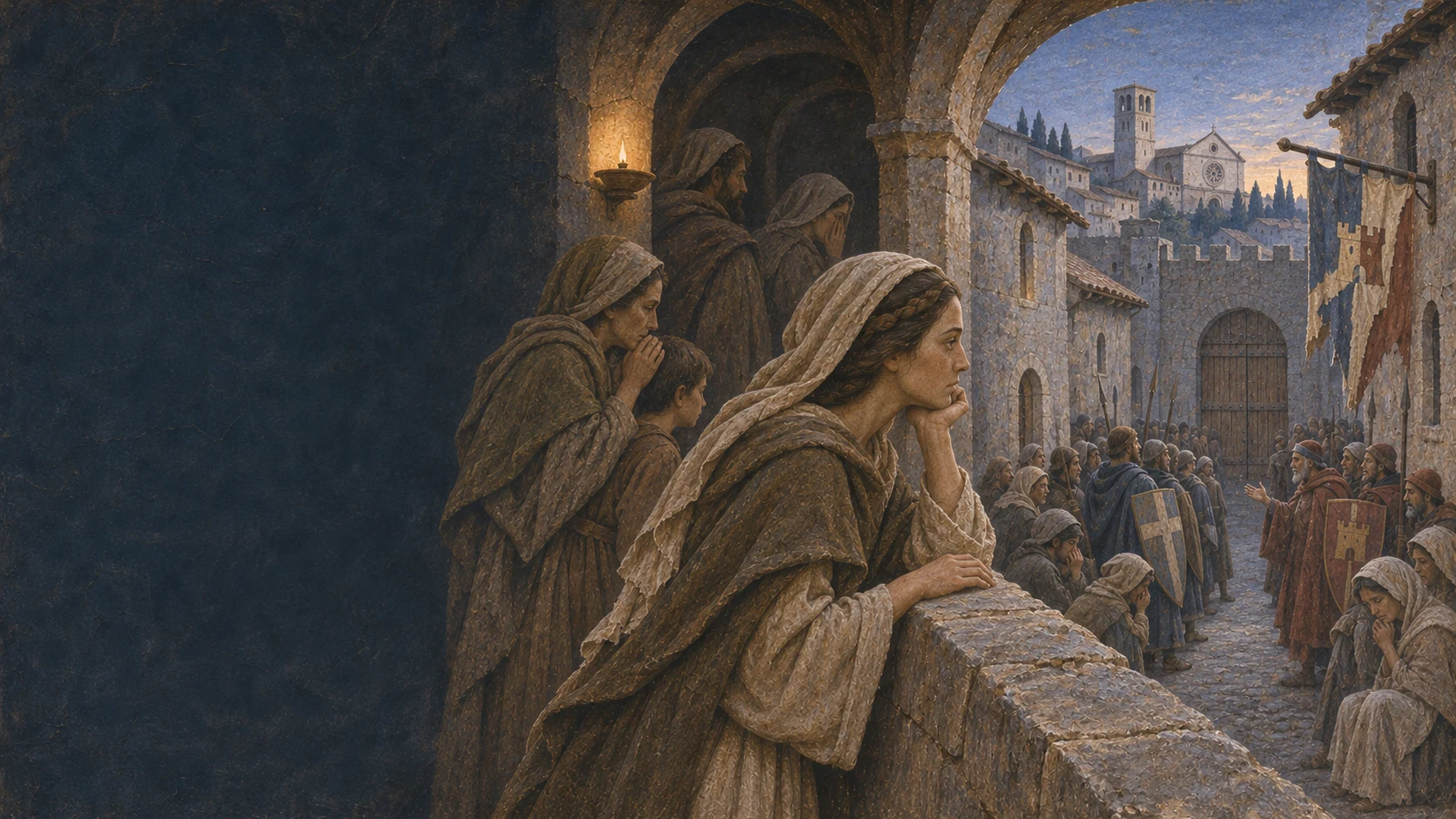
In the art of this chapter, Clare observes two groups. Maybe she never saw exactly that scene. But she lived its consequences. In the background, shields recall the confrontation; near her, women and children gather. War does not just happen where swords cross. It enters homes.
A city she wouldn’t abandon
Clare left the family home, but did not abandon Assisi. San Damiano was outside the walls and within the life of the city. The sisters depended on alms, external brothers, workers, priests and local relations. Decades later, witnesses would say that Clare prayed when enemy forces threatened the place and the city itself.
These later episodes have hagiographic language and will be carefully examined. Nevertheless, they show how the Clarian memory understood its vocation: not escape from the world, but an unarmed way to remain before it.
The noble girl saw a city try to free itself and also destroy. The exiled girl returned to a city still marked by sides. The woman of San Damiano built a small community where greatness should mean serving.
Assisi would remain imperfect. Clare also belonged to the tensions of her time. But within a broken city, she learned that a door could open to another kind of power.
The wound continued after the deal
Treaties can order returns and recognize authorities; they do not erase memories. Families who lost towers and inhabitants who suffered domination continued to divide streets, churches and markets. Clare returned to a city where peace needed to be practiced every day.
San Damiano would not be left out of this story. By calling women “sisters” and insisting that the responsible one serve, the community offered a small response to the hierarchies that had left Assisi. He did not eliminate inequalities at once, but refused to make them the ideal.
stones and testimonies
Sources for this chapter
- Clarian SourcesPrimary corpus. Gather Process, Legend and writings to distinguish family memory from historical reconstruction.
- Process of CanonizationTestimonies. Registers what the sisters remembered, but does not narrate a chronic childhood policy.
- Guide to St. ClareDocuments. Offers translations and references of the ancient Clarian corpus.
- Letter for the Year of ClareOfficial synthesis. Places Clare's youth in conflict between major and minor.
- The Cambridge Companion to Francis of AssisiAcademic research. Contextualizes commune, war and identity of Minors.
- Le social recruitment des ClarissesSocial history. Helps to understand the aristocracy, kinship and entry of the first women.
Level of certainty: revolt, exile and war belong to documented history; Clare's thoughts, position and vision in art are reconstructions.