
A lead seal is small, heavy, and cold. Fastened by cords to a parchment, it declared that those words were not merely private counsel. They had received the authority of a pope.
On 29 November 1223, Honorius III issued the bull Solet annuere and confirmed the Rule of the Friars Minor. For that reason the text is called the Later Rule, or the Bullated Rule. It was not “filled with bulls”; it came with a bulla, the official seal.
The original document is still kept in Assisi at the Sacro Convento. This is a rare closeness: before it, we stand not only before a late copy but before the medieval parchment connected to the act of approval.
The Rule has twelve chapters. It is much shorter than the Earlier Rule of 1221. Its sentences are organized more clearly to guide an Order that had already crossed national borders. Yet the opening preserves its whole heart: to observe the holy Gospel of Jesus Christ, living in obedience, without anything of one’s own, and in chastity.
What came before 1223
The Rule did not begin that November. In the Testament, Francis recalls a simple and brief form presented to the pope when the first brothers were few. Directions and decisions then grew into the extensive Earlier Rule, completed in 1221.
Only two years later, the more compact text of 1223 emerged. We possess no diary recording every stage of revision. The early biographies say that Francis withdrew to compose the Rule and mention the collaboration of Cardinal Ugolino, protector of the fraternity and future Gregory IX. Scholars debate how much came directly from Francis, how much arose from the brothers’ gatherings, and how much was shaped with the help of specialists close to the pope.
A balanced conclusion is possible: the Rule is genuinely Franciscan and was received as the law of life of Francis and his fraternity. At the same time, it was prepared and approved with the help of others; it was not born from one man writing alone.
Tradition connects its composition with Fonte Colombo in the Rieti Valley. The sanctuary preserves that memory. The narrative details, however, come from accounts written later. They should be called tradition, not minutes of a meeting.
Who may enter
The second chapter concerns candidates. Ministers are to examine their Catholic faith and family circumstances. Those able to dispose of their possessions should sell them and seek to distribute the proceeds to the poor. The brothers should not interfere with how the distribution is made.
After a period of probation, the candidate would receive the habit and profess the life. The Rule declares that after profession he would not be permitted to leave the fraternity, in keeping with the Gospel saying about the one who puts a hand to the plough and looks back.
Religious formation today follows more developed norms, and the Church has legal instruments that did not exist in the same form in 1223. We should not use one isolated medieval sentence to explain all present discipline. In the Rule it shows the seriousness of the promise: entering was not a trial of different clothes for a few months.
Francis also warns the brothers not to despise those who wear coloured clothing or eat delicate foods. A poor habit gives no one permission to judge a neighbor’s heart.
Feet on the road and brief words
Clerical brothers were to pray the Divine Office according to the practice of the Roman Church; lay brothers would say a prescribed number of Our Fathers. They would fast during certain periods. As they went through the world, they were not to quarrel, judge others, or answer harshly. They were to be gentle, peaceful, modest, and humble.
On entering a house, they were first to wish it peace. They could eat the food set before them.
These directions seem simple, but they mattered for traveling religious. A friar entering a village could be mistaken for a suspect preacher, beggar, or agitator. His conduct preached before his words did.
No brother was to preach against the forms and regulations of the Church or without his minister’s permission. Sermons were to be considered, brief, and useful. The Rule supplies no ready-made speeches. It asks for words capable of leading to virtue and penance.
Work without ownership
Chapter 5 directs the brothers whom the Lord has given the grace to work to do so faithfully and devotedly, so that work does not extinguish the spirit of prayer and prayer does not become an excuse for abandoning work.
They could receive necessities as payment, but not coins or money. The sentence tries to sustain two goods at once: a brother does not live idly, and he does not accumulate financial security.
It is easy to admire this from a distance. In practice, a growing Order needed to buy, build, study, and travel. The Rule states the ideal clearly; later legal interpretations would try to organize how things could be used without being owned individually or communally.
The debate does not prove that Francis had already been defeated in his lifetime. It shows that an absolute promise enters situations filled with details. The text does not answer every future question, but it establishes the direction.
“Nothing of their own”
Chapter 6 contains perhaps the best-known passage. The brothers are not to appropriate a house, place, or anything else. As pilgrims and strangers, they are to serve the Lord in poverty and humility and beg alms with confidence, without shame, because Christ made himself poor.
Fraternity follows immediately: wherever they are, they should show themselves to be members of one family. One brother may express his need; another should care for him. If a mother loves and feeds her child, how much more should a brother love his spiritual companion?
Poverty is not left alone. Without fraternity, “owning nothing” could become abandonment. The Rule places care beside detachment.
When someone falls ill, the others must serve him. The brother is not a logistical problem. He is part of the promise.
Penance that does not arise from anger
If a brother commits a serious sin, the Rule directs him to approach the ministers and receive guidance. The ministers must avoid anger and disturbance, for those reactions obstruct charity in themselves and in others.
The expression appears elsewhere in Franciscan writings. Francis knows that a person in authority can use another’s error to feel righteous. He does not remove responsibility; he tries to prevent discipline from being governed by the pride of the one correcting.
The text also forbids the brothers to slander, quarrel, and judge. Fraternity was not to turn rumour into government.
This is as contemporary as it is medieval. A community may possess a perfect rule and be destroyed by words cast into its corridors.
Ministers, chapters, and succession
An international Order needs to know who cares for whom. The Rule provides for the election of a minister general and permits the provincial ministers to choose another if they judge that the person elected does not serve the common good.
It also tells the ministers to meet in chapter by the church of Saint Mary of the Portiuncula. Regular gatherings held distant regions together in a time without rapid communication.
The text preserves a beautiful tension: authority is real, but the minister is called a servant. He may be replaced. Government does not become personal property.
Chapter 10 tells ministers to visit and correct humbly, imposing nothing contrary to a brother’s soul or to the Rule. It asks the brothers to desire above all the Spirit of the Lord and the Spirit’s holy activity, to pray with a pure heart, and to have humility, patience, and love even for those who persecute them.
In the middle of an institutional norm, the priority becomes invisible again: the Spirit at work in the heart.
Mission and obedience to the Church
Anyone wishing to go among Muslims and other non-Christians needed the provincial minister’s permission, and the minister was to assess his suitability. The Rule of 1223 is briefer than that of 1221 and does not repeat the earlier two forms of presence. Mission now appears within a process of being sent.
In the final chapter, the minister general is to ask the pope for a cardinal protector to govern, correct, and protect the fraternity. The brothers wish to remain subject to the Roman Church and firm in the Catholic faith.
This may seem at odds with Francis’s wish not to seek privileges. But protection and privilege are not exactly the same. The fraternity needed a stable relationship with the Church. Tensions would arise over how far that protection could go.
We need not resolve eight centuries of debate in one sentence. The Rule itself preserves both sides: Friars Minor with nothing of their own, and a recognized, commissioned, and protected Order.
The parchment that survived
The bull opens with a papal formula and includes the Rule. Its name, Solet annuere, comes from its first Latin words, as was customary. The seal attached to the document confirmed its authenticity and authority.
The original preserved in Assisi has been studied and digitised. Conservation projects allow us to examine parchment, script, cords, and seal without turning the object into an imaginary relic. It is both a legal document and a material witness.
Many medieval copies also exist, since every fraternity needed to know the Rule. Scribes could introduce small variants, and critical editions compare witnesses. Here, the original provides an exceptional anchor.
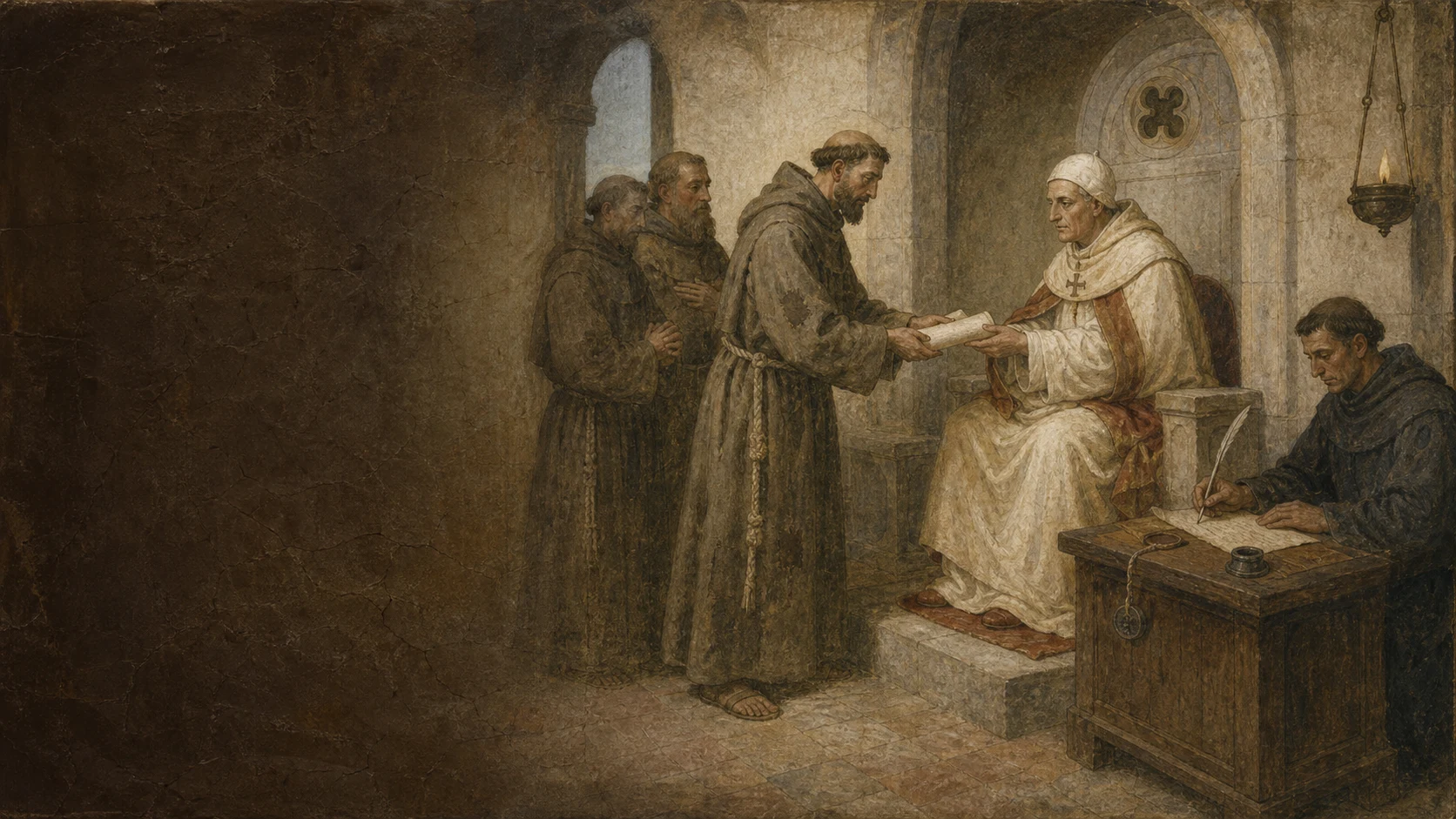
The scene of Francis personally handing a scroll to the pope is an artistic synthesis. We know that Honorius III approved the text and that Francis was alive. We do not possess an eyewitness description of a ceremony with those positions, that notary, and that room.
The seal and the footprints
A papal bull could have turned the fraternity into a machine concerned only with outward obedience. The Rule tries to prevent this. It speaks of law, election, and permission, but continues to ask for peace, work, care of the sick, and desire for the Spirit.
The seal does not make life easy. It makes the promise public.
After 1223, friars continued to disagree about poverty, houses, books, and money. Popes interpreted passages. Groups argued until they broke apart. None of this erases the moment when a barefoot fraternity received a recognized form capable of crossing time.
The lead remained attached to the parchment. Yet the Rule never wanted the heart to become leaden. Its center remained light and demanding: to live the Gospel as Friars Minor.
The sealed parchment
Sources for this manuscript
- Francis of Assisi and the Regula Bullata — ScriniumDocument and conservation. Presents the original preserved at the Sacro Convento and the project studying its physical features.
- Felice Accrocca — “Francesco e la conferma del signor Papa,” L’Osservatore RomanoVatican study. Places the confirmation by Honorius III and the text of Solet annuere in context.
- Later Rule — Capuchins of Rio Grande do SulText in Portuguese. Introduces the preserved original and provides access to the twelve chapters.
- Celebrating the Rule 1223–2023 — Order of Friars MinorOfficial Franciscan interpretation. Presents the Rule as a communal form of living the Gospel.
- Blastic, Hammond, and Hellmann — The Writings of Francis of AssisiTextual study. Examines the Later Rule in relation to the Earlier Rule, its authorship, and transmission.
- Felipe Augusto Ribeiro — The Construction of Norms in the Franciscan Movement, USPAcademic research in Portuguese. Analyses how an evangelical form became a religious and legal norm.
How we read this chapter: the date, the confirming pope, the text, and the existence of the original are documented facts. The precise composition process and the contribution of each collaborator cannot be measured. Fonte Colombo belongs to the early tradition of composition. The painted ceremony is a visual synthesis, not a reconstruction from eyewitness testimony.