
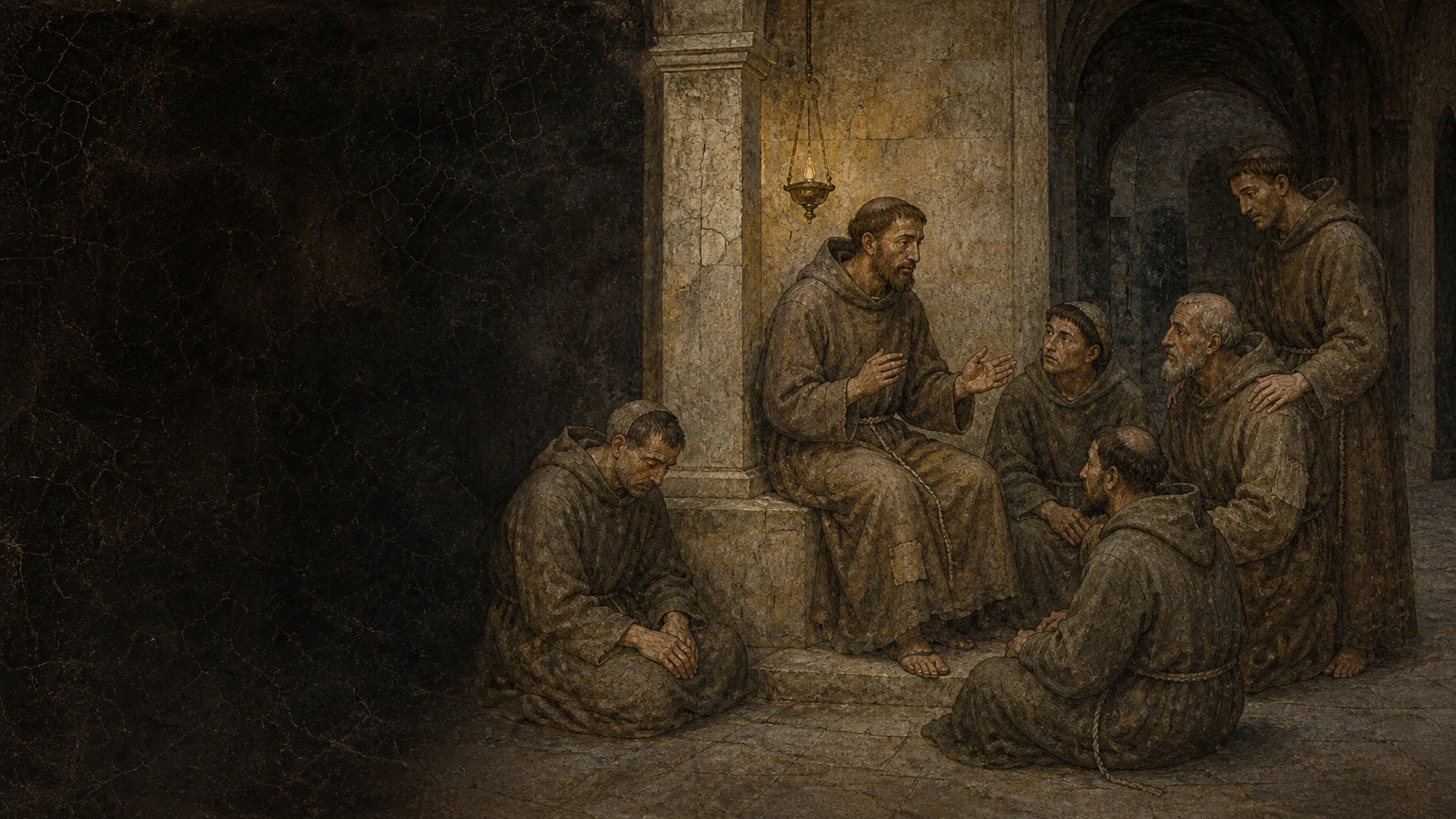
Imagine a room with no board, rows of chairs, or textbook. Several brothers sit on the floor. One has returned angry from an assignment. Another wants admiration because he prays well. A minister needs to correct without humiliating. Francis speaks, perhaps briefly, and his words continue working after the gathering ends.
We do not know whether the Admonitions arose in exactly this way. The collection provides no dates, places, or listeners’ names. It gathers twenty-eight short teachings attributed to Francis and accepted as an authentic part of his writings.
Some seem like prepared meditations. Others take the form of a beatitude: “Blessed is the servant…” Several may preserve directions spoken at chapters of the friars. They were probably recorded by secretaries or listeners and then collected. Yet we possess no recording, autograph, or account of each occasion.
“Admonition” does not mean an angry scolding. It carries the idea of reminding, warning, and guiding. Francis tries to place a lamp before those parts of the heart that we prefer to leave in darkness.
Twenty-eight pieces, not one speech
Modern editions number the Admonitions from 1 to 28. This order helps readers, but it does not prove that Francis delivered them in sequence one afternoon. The collection was probably formed from separate teachings.
Their lengths vary. The first is long and contemplates the Body of Christ. Some have only a few lines. The last describes virtues that drive out vices: where there are charity and wisdom, there are neither fear nor ignorance; where there is poverty with joy, there is no greed; where there are mercy and discernment, there are neither excess nor harshness.
The whole resembles less a school treatise than a notebook of stones gathered on different journeys. Each fits in the hand. Together, they have weight.
Scholars observe that several Admonitions use biblical language and patterns like those in Francis’s other writings. The early manuscript tradition and this closeness support their authenticity. That does not mean we can identify Francis’s precise handwriting in every line: medieval authorship could include speech, dictation, listeners’ memory, and compilation.
Seeing the invisible in the humble
The first Admonition begins with Jesus’ words: whoever sees the Son sees the Father. Francis reflects on the disciples, who saw Christ’s humanity but recognized his divinity by faith. He then brings this mystery close to the Eucharist.
The Lord, he says, comes daily in a humble appearance. As he descended from the Father’s bosom into Mary’s womb, he gives himself under a simple form. Bodily eyes see bread and wine; faith recognises the Body and Blood of Christ.
The text does not attempt to explain all medieval Eucharistic theology. It offers a spiritual comparison: God need not look powerful in order to be present. Anyone who recognises greatness only when it shines may miss Christ when he makes himself small.
This is a key to the other Admonitions. Francis distrusts the heart that seeks appearances: to seem wise, holy, obedient, or patient. Truth is often hidden where no one applauds it.
The will that wants to possess
The second Admonition reads the story of Adam as appropriation of one’s own will. Eating the forbidden fruit appears not merely as desire for food, but as an attempt to make the will an absolute possession.
Francis uses “appropriating” in many senses. A brother may own no coins and still cling possessively to an idea, an office, or the glory of a good work. He may turn even a gift from God into a personal trophy.
Admonition 5 asks why anyone boasts. Human beings were created by God, and Christ himself gave himself for them. Gifts, intelligence, and beauty did not begin in us. The only possible boast would be to carry the cross of Jesus each day.
This does not tell us to hate our talents. It teaches gratitude. A child who draws well may rejoice and practice. The danger begins when the drawing becomes a way to declare that others are worth less.
The book that did not reach life
In Admonition 7, Francis speaks of those who know words but do not wish to follow the spirit of Scripture. They seek knowledge in order to be admired or to gather wealth for relatives. The problem is not study. It is keeping the letter as an object of prestige.
In the next Admonition, he calls blessed the one who keeps no good for oneself but returns it to God. Even literacy can be received as service.
This nuance matters. Some readings have turned Francis into an enemy of books. Yet his writings quote the Bible constantly and show respect for divine words. He opposes knowledge that rises to the head but never descends to the hands.
An illuminated manuscript may be costly, take months to make, and be beautiful. It still feeds no one if it serves only to prove its owner’s importance.
The test of patience
It is easy to believe we are patient when everyone agrees with us. Admonition 13 offers a test: a person does not know how much patience and humility they possess while everything happens as desired. When contradiction comes, the real measure is revealed.
Francis does not say that suffering injustice is always good or that a victim should remain in danger. He speaks to brothers who want to know themselves. Opposition removes the mask.
Admonition 11 addresses the person angered by another’s sin. If someone stores up rage because of another’s fault, that person appropriates guilt and disturbance. This does not forbid protecting someone who has been harmed or correcting abuse. It forbids using another’s evil to nourish evil within oneself.
There is a difference between firmness and fury. Firmness seeks truth and reparation. Fury may seek only to win.
Peace that does not depend on silence around us
“Blessed are the peacemakers” appears in Admonition 15. Francis interprets the peacemaker as one who, for love of Christ, preserves peace in heart and body despite what is suffered in the world.
This does not describe an unfeeling person. Franciscan peace is not never crying, never trembling, or never asking for help. It means not handing the heart’s direction over to hatred.
Admonition 14 examines poverty of spirit. Someone may pray much and practice penance, yet become disturbed by a single word that seems insulting. That disturbance reveals a possession still being guarded: personal reputation.
The teaching is demanding because it reaches an invisible possession. Someone may give away a coat and fiercely protect the image of being a perfect person.
Envying a gift touches its source
Admonition 8 says that envying the good God accomplishes in a brother comes close to offending God, the author of every good.
Francis shifts the comparison. If another person sings better, cares more patiently, or understands a difficult passage, their gift does not diminish ours. It is a different window through which the same light enters.
Envy wants to close a neighbor’s window so that our room looks brighter. The result is darkness for everyone.
Other teachings warn against the servant who wants to place himself above others and the person who takes pride in an office. For Francis, becoming a minister is not moving upward. It is accepting the task of washing feet.
This language comes from the Gospel and the fraternity’s experience. As groups grow, offices begin to look like steps. The Admonitions cut those steps away at the root.
Obeying when no one is watching
Several Admonitions concern obedience. Perfect obedience is not carrying out easy orders to receive praise. Nor is it obeying something contrary to conscience and the Rule. Francis recognises that a command may be one that a person should not fulfil; in that case, the brother must bear the consequences without abandoning love.
This passage prevents us from understanding obedience as blindness. The brother does not become an object. He remains responsible before God.
At the same time, Francis distrusts the person who calls every preference “conscience.” Humility requires listening and accepting that another may see something we do not.
Admonition 20 blesses the one who bears with a frail brother as he would wish to be borne with. The hardest obedience may not concern an extraordinary order. It may be the daily space given to someone slow, ill, or repetitive.
The secret that need not be displayed
Admonition 21 calls blessed the person who remains as humble when praised as when considered simple and despised. Admonition 23 praises one found as humble among subordinates as among superiors.
These teachings dismantle holiness performed on a stage. If goodness disappears when no important person is watching, perhaps it was a performance.
Another piece praises the servant who keeps God’s secrets in the heart and does not hurry to make them known in search of reward. Francis does not despise witness. He warns against turning every intimate experience into an advertisement for oneself.
In today’s world of constant exposure, the sentence sounds new. Some things grow better in darkness, like a seed beneath the earth.
How the words crossed time
We do not possess the original notebook of the Admonitions. They survive in Franciscan manuscripts, including some very early copies. Assisi Codex 338 holds an important place in the transmission of the writings, although it is a volume composed of units from different periods.
A published study of an early manuscript of the Admonitions showed how new witnesses can still help us understand the collection’s formation and circulation. Comparing manuscripts allows editors to correct copying errors and notice variants.
The modern order and titles may not have belonged to a collection organized directly by Francis. The core, however, is recognized as his teaching. Historical caution does not cool the voice; it prevents us from claiming more than the pages allow.
The artwork for this chapter imagines Francis speaking in a cloister. He may well have taught brothers in similar spaces. We do not know where he spoke each piece, who was present, or whether some began as speech and others as dictation.
The lamp before the heart
The Admonitions do not offer a list of the sins of “bad people.” They speak to religious people capable of hiding pride within prayer, envy within the defense of truth, and vanity within poverty.
That is why they remain uncomfortable. Readers cannot stand outside and point at characters. Each sentence moves the lamp to another corner: how do I react when contradicted? Do another person’s gifts make me glad? Do I serve in the same way when no one sees? Do I seek knowledge to love, or to appear greater?
Francis does not end in despair. The last Admonition gathers luminous pairs: love and wisdom, patience and humility, poverty and joy, quiet and meditation, mercy and discernment. Virtues are not ornaments. When they enter, they drive out what destroys.
The cloister stone remains cold. The brothers must still return to their tasks. But a small light has been kindled where no audience can reach.
The small windows
Sources for this manuscript
- Admonitions of Saint Francis — VaticanComplete text. Presents the twenty-eight teachings in sequence.
- Admonitions — Capuchins of Rio Grande do SulText in Portuguese. Introduces the collection and provides access to each separate piece.
- Francis of Assisi: Early Documents, volume 1Franciscan academic edition. Offers a critical translation and context for the writings.
- Michael J. P. Robson — “An Early Manuscript of the Admonitions”Manuscript study. Examines an early witness, the nature of the collection, and its transmission.
- Blastic, Hammond, and Hellmann — The Writings of Francis of AssisiTextual study. Discusses the Admonitions’ authorship, literary form, and manuscript tradition.
- C. Knowles — The Writings of St Francis of AssisiAcademic research. Places the collection within the principal Franciscan codices.
How we read this chapter: the twenty-eight Admonitions are accepted as an authentic collection of Francis’s teachings. We do not know the date, place, listener, or form of recording for each piece. The lesson in the cloister is a contemplative image. Applications to present situations are pastoral explanations, not words attributed literally to the medieval text.