
Before the seal, there was the road.
One brother returned from a town where he had been poorly received. Another needed to know how to work without accepting money. A third wished to cross the sea and live among Muslims. There were sick brothers, tired ministers, new companions, and disputes that the small fraternity of the early years had never imagined facing.
The Earlier Rule was born in this moving world. It does not read like a law written all at once at a silent desk. Its twenty-four chapters preserve layers: words from the Gospel, practical directions, long prayers, and responses to accumulated experience.
The Latin name Regula non bullata means a rule “without a bull,” that is, one not confirmed by a solemn papal document bearing a seal. The name is later; the brothers of 1221 had no need to call it that, because the Later Rule of 1223 did not yet exist.
A short form that grew
In the Testament, Francis recalls that when the Lord gave him brothers, he had a form of life according to the Gospel written simply and briefly. The pope confirmed it. This event is usually dated around 1209–1210 and associated with an oral approval by Innocent III.
The original short text has not survived. Some Gospel verses and portions of the later rules may preserve its heart, but it cannot be reconstructed word for word with certainty.
Over the years, the fraternity grew. Decisions made at annual chapters and teachings of Francis were gathered together. In 1221, at the great Pentecost chapter near the Portiuncula, the process reached the long form we know as the Earlier Rule.
This explains why its authorship must be presented carefully. Francis stands at the center of the text, and his voice is strong. Yet this was not necessarily an individual work composed by him alone from beginning to end. The ministers general of the Franciscan family describe it as a text born in dialogue with the friars and with life.
A rule that still breathes conversation
As we read, we notice changes of tone. Some chapters resemble instructions: how to receive new brothers, how to dress, how to choose ministers. Others bring together biblical passages. Chapter 23 becomes a great prayer of praise and thanksgiving. The last asks the brothers to learn and remember the meaning of the written life.
This variety is not a flaw. It lets us see the workshop before the walls were smoothed.
In chapter 5, the ministers are to visit and admonish the brothers humbly. The others are to obey in matters concerning salvation that do not contradict the life they have professed. Then comes a striking sentence: through the charity of the Spirit, they should willingly serve and obey one another.
Obedience does not flow only downward from a superior. It runs among brothers like shared water.
The text then forbids anyone to be called “prior.” All are to be called Friars Minor. “Minor” does not mean that a person is worth less. It means choosing not to take first place.
Money that could not come in
The Rule strictly forbids accepting coins or money, directly or through an intermediary. In the medieval world, this was radical. Coins bought food, paid for transport, rented space, and met emergencies.
The text tries to prevent the fraternity from building its security on financial reserves. Spiritual friends could help with the needs of the sick and with clothing, but the brothers were not to receive money.
We should not imagine a simple, identical application in every region. As the Order spread, travel, study, and care became harder to arrange. Later debates about intermediaries, the use of goods, and ownership arose precisely from this tension.
The Rule is not a portrait of romantic poverty. It lets us feel the real risk of depending on others. It also asks the brothers to work without extinguishing the spirit of prayer and devotion.
Sitting with those the world avoids
Chapter 9 directs the brothers to rejoice when they live among people regarded as worthless and despised: the poor, the weak, the sick, people affected by leprosy, and beggars by the roadside.
These words connect with the beginning of the Testament. Francis does not want his experience of mercy to remain the private memory of a saint. He wants the fraternity to keep choosing companionship where society chooses distance.
Today we should not repeat medieval labels as though a person were their illness. We can, however, hear the question: whom does no one want to sit beside? The Rule pushes the brothers toward that place.
It also tells them not to judge those who wear fine clothes or eat delicate food. Poverty must not become a new form of superiority. A patched habit can hide pride as great as that beneath luxurious clothing.
When a brother falls ill
If a brother becomes sick, the others are to serve him as they would wish to be served. The sentence is short and overturns any spirituality that admires suffering from a distance.
Even a poor group must provide care. Someone fetches water, prepares food, and stays awake. The Rule gives no medical manual. It establishes a measure: imagine yourself in the sick person’s place.
It also asks that no one become angry or disturbed because of another person’s sin. Anger and agitation can obstruct love. This does not eliminate correction. It prevents the person correcting another from turning someone else’s fault into fuel for personal vanity.
This concern appears in other writings, especially the Letter to a Minister. Its repetition suggests a central concern of Francis, not a decorative phrase.
Two ways of going among other peoples
Chapter 16 concerns brothers who wished to go “among Saracens and other unbelievers,” medieval Christian language for Muslims and other non-Christians. The vocabulary belongs to its period and need not be repeated today as an insult.
The text proposes two forms of presence. First, they should not enter disputes, but remain subject to every human creature for God’s sake and confess that they are Christians. Second, when they perceived that it pleased the Lord, they could proclaim the faith.
The order matters: before speaking, live without quarrelling or seeking dominance. The Rule was completed after Francis traveled to Egypt in 1219. His experience among Christians and Muslims may have influenced this chapter, but we have no note from Francis explaining exactly how each sentence arose. The historical connection is plausible; the details are reconstruction.
The Gospel stitched into parchment
Few writings of Francis contain so many biblical quotations. The chapters on mission gather Jesus’ words when sending disciples. Other passages draw on the apostolic letters. The text does not use the Bible merely to decorate a decision already made; it builds decisions out of biblical words.
This also explains some repetition. A modern reader might want to cut sentences. For the brothers, repeating the Gospel meant remaining under a voice greater than their own.
In chapter 22, a long arrangement of passages warns against a hardened heart. In chapter 23, legal language gives way to praise: God is the fullness of good, all good, the true and supreme good. The fraternity that debated clothing, money, and travel ends on its knees.
A rule made only of prohibitions would produce fear. Francis wants desire for God to remain at its center.
Why did it not receive a papal bull?
To say that the Earlier Rule was “rejected” by the pope is too simple. We possess no document of rejection from 1221. We know only that it did not receive the sealed papal approval later given to the text of 1223.
Because it was long, filled with biblical quotations, and written partly as counsel, it may have been difficult to use as the common law of an Order spread across several countries. During the next two years, another, shorter and more organized text was prepared. Cardinal Ugolino, the future Gregory IX, is often associated with this work, but we do not know precisely how much he contributed.
The Rule of 1223 did not erase that of 1221. The later text became the professed norm; the earlier one remained a precious witness to the formation of the charism.
It is like comparing the notebook of a long journey with the map finally handed to travelers. The map is clearer. The notebook preserves rain, encounters, and questions that explain why the road took that direction.
The copies that remained
The original of 1221 has disappeared. The Rule came down through manuscripts and early compilations. Modern studies compare these witnesses as well as small fragments of earlier forms preserved in other works.
Some passages have variants, especially where texts were copied or incorporated in different ways. That does not make the work a late invention. It shows the normal—and sometimes complicated—work of medieval transmission.
When an edition presents neatly ordered chapters and numbers, we should be grateful to scribes and editors while remembering that Francis did not hold our printed book. He lived in a world of costly sheets, reading aloud, and communal memory.
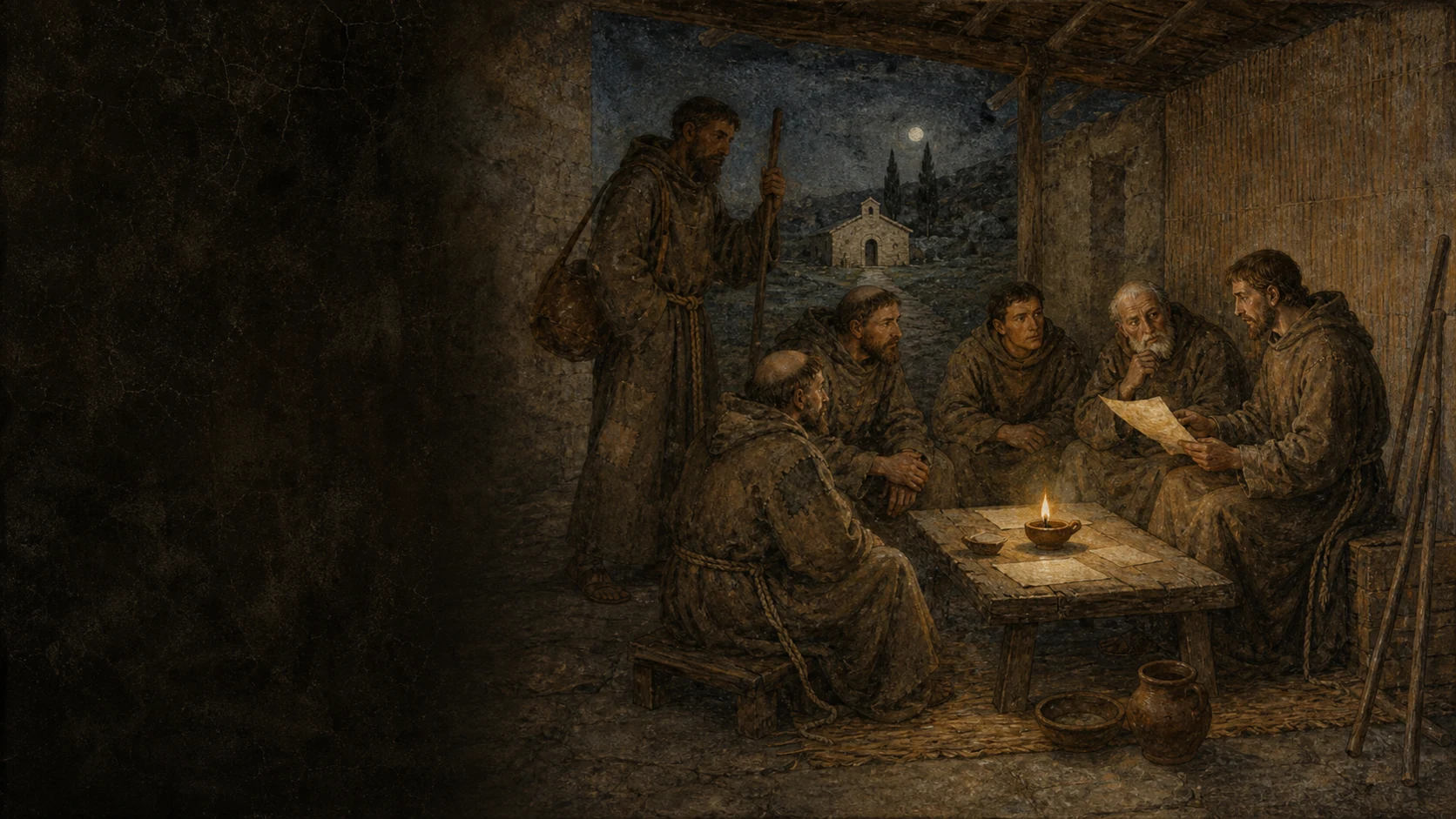
The image of brothers gathered by night around a lamp represents this communal character. It does not claim that a particular meeting occurred with those six people or in that shelter.
The text before the seal
The Earlier Rule is long because life had grown large. It had to speak of ministers, work, illness, mission, food, preaching, and chapters. Even so, its question fits into one sentence: how can people follow the footprints of Jesus without turning the fraternity into a possession?
The document does not offer a perfect Middle Ages. It shows conflicts, a need for correction, and fear of money. That is precisely why it is alive. Rules become necessary when real people disagree, fall ill, and grow tired.
At the end, Francis does not tell the brothers to admire the text. He asks them to learn its substance and meaning for the salvation of their souls and to put it into practice with simplicity.
The seal has not yet arrived. The ink still carries dust from the road. Perhaps that is why, eight centuries later, we can almost hear the brothers breathing between one sentence and the next.
Pages before the seal
Sources for this manuscript
- “To Live and Follow” — Ministers General of the Franciscan FamilyOfficial Franciscan interpretation. Explains the communal composition, the year 1221, and the Rule’s central themes.
- Earlier Rule — Capuchins of Rio Grande do SulText in Portuguese. Introduces the work and provides access to its chapters.
- Blastic, Hammond, and Hellmann — The Writings of Francis of AssisiTextual study. Discusses the Rule’s formation, manuscripts, fragments, authorship, and genre.
- Acta Ordinis Fratrum Minorum, 2020Document of the Order. Publishes material for the eighth centenary and its historical and spiritual interpretation.
- Jacques Dalarun — “Lesser Brothers I: Writings by and about Francis”Academic study. Places the Rule within the development of the fraternity and its government.
- Felipe Augusto Ribeiro — The Construction of Norms in the Franciscan Movement, USPResearch in Portuguese. Analyses the transition among the forms of life, the two Rules, and the Testament.
How we read this chapter: the Rule of 1221 is authentic and decisively associated with Francis, but it resulted from a communal process rather than a single night of writing. The short form of 1209–1210 and the 1221 original have been lost. There is no evidence of a formal papal rejection; we state only that the text did not receive a bull. The nocturnal gathering in the artwork is a contemplative synthesis of this process.