
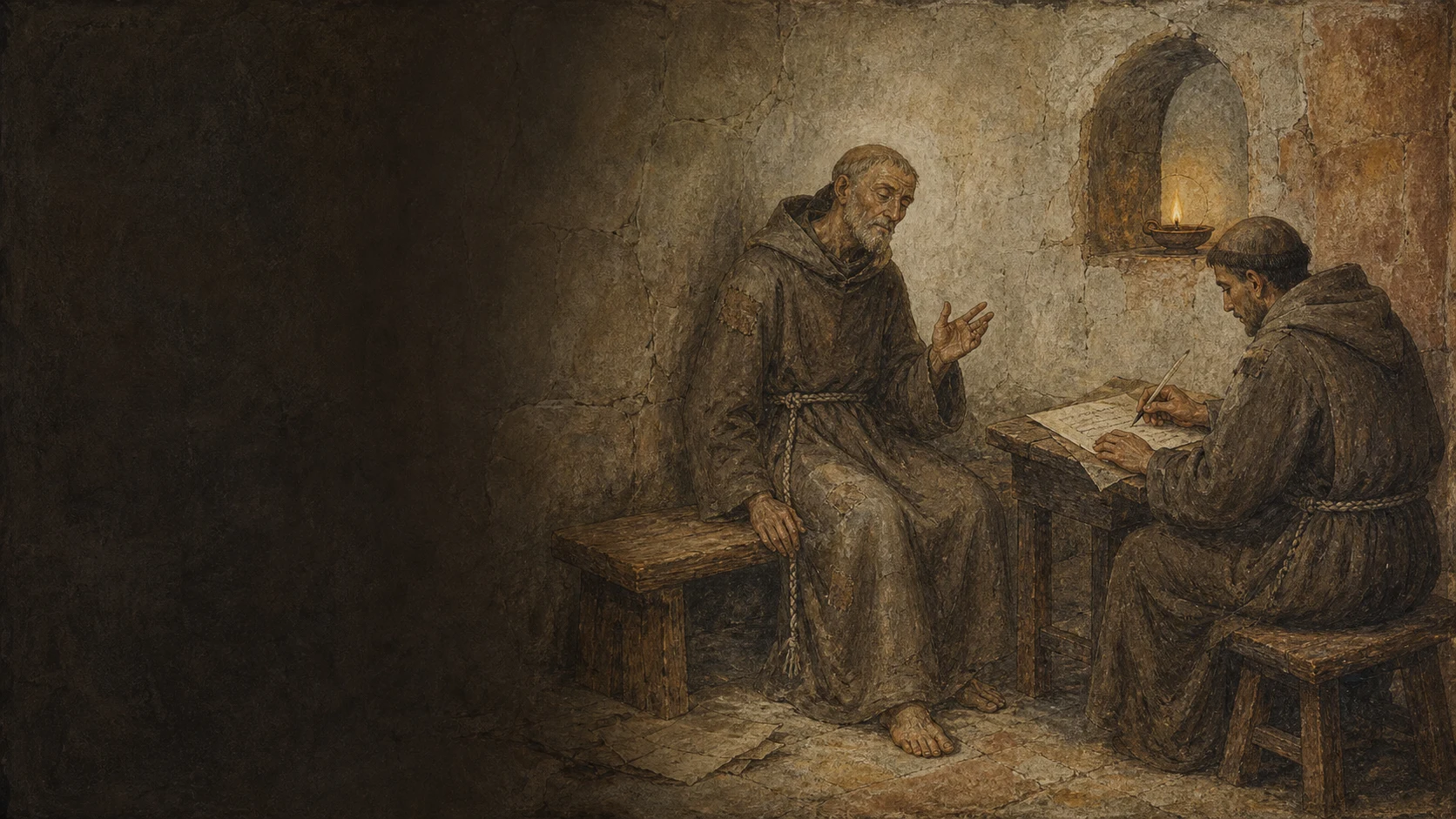
At the end of his life, Francis does not begin by recounting his successes.
He does not speak first of the crowds who heard him, the friars’ journeys, or the approval received from the pope. He returns to an uncomfortable memory: when he was living “in sins,” the sight of people affected by leprosy seemed bitter to him. Then, he says, the Lord led him among them. Francis showed mercy. When he left them, what had seemed bitter had changed into sweetness for body and soul.
This is how the Testament begins. A few lines open a doorway into Francis’s memory. He is very ill, nearly blind, and close to death in 1226. He does not write a complete biography. He chooses moments that he wants to place once more before the brothers.
The text is authentic. Scholars recognize it as one of Francis’s writings, although he probably dictated it to a secretary, as happened with other medieval documents. The original parchment has not reached us. What we read was preserved in manuscripts copied later.
A remembrance, not a complete autobiography
The Testament does not tell us where Francis was born, who his parents were, or how many brothers entered the fraternity. Nor does it narrate several famous scenes, such as the voice of the San Damiano Crucifix, the wolf of Gubbio, or the crib at Greccio.
This does not automatically make those traditions false. It shows only that the Testament has another purpose. Francis chooses events that explain how he understood his vocation: mercy among people with leprosy, faith in churches, reverence for priests and the Eucharist, the gift of the brothers, and the discovery of a life according to the Gospel.
As he tells these things, he repeats that the Lord gave them to him. The Lord gave him the beginning of a life of penance. Gave him faith. Gave him brothers. Revealed to him a greeting of peace. Francis does not paint himself as the solitary inventor of a great work. He presents himself as someone who received and tried to respond.
For a twelve-year-old reader, it is like opening a grandfather’s final letter and discovering that he did not place medals at the center of the table. He placed the names of those who taught him to love.
Poor churches and the Body of Christ
Francis recalls the faith he received in churches. He records a short prayer before them: to adore Christ in his churches and bless him because by the cross he redeemed the world. He also declares profound respect for priests, even if some were sinners.
This passage must be read in its period. At the beginning of the thirteenth century, religious movements severely criticised the clergy, and some broke with the Church’s sacraments. Francis could see failures, but he refused to turn a priest’s imperfection into an excuse for despising the Eucharist.
He also speaks of the reverence due to God’s names and words when found in unsuitable places. He asks that they be gathered up and kept. For him, a written fragment was not rubbish when it carried holy words.
We should not invent a scene in which Francis travels through every church collecting sheets. The text gives a direction, not a diary of every action. But it reveals a world in which parchment was scarce, reading was a privilege, and a copied word could be treated as an object of care.
“The Lord gave me brothers”
Then comes one of the most important sentences in all Franciscan history: the Lord gave him brothers.
Francis says that no one showed him what he should do. The Most High revealed to him that he should live “according to the form of the holy Gospel.” He had that form written simply and briefly, and the pope confirmed it.
This first text is usually called the form of life or Primitive Rule, associated with the journey of Francis and his companions to Rome around 1209–1210. We do not possess its original. We cannot simply say that the Earlier Rule of 1221 is an exact copy of it. The Testament confirms that there was a brief formulation and papal approval, while early biographies complete the setting with details written later.
The center, however, is clear: the fraternity did not begin as an association created by strategy. In Francis’s memory, the companions arrived as gift and responsibility.
Small houses, poor tables
Francis recalls that the first brothers were content with a patched tunic, cord, and simple clothing. They prayed the office according to their state; clerics had liturgical books, while lay brothers prayed the Our Father. They were subject to everyone and sought poor churches and dwellings.
He insists that the brothers not accept churches, dwellings, or other buildings that do not accord with promised poverty. They are to remain as guests, pilgrims, and strangers.
This language is not a photograph of every Franciscan house in 1226. The Order had already grown, crossed borders, and encountered needs for study, government, and housing. Precisely for this reason the Testament sounds urgent. Francis looks to the beginning to recall the criterion he did not want to lose.
His memory is not gentle nostalgia. It is a question addressed to the mature fraternity: do you still recognize the poverty you promised?
The hands that worked
The Testament dispels a caricature. Francis does not present poverty as laziness. He says that he worked with his hands and wanted to work. He asks capable brothers to perform honest labor and those who do not know how to learn—not out of ambition for payment, but to give a good example and avoid idleness.
If wages were not given, the brothers could have recourse to the Lord’s table, begging alms from door to door. Begging does not appear as a trick for avoiding effort. It is the last resort of those who work without possessing guarantees.
Here the voice seems concrete: tired hands, simple tools, the risk of lacking bread. The text does not say what work Francis was doing at that moment. Biographies connect his beginnings with rebuilding churches, but the Testament speaks generally. We should not fill the silence with invented certainty.
No letters of protection
A severe passage directs the brothers not to seek documents from the Roman Curia to secure churches, places, or preaching privileges, even under the pretext of persecution. If they were not received, they were to go to another land and do penance with God’s blessing.
This command reveals a real tension. The fraternity already needed to relate to bishops, cities, and authorities. Papal documents could protect the friars, but also change their position: someone who possesses a powerful letter may cease to appear lesser before the person who rejects him.
After Francis’s death, the legal force of these words would be debated. In 1230 Gregory IX’s bull Quo elongati declared that the friars were not bound by the Testament’s command as though it were new legislation, because Francis could not impose an obligation without the ministers’ consent. This did not declare the text false or useless. It determined its legal place within the Order.
The distinctions matter: Francis truly wrote the prohibition; the later papal interpretation truly limited its legal force; the long disputes over poverty belong to the history of the text’s reception.
“Do not say: this is another Rule”
Francis knew that someone might ask whether he was creating a new Rule. He answers that he was not. He calls the writing a remembrance, admonition, exhortation, and testament. Its purpose was to help the brothers observe more faithfully in a Catholic manner the Rule they had already promised.
He asks that the Testament be kept beside the Rule and read at chapters. He also commands that no one add glosses saying, “This is to be understood in this way.” A gloss was an explanation placed beside a text. Francis’s fear seems clear: an explanation might make the words easier at precisely the point where they wounded.
This does not mean that all study is disobedience. Today we need ancient languages, manuscript comparison, and history in order to understand what words meant. The very existence of copies with small variants requires critical work. The warning is against explanations used to escape commitment, not against all exercise of intelligence.
How the voice reached us
We do not have a sheet in Francis’s handwriting. The Testament was transmitted in collections of Franciscan writings and alongside legal or biographical texts. Important witnesses include Codex 338 in the Library of the Sacro Convento in Assisi, a complex medieval compilation made from parts copied at different times.
Copyists were not recording machines. They could change spelling, reverse a word, or repeat a line. Editors therefore compare manuscripts. When many independent witnesses preserve the same core, we can approach the early text securely without pretending to possess the original.
The Testament’s authenticity is widely accepted. The precise scene of its composition—the place, secretary, hour, and sequence of dictation—cannot be reconstructed with equal certainty. It may have grown over the final months. The image of Francis speaking by lamplight is contemplative art, not reportage.
The voice that returns to the beginning
At the end, Francis offers a blessing to those who observe these things. He calls himself “little brother Francis” and servant. The voice that could demand a statue chooses to make itself small.
The Testament endured because it preserves something rare: not only rules about clothing, houses, and work, but the way Francis organized his own memory. He found the beginning not in a brilliant idea, but in a person he had previously wished to avoid. He found fraternity not as an achievement, but as a gift. He found security not in privileges, but in the peace of one who can leave.
The original parchment disappeared. Places changed. Disputes grew. Yet the first sentence still waits for the reader at the door.
Francis’s journey began when his feet were led where his heart did not wish to go. There mercy transformed the bitter into sweetness.
The voice preserved
Sources for this manuscript
- Testament of Saint Francis — Order of Friars MinorOfficial Franciscan text. Presents the complete document and its declared purpose.
- Testament PDF — OFM General CuriaEdition of the text. Allows readers to follow its sequence and traditional sentence references.
- Francis of Assisi: Early Documents, volume 1Franciscan academic edition. Translation, introductions, and notes on Francis’s writings.
- Gregory IX, Quo elongati (1230) — CapDoxEarly legal reception. Explains why the Testament was not treated as a new binding Rule.
- Michael W. Blastic, Jay M. Hammond, and J. A. Wayne Hellmann — The Writings of Francis of AssisiTextual study. Examines authorship, genre, manuscripts, and transmission of the principal writings.
- Felipe Augusto Ribeiro — The Construction of Norms in the Franciscan Movement, USPAcademic research in Portuguese. Studies the Rules, Testament, and legal disputes through the fourteenth century.
How we read this chapter: the Testament is accepted as an authentic writing by Francis, probably dictated. Its memories of people with leprosy, the brothers, work, and the Rule come from the text itself. The lamplit setting and precise form of dictation are artistic reconstructions. The loss of the original and transmission through manuscripts are stated so that a medieval copy is not confused with an autograph.