According to a very early tradition, the Canticle was born not on a comfortable morning, but close to darkness.
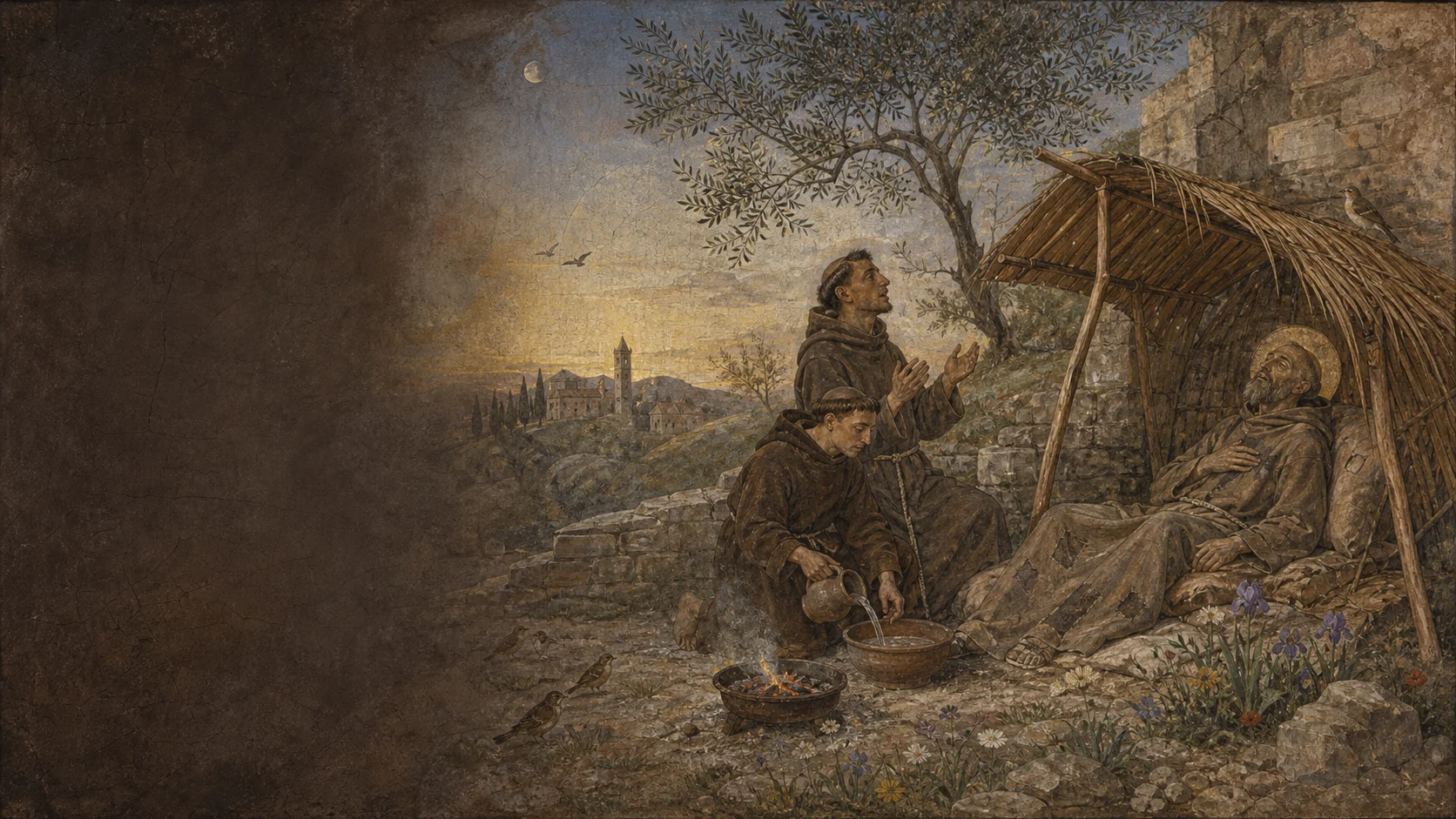
Francis was gravely ill at San Damiano. His eyes hurt; light could wound him. A near-contemporary Franciscan source relates that he spent weeks in a small hut or cell, also tormented by mice. The narrative describes suffering and, within it, a certainty that God had not abandoned him.
Then came the song.
Not in Latin, the language of books, liturgy, and scholars. Francis composed in his Umbrian vernacular, the speech of the people in his region. The opening still sounds across eight centuries: Altissimu, onnipotente, bon Signore. Most High, almighty, good Lord.
Then the household of the universe opens: Brother Sun, Sister Moon, Brother Wind, Sister Water, Brother Fire, and Sister Mother Earth. Later come those who forgive, those who endure illness and tribulation, and finally Sister Bodily Death.
This is not a cheerful list that forgot pain. It is praise that learned to sing within pain.
One of the beginnings of Italian literature
The Canticle is sometimes called “the first text in Italian.” Without qualification, that claim is too strong. Earlier vernacular texts exist, or have disputed dates, and “Italian” was still a group of regional forms of speech rather than a standardised language.
It is safer to say that the Canticle is one of the earliest foundational works of Italian literature and one of the first major vernacular texts with a known author. Its linguistic importance is immense.
The earliest surviving manuscript is Assisi Codex 338, from the thirteenth century. On folios 33 and 34, the scribe recorded the poem. Above its opening, space was left for musical notation. The lines intended for the melody remained empty.
That silence on the parchment is a fascinating loss. The sources say there was singing; the codex prepared a place for it; but the original music did not reach us in writing. Present melodies are later creations. Anyone singing today continues the story without being able to reconstruct with certainty the sound Francis heard.
Praised “for,” “through,” or “with” the creatures?
Each stanza repeats an Umbrian expression resembling Laudato si’, mi Signore, per… The little word per permits more than one nuance. God may be praised because of the creatures, through them, or with them.
Translations must choose, and no choice by itself carries the full richness. Francis is not praying to the Sun, Moon, or Earth. Praise is directed to the Most High. Creatures are not gods. They are kin because they come from the same Creator.
Calling the Sun brother does not mean that the Sun is human. It means that it is not our absolute property. Water is sister before it is a commodity. Earth is sister and mother: beside us as a creature, and sustaining us with fruits and flowers.
This double relationship prevents two errors. The first would be worshipping nature. The second would be treating it as a storehouse with no value of its own. Francis recognises a created family turned toward God.
The Sun, the Moon, and real wind
The Sun is beautiful and radiant and bears a sign of the One who is Most High. The Moon and stars appear clear, precious, and beautiful. Wind, air, clouds, fair weather, and every kind of weather sustain creatures.
The poem does not select only a perfect day. It includes clouds and different conditions of the air. Creation is not scenery painted for our pleasure. It has rhythms we do not control.
Water is useful, humble, precious, and chaste. Four words turn something ordinary into a teacher. Useful: it serves life. Humble: it descends and takes the shape of its vessel. Precious: it cannot be replaced. Chaste: clean and transparent.
Fire is beautiful, cheerful, robust, and strong. It lights the night. Francis knows its danger—medieval cities feared fires—but the stanza contemplates the service of the flame. Domestic light overcomes a little of the darkness.
Earth produces fruits, colourful flowers, and herbs. She is not called only mother, as though above us; she is sister. This combination prevents Earth from becoming a divinity and prevents her reduction to a thing.
The family we do not own
Brothers and sisters before resources
The Canticle changes names before it changes actions. When water, fire, earth, and wind are received as kin, it becomes harder to use them without gratitude or destroy them through carelessness.
A poem written in stages?
The Assisi Compilation, a collection of memories connected with Francis’s companions, presents a story in three moments. First, the praises of the creatures are said to have arisen at San Damiano. Later, during a conflict between the bishop and the mayor of Assisi, Francis is said to have added the stanza about those who forgive and endure tribulation. Finally, as death approached, he would have added the stanza about Sister Bodily Death.
This explanation is ancient and fits the poem’s change of subject. Yet we must distinguish degrees of certainty. The Canticle’s text is authentically Franciscan and its transmission solid. The detailed narrative of stages comes from a memorial source written and transmitted by others. It is not a note from Francis dating each stanza.
Even so, the tradition contains a literary truth visible in the poem: it does not stop at natural elements. It advances toward wounded human relationships and death. Reconciled creation includes the city.
When Assisi was not at peace
The bishop and the civil ruler of Assisi are said to have entered a serious conflict. The medieval city knew disputes among powers, families, and groups. Already ill, Francis could not resolve everything by force.
According to the Compilation, he sent the brothers to sing before the opponents and added the stanza that praises God through those who forgive for God’s love and endure illness and tribulation in peace.
The source relates a moving reconciliation. We possess no municipal record transcribing the dialogue exactly as narrated. We therefore receive the episode as an early, plausible, and meaningful communal memory, not a court transcript.
The central point remains in the poem itself: praise is incomplete if the Sun is brother but the person beside us is treated as an absolute enemy. Ecology without human reconciliation would be incomplete. Human peace that destroys our common home would also be incomplete.
Forgiving does not mean pretending nothing happened. The stanza joins forgiveness with enduring tribulation. Reconciliation may cost. The Canticle offers no legal method; it offers a spiritual direction.
The sister no one wants to meet
Near the end appears Sister Bodily Death, from whom no living person can escape. It is the poem’s most unsettling expression.
Francis does not call death good in every sense or say suffering is pleasant. He distinguishes bodily death from the “second death,” biblical language for final separation from God. There is a warning: blessed are those whom death finds within the divine will; woe to those held by mortal sin.
Calling death sister removes its power to be an absolute stranger. It remains painful. According to the sources, Francis asked the brothers to sing as his own life approached its end. Kinship does not eliminate tears; it places the final passage within God’s creation.
A portal for young readers must say this gently. The stanza should not be used to tell someone “not to be sad” after a death. Francis knew tears and illness. His praise is not lack of feeling. It is trust passing through fragility.
What the manuscript shows and does not show
Codex 338 is a copy, not Francis’s autograph. Its spellings preserve very early Umbrian features. Other manuscripts, such as Vatican Latin 7650, contain variants and forms closer to other varieties of speech.
Philologists compare these witnesses to reconstruct the text. A letter can alter interpretation; modern punctuation also shapes reading. The medieval poem did not arrive with all the commas seen in current editions.
The codex shows the empty space for music, but does not prove what instrument was used, what the melody was, or how many voices sang. Biographies mention Francis’s wish that the brothers become minstrels of the Lord, singing and then inviting people to conversion. The image is beautiful; details of each performance did not survive.
It is also legendary to imagine Francis writing the Canticle alone under a tree exactly as in so many paintings. He was nearly blind and may have dictated. Tradition places the composition near San Damiano; the scene must remain humble before what is unknown.
An ancient song in the present
The Canticle gained new force in ecological discussion. Pope Francis’s encyclical Laudato si’ takes its title from the poem and recognises Earth as our common home. This contemporary use is legitimate, but we should not turn the medieval text into a manifesto written in twenty-first-century words.
Francis knew nothing of industrial climate change, plastic in the oceans, or extinction caused by modern machinery. He offers a spiritual vision preceding those problems: no creature exists only to feed our possession; gratitude, limits, and fraternity belong to our relationship with the world.
His poem also avoids a nature without people. Illness, conflict, forgiveness, and death are inside the Canticle. Caring for creation includes water and includes the person suffering beside it.
At the end, Francis asks everyone to praise, bless, thank, and serve the Lord with great humility. The song ends in service. Beauty that does not change the way we live would be only passing enchantment.
The old musical notes disappeared. Even so, the Canticle keeps singing because its structure is simple and breathable. The Sun crosses the page; water descends; fire warms; Earth produces; enemies may forgive; death is not left outside the family.
And everything begins in the voice of a man almost unable to see. The visible world was becoming painful to his eyes, but he did not cease receiving it as gift.
Voice, language, and parchment
Sources for this chapter
- BeWeb — Assisi Codex 338Earliest manuscript witness. Record for the volume preserving the Canticle on folios 33r–34r.
- Edoardo Fumagalli — text and facsimile of the CanticlePresents the Codex 338 page, its transcription, and features of the textual tradition.
- Davide Pettinari — text and language of the Laudes creaturarumPhilological study. Examines medieval Umbrian and the poem’s editorial problems.
- José Antonio Merino and collected studies — the Canticle and our common homeOpen academic article. Discusses authorship, early sources, vernacular language, and the theological reading of creatures.
- Rodney Lokaj — the Canticle and Assisi Codex 338Highlights the value of the earliest Umbrian witness and its relationship with San Damiano.
- Pope Francis — encyclical Laudato si’Official contemporary reception. Takes up the Canticle as inspiration for care of our common home.
- CapDox — writings of Saint FrancisOpen historical edition of the text, useful for comparison with the editorial tradition.
How we read this chapter: Francis’s authorship, the Umbrian language, and transmission in Codex 338 are firm. Composition in stages, the hut at San Damiano, and the civic reconciliation come from early Franciscan memories and are identified as tradition. We do not know the original melody or the precise scene of composition. The brief English phrases are our own pastoral translations.