
Fear does not mean that you have little faith. It is a warning from the body and heart. It may appear in response to a noise, a test, an illness, a change, or something that truly is not safe. Sometimes we know why. At other times, our heart races and we cannot even explain the reason.
In the Bible, people loved by God felt afraid. The disciples cried out in a storm. Peter was afraid when he saw the strength of the wind. Jesus did not wait for them to pretend to be brave before drawing near. He came to meet them and called them to courage.
Courage does not mean never feeling afraid. It means choosing the next good step even when we tremble. In some situations, that step is to breathe and continue a task. In others, it is to leave the place, call for help, tell the truth to a safe adult, or seek care. Prayer never means remaining still in the face of danger.
Francis faced his own fears. He approached people he had once avoided and traveled along unfamiliar roads. He did not become a stone without feelings. He learned to trust and recognize brothers and sisters. We too can entrust our fear to God without shame—and reach out to someone who can protect us.
Where does this prayer come from?
This is an original prayer by Portal São Francisco. It was not written by Saint Francis, and it does not replace healthcare, the protection of responsible adults, or emergency services.
Its central image comes from the Gospels: Jesus approaches the disciples amid the wind and invites them to take courage. The text is also inspired by the Christian trust that places our cares before God, who cares for every creature.
But trust is not passivity. The Catechism teaches that God’s providence includes human cooperation. This means asking for help, using our intelligence, respecting signs of danger, and protecting life. For children and adolescents, safeguarding organisations recommend turning to a trusted adult when there is violence, abuse, or danger.
This prayer therefore joins two hands: one turns toward God; the other reaches for someone able to help.
Prayer when fear comes
Jesus,
my heart is afraid.
You know what I can explain
and what still has no name.
I do not need to pretend before you.
Receive my hurried breathing,
my confused thoughts,
my restless hands,
and the desire to run away or hide.
Stay close to me now.
Remind me that feeling afraid
does not make me weak,
bad, or less loved.
If this fear comes from real danger,
show me the safe way out.
Give me a voice to call for help,
courage to tell what happened,
and responsible people who will believe me.
Do not let shame
make me keep to myself
what needs to be told.
If this fear grows within me
even when I am protected,
help me breathe slowly,
feel the ground beneath my feet,
and seek companionship.
Bring clarity to my thoughts:
I am here,
this moment will pass,
there are people who can help me.
Jesus of the storm-tossed boat,
you did not promise a life without wind,
but you drew near to your frightened friends.
Draw near to me as well.
If I need to wait,
sit with me while I wait.
If I need to speak,
open the right door.
If I need to run to a safe place,
make my steps firm.
If I need a doctor, psychologist,
teacher, family member, or authority,
help me accept this care.
I also entrust to you
the children who feel afraid in silence,
people who are threatened,
and those who live amid war, violence, or loneliness.
Move the hearts of adults
so that they listen, protect, and act.
Give me the humble courage of Francis:
not the courage to seem invincible,
but the courage to walk toward love.
When light appears,
teach me to recognize it.
When a safe hand opens,
teach me to reach for it.
Remain with me,
one step at a time.
In the name of the Father, and of the Son, and of the Holy Spirit.
Amen.
Original prayer by Portal São Francisco, inspired by the presence of Jesus amid storms and by practical care for life.
How to pray this prayer
First, ask a simple question: “Am I safe now?” If there is a fire, a threat, violence, abuse, persecution, or a risk that someone will be hurt, go to a safe place and immediately call a responsible adult or your local emergency service. If the first adult does not listen, seek another. The danger is not your fault, and you do not have to keep it secret.
If you are safe, place your feet on the ground. Look around and silently name five things you can see. Breathe in slowly and breathe out for a little longer. Then say: “Jesus, stay with me in this step.” Read the prayer without rushing.
When you finish, choose someone to speak with: a parent or carer, trusted relative, teacher, counselor, religious leader, or healthcare professional. Intense fears, panic attacks, recurring nightmares, or anxiety that disrupts study, sleep, and relationships deserve professional care. Seeking this care is not a lack of faith.
You can return to the prayer while waiting for help, but you do not have to resolve everything alone.
The door and the open hand
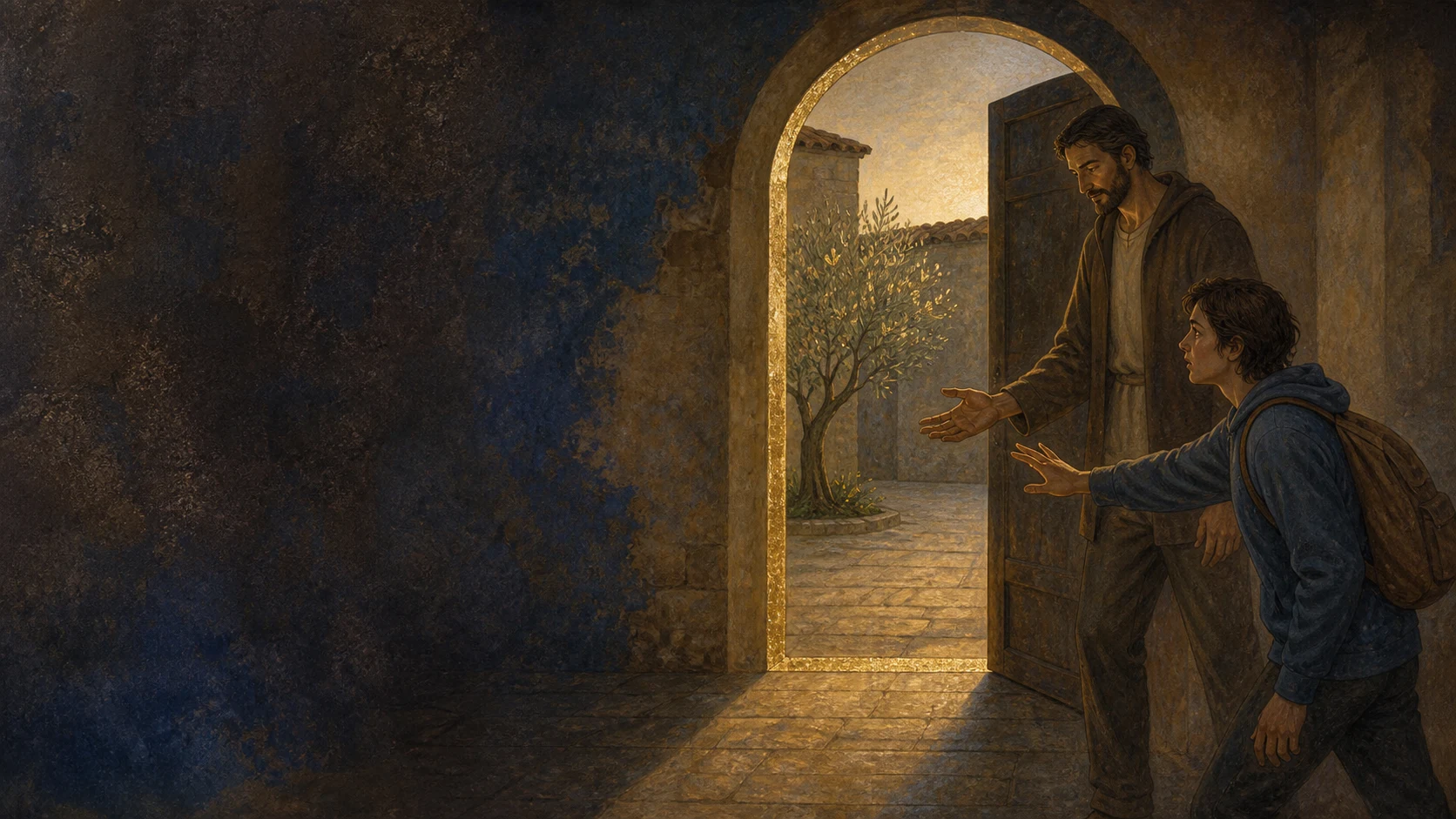
Imagine a dark corridor. At its end there is an open door. Beyond it are light, a protected courtyard, and an olive tree. Near the door, a safe person extends a hand. They do not pull you by force. They wait, listen, and help.
Fear often tells us that we are completely alone and that there is no way out. We cannot always see the whole path, but we can look for the next door and the next hand. For Peter, on the sea, the first step was to cry out: “Lord, save me.” The plea was not a cause for shame; it was an encounter.
Faith does not tell us to switch off the alarms that protect our lives. It helps us distinguish between a shadow we can pass through and a danger we need to leave. It also helps us remember that God can act through a conversation, treatment, a report of abuse, a welcoming family, or someone who decides to believe us.
Perhaps today your courage is simply to say: “I am afraid and I need help.” That sentence can already open a door.
Explore the sources
- Matthew 14:22–33 — United States Conference of Catholic Bishops — recounts Jesus approaching the frightened disciples and Peter asking to be saved.
- Mark 4:35–41 — United States Conference of Catholic Bishops — shows the disciples afraid in the storm and Jesus present in the boat.
- Catechism of the Catholic Church, 302–324 — Divine providence — teaches that God’s care also involves people’s free cooperation.
- World Health Organization — Staying safe in adolescence and youth — advises turning to a trusted adult in cases of violence or abuse and seeking professional care when distress becomes unmanageable.
- UNICEF — How to support your child after a negative online experience — recommends reminding children and adolescents that they can speak with parents, carers, or other safe adults.