Sometimes someone hurts us with a word. At other times, the wound is far more serious: a lie, humiliation, betrayal, or violence. Then we hear that we must forgive, and perhaps we think: “Do I have to pretend that it did not hurt?” or “Must I return to the person who hurt me?” No. God does not ask us to call evil good.
To forgive is to place before God our right to take revenge and to ask that hatred not rule our lives. It may be a decision that must be made many times while the heart heals. Reconciliation is something else: it requires truth, change, and safety on both sides. It is not always possible. We are allowed to keep our distance and set boundaries.
If someone is threatening, manipulating, or hurting you, tell a safe adult. Turn to your family, a responsible teacher, a trained leader, or your local safeguarding service. Silence that protects an abuser is not peace.
Where does this prayer come from?
This is an original prayer by Portal São Francisco. It was not written by the saint. It was inspired by Jesus’ call to forgive, his refusal of vengeance, and the Christian certainty that truth and justice belong on the path of peace.
Saint Francis learned to draw near to those who had once repelled him and called this a change of heart. His life does not teach us to accept abuse. It teaches us to let God transform the way we see and act, without hiding anyone’s suffering.
Prayer when I need to forgive
Jesus,
you know what happened.
I do not need to diminish the pain
or hide my anger from you.
Receive what still weighs on me:
the memory that returns,
the unanswered question,
the wish that everything had been different.
Give me courage to tell the truth
and seek help when I need it.
Teach me to protect life
without feeding vengeance.
Today I entrust this person to you,
and I entrust myself to you as well.
Do not let the wound
decide who I will become.
If forgiveness still seems far away,
stay with me through the first step.
If I need to keep my distance,
guard my boundaries with your peace.
If there is a safe way to talk,
give us truth, accountability, and change.
If reconciliation is not possible,
free my heart without sending me back into danger.
Care also for those wounded by my choices.
Give me humility to acknowledge the harm I have done,
make whatever amends I can,
and sincerely accept the consequences.
Jesus, you did not repay violence with violence.
Place your gentleness between my pain and my actions.
May justice protect,
may truth shed light,
and may your love restore my freedom.
Amen.
Original prayer by Portal São Francisco, inspired by the Gospel and Franciscan spirituality.
How to pray this prayer
Choose a place where you feel protected. You do not need to picture the face of the person who hurt you. Rest your open hands on your lap and breathe slowly. Say only: “Jesus, you know the truth.”
Read the prayer in small parts. If a sentence feels too heavy, stop. You may weep, remain silent, or continue another day. Forgiveness is not a test with a deadline. Afterwards, write down two things: “What I entrust to God” and “What I need to do to stay safe”. The second answer may include speaking with someone you trust.
If you were the one who hurt another person, do not use the prayer to demand that they forgive you quickly. Apologise without defending yourself, repair the harm wherever possible, and respect their time and boundaries. True repentance also appears in changed choices.
The door can remain open without losing its threshold
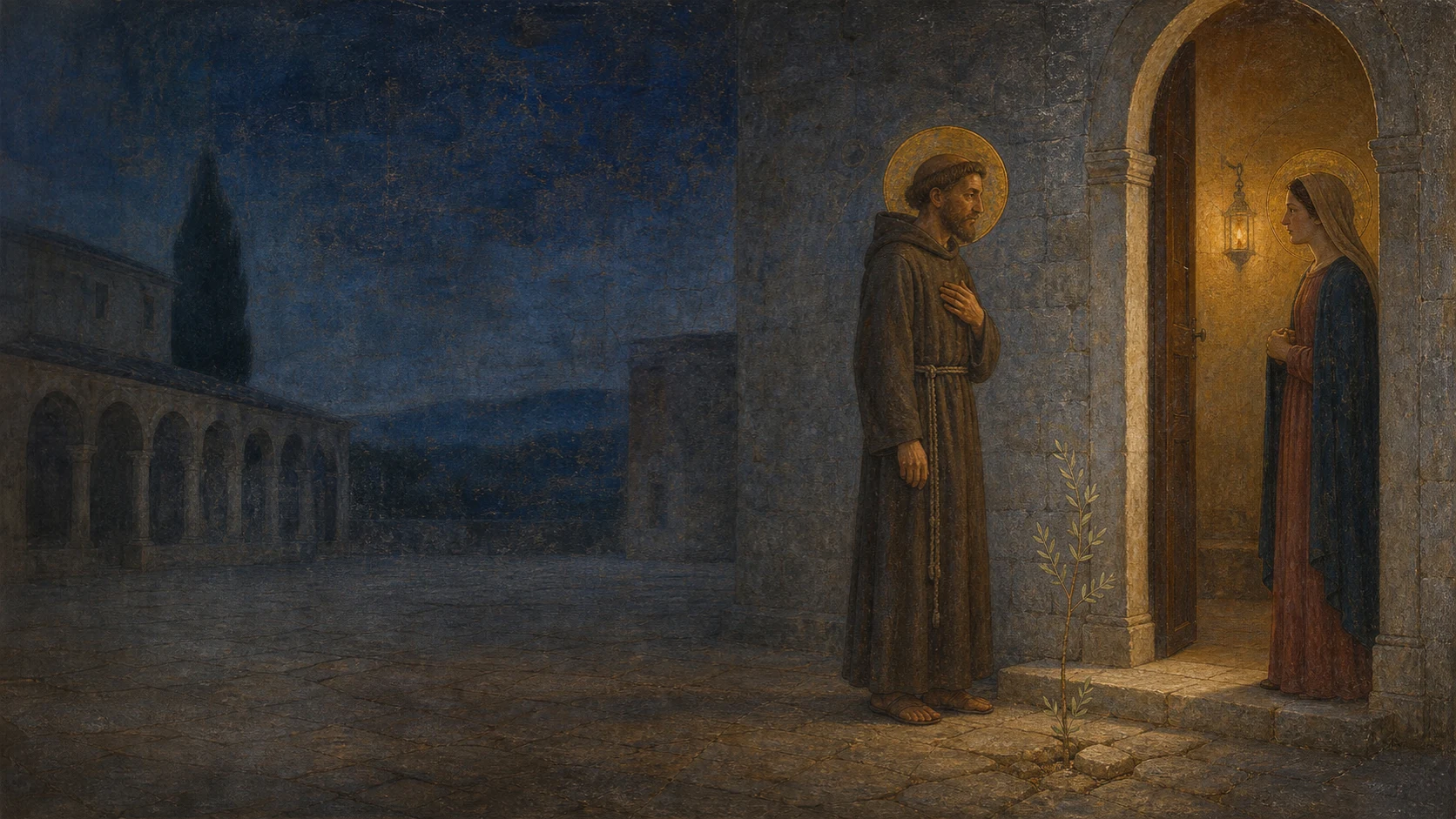
In the artwork on this page, two people stand before a door. There is light, but there is also distance. The small olive tree among the stones did not grow in a day. Forgiveness can be like this: new life appearing slowly where there was once hardness.
Jesus commands us to love our enemies, but he never commands us to hand a child, a vulnerable person, or any victim back to violence. Love may mean desiring that the other person abandon evil, answer for their actions, and find conversion. Sometimes the truest act is to report the abuse, move away, and prevent other people from being harmed.
Saint Paul counsels us not to repay evil with evil. This does not erase justice; it prevents us from becoming like what wounded us. When we entrust vengeance to God, we remain free to seek protection, truth, and reparation.
Perhaps today you still cannot say, “I forgive”. Begin with a smaller prayer: “Lord, I want one day to want to forgive”. God knows how to walk at the pace of a wounded heart.
Explore the sources
- Holy See — Fratelli tutti, 250–254 — distinguishes forgiveness, memory, justice, and reconciliation, without demanding that victims forget the cruelty they suffered.
- Holy See — Catechism of the Catholic Church, 2838–2845 — presents Christian forgiveness as the work of God’s grace in the heart.
- Franciscans — The Canticle of the Creatures — an authentic text by Francis that praises those who forgive for love and endure in peace.
- Bible: Matthew 5:43–48; Matthew 18:21–35; Romans 12:17–21 — passages about mercy, forgiveness, and the refusal of vengeance.