
Before you begin, open a window or draw near to some sign of nature. Perhaps you will find the sky, a tree, a plant pot, water in a glass, or the wind moving through the curtain. There is no place completely without creation. Our bodies, the air we breathe, and the ground beneath our feet are already part of it.
Francis of Assisi did not look upon the world as a storehouse of things. He called the sun, the moon, water, and fire brothers and sisters. This does not mean that he confused creatures with God. On the contrary: he received them as gifts from the Creator and invited each one to take part in praise.
The Canticle of the Creatures is joyful, but it was not born from an easy life. Francis composed it near the end of his life, when he was very ill and could scarcely bear the light. Later, he added verses about forgiveness and peace; close to death, he also sang about Sister Bodily Death. His praise did not hide pain. Within it, he discovered a communion greater than suffering.
Where does this path come from?
The Canticle of the Creatures, also called the Canticle of Brother Sun, is an authentic text by Saint Francis. It was written in the vernacular of Umbria rather than the Latin used in many religious texts of his time. The Order of Friars Minor includes the canticle among Francis’s prayers. In 2025, it celebrated the canticle’s eight-hundredth anniversary and recalled that the song embraces all creation, leading toward reconciliation with God, with our brothers and sisters, and with the created world.
This page does not present a complete translation of the canticle. Modern translations involve their own choices, and some may be protected by copyright. Instead, we offer a path of prayer and an original text by Portal São Francisco, inspired by the movements of the canticle: praising the Creator with creatures, giving thanks, becoming reconciled, and caring.
Pope Francis took the canticle’s opening words as the title of the encyclical Laudato si’. He explains that calling the earth our sister is not a romanticisation of nature. Everything is interconnected: care for rivers, animals, and forests must go hand in hand with care for the poor, victims of violence, and future generations.
Prayer to join creation’s chorus
Most High and gracious Creator,
today I join creation’s song.
With Brother Sun,
I give thanks for the light that awakens pathways
and ask for a heart that also gives light.
With Sister Moon and the stars,
I give thanks for the beauty I cannot possess
and for the night that teaches us to rest.
With Brother Wind and all the air,
I give thanks for every breath
and ask that we care for the sky we share.
With Sister Water,
I give thanks for thirst quenched,
for cleansing, rain, and rivers.
Teach me not to waste
what so many still seek.
With Brother Fire,
I give thanks for warmth and courage,
and ask that my strength may never destroy.
With our sister and Mother Earth,
I give thanks for food,
for seeds, fruits, and colors.
Make my hands caring hands,
never those of an owner without limits.
With those who forgive for love’s sake,
I ask for the peace that speaks the truth,
repairs the wound,
and brings vengeance to an end.
With those who suffer,
I ask for presence and consolation.
With every person and every creature,
I recognize that I do not live alone.
Receive my praise
and turn my gratitude into care.
May I serve you with humility
in the great family you have created.
Amen.
An original prayer by Portal São Francisco, inspired by the spiritual movement of the authentic Canticle of the Creatures.
How to pray with the Canticle of the Creatures
Choose a creature nearby. It does not need to be part of a magnificent landscape. It could be a leaf, a stone, water, or your own breathing. Observe it for one minute without taking a photograph or trying to explain it. Notice its color, shape, movement, temperature, or sound.
Then ask three questions. What do I receive from this creature? What does it tell me about God’s generosity? What care does it need? Water, for example, quenches thirst, recalls the life we have received, and asks not to be polluted or wasted.
Read the prayer slowly. After each part, respond: “Praise be to you, my God.” This short response is our way of following the movement of the canticle, not a complete reproduction of its verses.
At the end, choose one act of care that is possible today: use only the water you need, avoid buying something disposable, treat an animal with respect, sort waste, walk instead of driving when it is safe, or support someone affected by an environmental problem. If you are a child, invite an adult to carry out the action with you.
Do not turn the practice into a test of perfection. No one solves the crisis facing creation in a single day. Contemplation educates the way we see; a well-formed gaze makes better choices; small choices made together can form a great change.
One landscape, one family
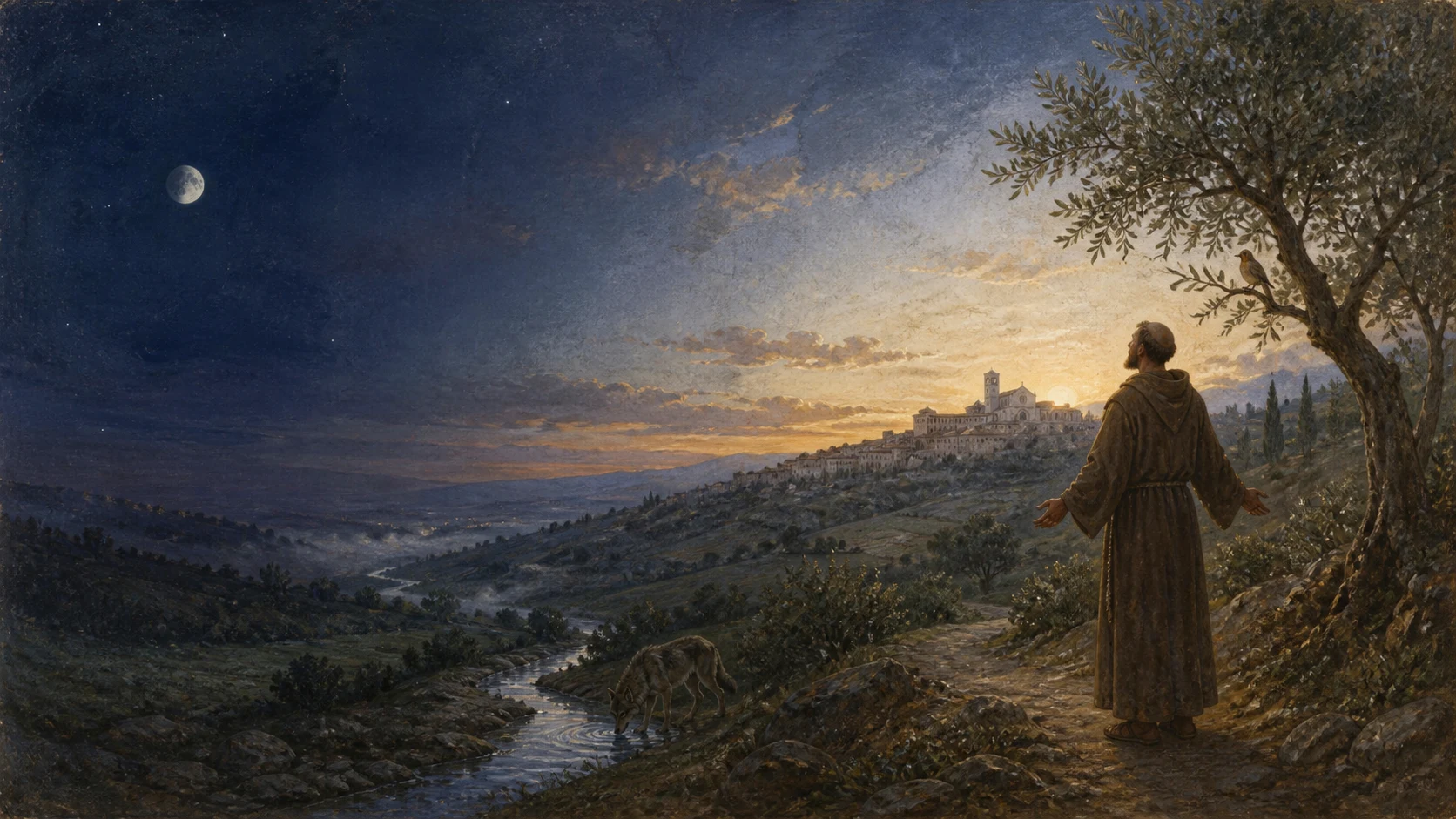
Imagine the night ending over Assisi. The moon is still in the sky, but the sun already touches the stones. The wind passes through an olive tree. Water flows through the valley. A bird awakens. None of these beings needs to compete for a place in the praise: each offers its own way of existing.
We enter this chorus by receiving, not by commanding. We do not make the day’s first light, teach the seed to open, or invent the air. This truth makes us humble. It also makes us responsible, because we have received intelligence, hands, and the ability to make decisions that can protect or harm.
Francis added human reconciliation to the canticle. This is decisive. We cannot say “Sister Water” and deny clean water to the poor. We cannot admire forests and despise the peoples who protect them. We cannot love animals and treat people as objects. True praise brings together what selfishness has separated.
When you contemplate a creature, let it enlarge your family. The water in your glass has passed through clouds, rivers, pipes, and the work of many people. A fruit holds sunlight, rain, soil, seeds, and human care. Everything is interconnected.
Perhaps today’s most Franciscan prayer is this: to receive with gratitude, use with moderation, share with justice, and give care in return. In this way, our voice finds its place in the canticle.
Sources and further reading
- Order of Friars Minor — Prayers of Saint Francis — includes the Canticle of the Creatures among the saint’s authentic prayer texts.
- Order of Friars Minor — celebration of the Canticle’s 800th anniversary — places its composition at San Damiano in 1224–1225 and highlights creation, praise, and reconciliation.
- Holy See — Laudato si’, 1, 10–12 and 87–92 — explains Francis’s kinship with creatures and the inseparable bond between environmental care and love for people.
- Psalm 148 — USCCB Bible — calls heaven, earth, and creatures to praise the Lord.