Sometimes it is difficult to look at the cross. It reminds us that Jesus suffered and that there are still people who are wounded, abandoned, or treated unjustly. But the Christian cross was not placed before us to turn pain into a spectacle. It shows how far the love of Jesus reaches: he did not flee from those who suffered, answer violence with more violence, or cease to love.
Praying before the cross does not mean seeking suffering or accepting that someone should hurt us. Jesus spent his life healing, feeding, welcoming, and restoring dignity. The cross denounces the evil that wounds the innocent and reveals a love that remains faithful. Contemplating it can therefore teach us two things at once: not to abandon those who suffer and not to turn our own pain into a weapon against others.
You can pray before a crucifix or a simple cross, or merely imagine its two strokes. You do not need to feel anything special. Remaining for a few minutes can already be prayer.
Where does this path come from?
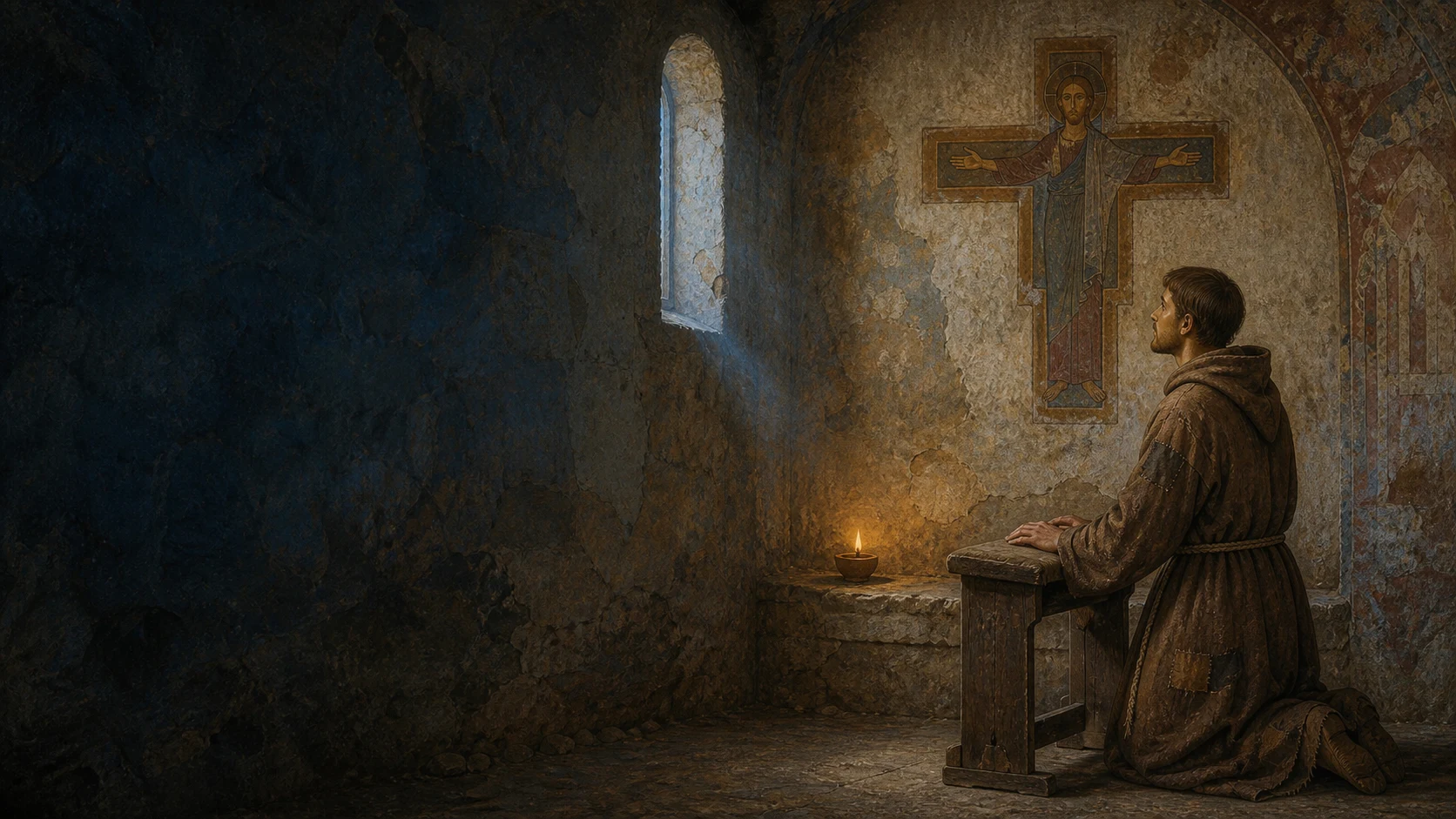
Francis prayed before the San Damiano Crucifix at a decisive moment in his youth. Franciscan tradition connects this encounter with the call to rebuild the Church. The Order of Friars Minor preserves the authentic Prayer before the San Damiano Crucifix, in which Francis asks for light in the darkness of his heart, faith, hope, charity, wisdom, and knowledge so that he may carry out God’s will.
This page does not repeat that prayer, which already has its own chapter on this portal. Here we propose a different contemplative exercise: remaining before the cross, observing, speaking with Jesus, and listening in silence. The prayer below is an original prayer by Portal São Francisco. It is inspired by the Gospels, Francis’s authentic prayer, and Franciscan spirituality, but it must not be attributed to the saint.
Jesus invites his disciples to take up the cross and follow him. This does not mean hiding abuse or enduring violence without seeking help. Following Jesus means rejecting selfishness and choosing courageous love. When faced with danger, aggression, or abuse, moving away and seeking a safe person is also a way of protecting the life God loves.
Prayer for remaining before the cross
Jesus,
I remain before your cross
without needing to explain everything.
You know the pain that can be seen
and the pain that no one can see.
I see your open arms
and I remember:
your love does not close the door.
I see the heavy wood
and entrust to you the burden
that I cannot carry alone.
I see your face
and remember every wounded face:
those who are hungry,
those who are afraid,
those who have been rejected,
those who weep in secret.
Do not let me pass by
when I can offer care.
And do not let me
call violence love
or silence peace.
Give me courage to ask for help,
to defend life,
and to speak the truth with gentleness.
When my heart wants to run away,
teach me to remain with you.
When I want to return hurt for hurt,
bring the path of vengeance to an end within me.
When I do not know what to do,
kindle a small light:
the next good action,
the next true word,
the next possible step.
Jesus, crucified and risen,
keep me in your love
and make me a companion
to those who are alone.
Amen.
An original prayer by Portal São Francisco, inspired by the Gospel and the Franciscan contemplation of the cross.
How to pray before the cross
Sit at a comfortable distance. You do not need to kneel or maintain a position that causes pain. Place your feet on the floor and breathe slowly. First look at the whole cross. Notice the vertical stroke, the horizontal stroke, and the space around it.
In the first stage, say: “Jesus, you are here.” Do not search for beautiful thoughts. Simply remain. If your attention wanders, return without being hard on yourself.
In the second stage, tell Jesus one truth. It may be gratitude, fear, tiredness, anger, or confusion. Use simple words: “This hurts”, “I cannot forgive yet”, or “Thank you for not abandoning me.” Truth is also prayer.
In the third stage, observe Christ’s open arms and think of someone who needs presence. Ask: “What care can my hands offer?” It may be listening, visiting, phoning, sharing food, or seeking responsible help.
End with two minutes of silence. If images of the cross awaken difficult memories or intense fear, stop the practice and speak with a trusted adult, family member, teacher, priest, or professional. Prayer can accompany care, but it does not replace protection, treatment, or practical help.
The cross as a place where no one is abandoned
Imagine an almost-dark chapel. There is a crack in the wall and a small lamp. Someone enters carrying questions that cannot fit into a sentence. They do not find an easy explanation. They find Jesus with open arms.
Not every pain has an immediate answer. Sometimes the first form of love is to remain close: to sit beside someone, listen, and not hurry their tears. This is how faithful people remained close to Jesus in his Passion. This is how Jesus remained close to humanity.
The cross also prevents us from treating suffering as something insignificant. If God entered so deeply into human pain, no wound can be treated with contempt. The child who is bullied, the family without food, the person who is ill, and the people struck by war are not distant numbers. Each one has a face.
Contemplating the cross sends us toward these faces. Not to solve everything alone, but to refuse to abandon anyone. Before the San Damiano Crucifix, Francis heard a call to rebuild. We too can leave prayer with a small stone in our hands: an act of justice, a request for forgiveness, a visit, a responsible report of wrongdoing, a piece of the world repaired with love.
Sources and further reading
- Order of Friars Minor — Prayers of Saint Francis — presents the text of the authentic Prayer before the San Damiano Crucifix and other prayer writings.
- Order of Friars Minor — the Crucifix returns to San Damiano — recalls the crucifix’s connection with Francis’s call and with the prayer life of Clare and her sisters.
- Matthew 16 — USCCB Bible — brings together the prediction of the Passion and Jesus’s invitation to his disciples to take up the cross and follow him.
- John 19 — USCCB Bible — recounts the Crucifixion and the presence of those who remained close to Jesus.