
Perhaps you have tried to be silent and discovered that, inside, there was an entire marketplace. One memory pulled another along. Your body wanted to move. A sound seemed enormous. Your list of tasks began to parade past. Then came the doubt: “Am I praying wrongly?”
No. Praying in silence does not mean erasing your mind. Nor is it about winning a competition in stillness. It is offering God a few minutes of genuine presence. You arrive as you are: lively or tired, calm or anxious, focused or full of thoughts. God does not wait for a perfect version of you before drawing near.
Jesus sought out secluded places to pray, but his silence never distanced him from people. After praying, he returned to listen, heal, teach, and serve. Christian silence is like this: it does not close a door on the world; it opens the heart to love the world more truly.
Where does this path come from?
This prayer is an original prayer by Portal São Francisco. It is not a text by Saint Francis or an ancient formula. It was written out of the Christian tradition of contemplative prayer and the Franciscan way of recognising God close to us: in Jesus, in the Word, in people, and throughout creation.
The Catechism calls contemplation a loving attention to Jesus. In it, silence can be “silent love”: not a cold absence, but communion. It also teaches that prayer can take place amid different conditions of health, work, and emotion. This is important: God does not abandon you when your heart races or your attention wanders.
For some neurodivergent people, closing their eyes, remaining completely still, or enduring absolute silence can be uncomfortable. For someone who is anxious, attending to their breathing can even increase distress. None of these things is a lack of faith. You can pray with your eyes open, rock your body gently, hold a smooth stone, look at an image of Jesus, or leave a quiet sound playing in the background. The practice serves the encounter; it is not a test you need to pass.
Prayer for remaining
Jesus,
I am here.
I have not brought a tidy heart.
I have brought my racing thoughts,
my restless body,
my joy or my tiredness,
and this small desire to remain with you.
Receive the whole of me.
When a memory comes,
may I not fight against it:
I place it in your hands.
When a sound rouses me,
may it remind me:
you are also present in the world that goes on living.
When I need to move,
remain with me in my movement.
When I feel nothing,
teach me that your presence
does not depend on my feelings.
Look upon me with love, Jesus.
I look at you as best I can.
Keep those who suffer,
visit those who are alone,
and turn this brief silence
into patience to listen,
courage to do good,
and tenderness to care.
I do not want to flee from the world.
I want to return to it
less quick to judge
and with more room to love.
Remain with me.
I remain with you.
Amen.
An original prayer by Portal São Francisco, inspired by the Christian contemplative tradition.
How to pray in silence
Begin with just two minutes. Choose a reasonably safe place and say: “Jesus, I am here with you.” Find a posture that works for your body: sitting, lying down, standing, or moving slowly. If closing your eyes does not feel right, choose a simple point to look at—a cross, a safely placed candle, a leaf, or your own hands.
Then use an anchor. It could be the name “Jesus”, repeated inwardly; a short phrase such as “You are with me”; the contact of your feet with the floor; or the weight of a small object in your hands. When you notice that your mind has wandered far away, do not scold yourself. Simply acknowledge, “a thought has come”, entrust it to God, and return to the anchor. Returning is already part of the prayer.
If silence increases your anxiety, shorten the time, keep your eyes open, play quiet instrumental music, or read a psalm slowly. If it still causes distress, stop. Speak with someone safe and, if the anxiety is frequent or intense, ask a responsible adult or health professional for help. Seeking care is also a way of respecting the life God gave you.
When you finish, ask: “Who needs me to listen to them today?” Write down a name or choose an action. In this way, silence creates willing hands.
The oil lamp makes no noise
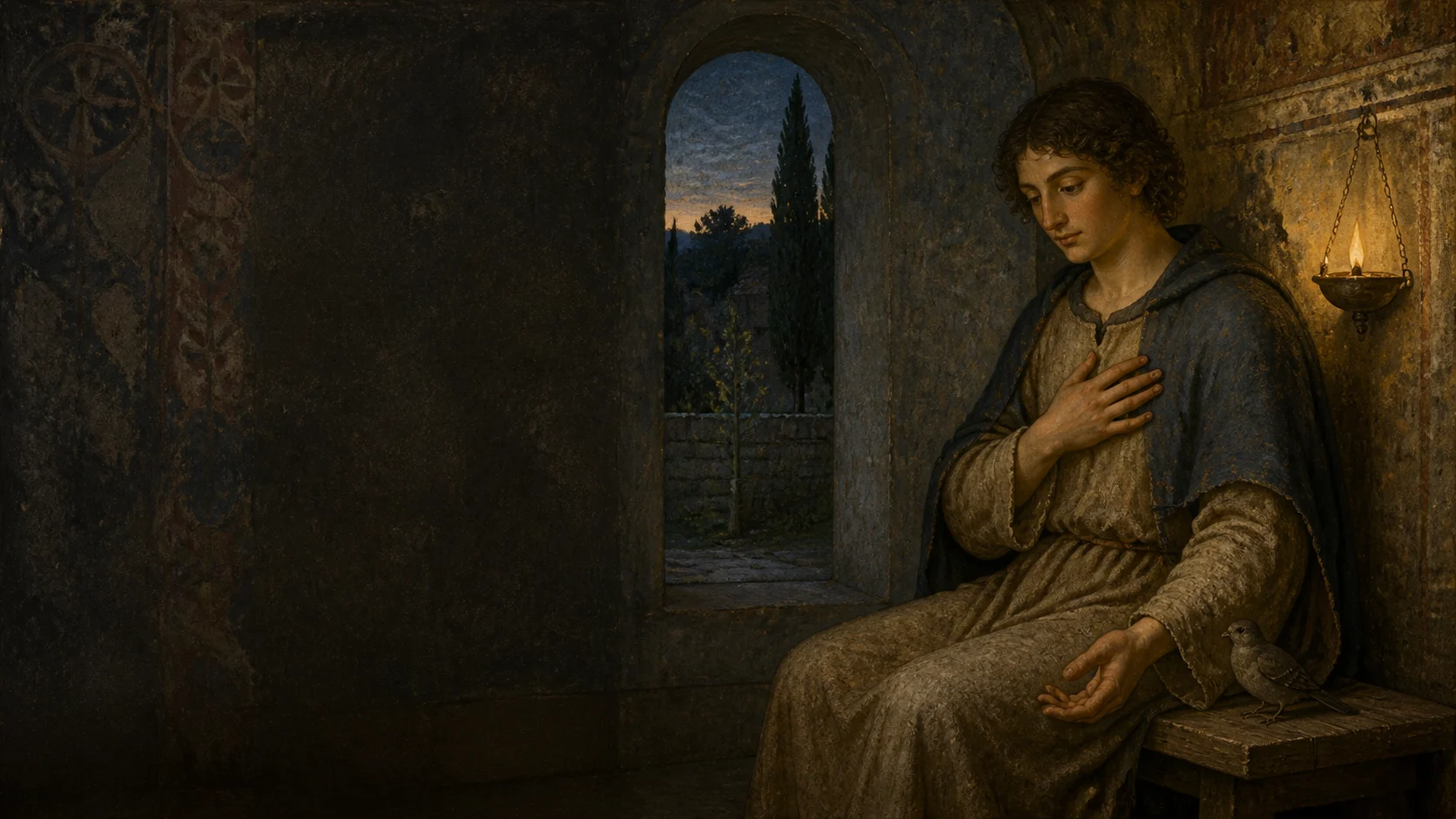
Imagine a chapel before dawn. A small oil lamp gives little light, but enough to show that no one is abandoned in the darkness. It makes no speech. It simply remains alight.
Perhaps your prayer today is as small as that flame. You may become distracted twenty times and return twenty-one. You may feel no peace at all. Even so, you have offered time and trust. Pope Francis explained that contemplation is looking at Jesus and welcoming his loving gaze; from this encounter comes a new way of looking at others. Contemplation is therefore not passivity. The Catechism says that it must bear fruit in acts of charity.
The best sign of a good silent prayer is not that you remained still. It is that you leave a little more able to listen without interrupting, notice who has been forgotten, and respond without cruelty. Francis sought out solitary places, but returned from them as a brother. Silence kept with Jesus can also make you a presence that does not add to the clamour of pain.
Sources and further reading
- Catechism of the Catholic Church, 2709–2719 — contemplative prayer — presents contemplation as encounter, listening, silent love, and communion that bears fruit in charity.
- Pope Francis — Catechesis on contemplative prayer, 5 May 2021 — explains contemplation as a gaze of faith fixed on Jesus that transforms the way we see and love.
- Order of Friars Minor — Commission for Prayer and Devotion — describes Franciscan prayer as rooted in Scripture, theologically sound, and pastorally welcoming.
- Pope Francis — Meeting with the Laudato si’ Communities, 12 September 2020 — connects contemplation, harmony between head, heart, and hands, compassion, and practical action.