
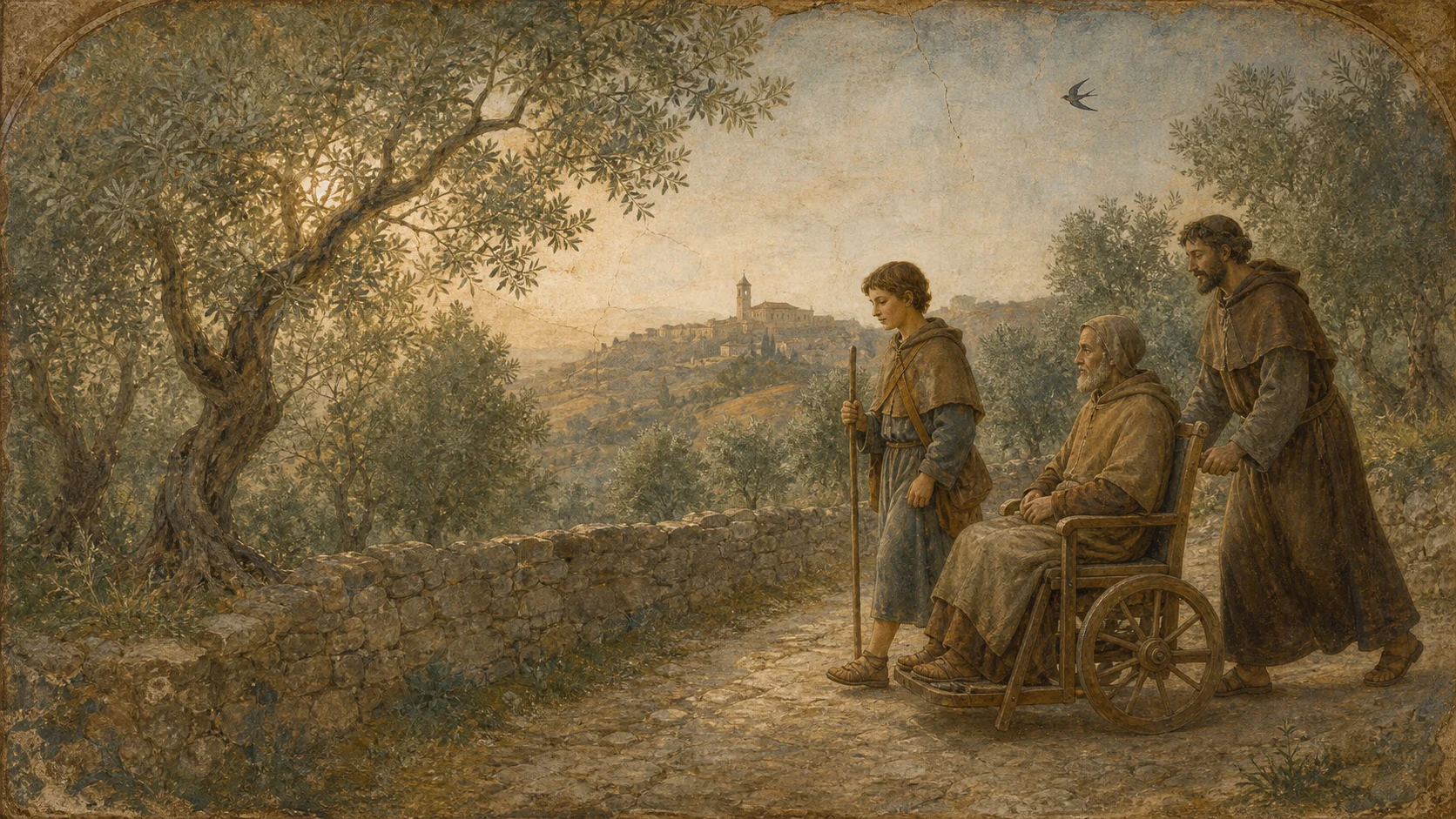
Not every prayer happens while the body is still. Sometimes our feet find a rhythm that helps the heart. A familiar street looks new. The wind reminds us that we receive air without buying it. A tree, once invisible in our hurry, becomes a small sign of God’s goodness.
In the Gospels, Jesus is often on the way. He crosses towns, climbs hills, enters homes and meets people at the roadside. After the Resurrection, he draws near to two disciples walking sadly toward Emmaus. Jesus asks about their pain, listens, talks with them and breaks bread. The road becomes a place of encounter.
Praying while walking does not require a beautiful trail, strong legs or many miles. Here, walking means traveling a possible path attentively. It may be on foot, with a cane or walker, in a wheelchair, guided by someone, moving arms and hands, or following a route with your eyes from a window. Before God, distance does not measure the depth of prayer.
Where does this path come from?
This is an original prayer by the São Francisco Portal, inspired by Jesus’s journeys, Francis’s pilgrim life and the Christian invitation to contemplate creation. It is not a text written by the saint.
Francis and his brothers understood themselves as pilgrims in this world. They traveled to proclaim the Gospel and depended on hospitality, but their journey was not spiritual tourism. It was a school of simplicity, encounter and peace. The Order of Friars Minor still describes Franciscan life as prayer, fraternity and following in Christ’s footsteps.
In the encyclical Laudato si’, Pope Francis says that we can discover a mystery in a leaf, a mountain path, a drop of dew and a poor person’s face. This does not mean that creatures are God. It means that they can teach us gratitude, limits and care, directing our gaze toward the Creator.
This is why this prayer includes three movements: receiving the path, noticing those who share it and responding with care.
Prayer of the possible path
Jesus, my companion,
walk with me along this possible path.
Keep pace with me,
without hurry or demands.
When my feet touch the ground,
remind me that the earth is a gift.
When wheels move forward,
bless those who opened the way,
and teach us to remove barriers.
When my body needs to stop,
remain with me in the pause.
When I can only look at the path,
carry my heart to those
for whom I wish to pray.
Open my senses:
may I notice the light,
the wind, the sounds and the faces,
possessing nothing,
receiving everything with gratitude.
Show me those who walk alone,
those who carry too much weight,
those who find steps where there should be doors,
those who need companionship and respect.
If I am sad like the disciples at Emmaus,
listen to what hurts within me.
If I am joyful,
turn my joy into sharing.
If I lose myself in haste,
call my name gently.
May every step,
every turn of a wheel,
every movement and every pause
bring me closer to your way of loving.
And when I return,
may the path continue within me:
in care for creation,
in room for everyone,
and in peace shared with others.
Amen.
Original prayer by the São Francisco Portal, inspired by the Gospel and Franciscan spirituality.
How to pray while walking
Begin with safety. Choose a familiar place that is accessible and suitable for your body. If you are a child, tell a responsible adult and do not go alone into isolated areas. Do not use headphones that prevent you from noticing vehicles, bicycles or people. Take water when needed, and respect pain, heat, cold and tiredness. Stopping does not spoil the prayer.
Begin by saying: “Jesus, walk with me.” During the first few minutes, find a comfortable rhythm. You can pair a phrase with your movement: “I receive your peace” as you move forward; “I share your peace” with the next movement. Do not force your breathing.
Then make four brief pauses of attention, even without stopping your movement:
- Ground: give thanks for what supports you.
- Creation: notice a color, sound or form of life without picking or harming it.
- People: silently bless those who pass, respecting their privacy.
- Mission: notice something you can care for—litter that is safe to collect, a blocked passage to report or a person who needs company.
If you have limited mobility, adapt freely. Take a short accessible route, move your hands in the rhythm of the prayer, follow a tree through the window or ask someone to describe the path. No one needs to prove effort. If someone accompanies you, that person should ask before pushing a wheelchair or offering help; respect also prays.
At the end, remain still for a few moments and say: “Thank you for the journey. Show me love’s next step.”
Jesus does not hurry past
On the road to Emmaus, Jesus could have arrived quickly and explained everything at once. Instead, he matched the pace of two discouraged friends. He asked, listened and remained. The journey changed not because the stones disappeared, but because they discovered that they were not alone.
This is the heart of this prayer. The journey is not an escape. By paying attention to the ground, we learn our limits. By noticing a barrier, we learn responsibility. By noticing another person, we learn fraternity. Franciscan contemplation returns us to the world more attentive.
Perhaps your path today is ten miles. Perhaps it is ten steps. Perhaps it takes place entirely from a chair, a bed or a window. Jesus is not waiting at the end of a perfect distance. He draws near where you are and asks, as he asked the disciples: what are you carrying in your hearts as you walk?
Sources for further reading
- Gospel according to Luke 24 — the disciples on the road to Emmaus — tells how Jesus draws near, walks, listens and breaks bread with the disciples.
- Pope Francis — Laudato si’, especially 233–234 — presents the contemplation of God in creatures, including a leaf, a path and a drop of dew.
- Order of Friars Minor — Pilgrims and Strangers in this World, Guided by the Word — relates the Franciscan journey to listening to the Word, prayer and peace.
- Catechism of the Catholic Church, 2700–2708 — recalls that we are body and spirit and that prayer involves thought, imagination, emotion and desire.