Sometimes news of war reaches us through a screen while we are sitting in a safe room. We see wounded cities, separated families, and children who should be playing, not fleeing. We may feel sadness, anger, fear, or guilt about carrying on with life. We may also feel confused: every message seems to tell a different version of events.
Praying for peace does not require us to understand the entire history of a conflict on our own. But it does require us to reject the lie that some lives are worth less than others. Every person retains their dignity.
Christian peace is not silence in the face of violence. It does not ask the victim to embrace someone who is still harming them. It does not call oppression order. It seeks truth, justice, protection for the innocent, humanitarian aid, responsible dialogue, and nonviolent paths that bring evil to an end. To pray is to place all this before God and allow him to transform our choices too.
Where does this prayer come from?
This prayer is an original prayer by Portal São Francisco. It was not written by Saint Francis and does not replace the Church’s liturgical prayers. It springs from the Gospel, which calls peacemakers blessed, and from the Franciscan vocation to proclaim: “May the Lord give you peace.”
The Order of Friars Minor teaches that praying for peace is a moral act rooted in the Gospel. In 2026, it invited the Franciscan family to unite prayer, closeness to those who suffer, and practical initiatives of solidarity and assistance. The Church also affirms that the human person is at the heart of peace, that civilians and refugees have a right to humanitarian aid, and that falsehood fuels violence.
For this reason, this path has four inseparable movements: pray, seek information responsibly, help, and act without violence. None of them can end a war on its own. Together, however, they prevent distant pain from becoming spectacle or indifference.
Prayer for world peace
God of the whole human family,
receive the cry of peoples wounded by war.
Receive by name each person who has died,
even when I do not know their name.
Protect those in hiding,
those crossing borders,
those seeking food, water, medicine, and shelter,
those caring for the wounded,
and those risking their lives to tell the truth.
Console frightened children,
separated families,
those waiting for news,
and those carrying grief the world does not see.
Disarm the hearts of those who order violence.
Bring to an end the lies that turn people into targets.
Give courage to those who can negotiate,
protect, bring relief, and open paths of justice.
Do not let my prayer become a hiding place.
Teach me to verify before sharing,
not to circulate images that humiliate,
not to hate an entire people
for the crimes of governments or armed groups.
Show me honest help I can offer,
a responsible voice I can support,
a prejudice I need to challenge,
a refugee I can welcome.
Risen Jesus,
you came to your frightened friends
and offered them peace.
Make us builders of a peace
with no weapons in our hearts,
no lies in our mouths,
no indifference in our hands.
May it be humble and persevering,
protected by truth,
founded on justice,
and made visible in care.
May the Lord give us peace
and teach us to serve it.
Amen.
An original prayer by Portal São Francisco, inspired by the Gospel and the Franciscan commitment to peace.
How to pray and act for peace
Choose a conflict or a wounded people to bring to prayer. First, seek an explanation from reliable sources that identify their author and date. Distinguish news, opinion, and content designed to provoke anger. Do not share shocking videos without verifying them; images of dead or injured people can rob them of their dignity and increase their families’ suffering.
Light a candle only if it is safe to do so, or place a bowl of water before you as a sign of life. Say the names of the places and people you know. When you do not know their names, God does. Read the prayer slowly. Leave one minute for mourning, without trying to produce a beautiful emotion.
Then choose one possible and verifiable action:
- donate, with a responsible adult, to a recognized humanitarian organisation;
- support a community that welcomes refugees;
- write respectfully to public representatives in defense of civilians, negotiation, and aid;
- challenge a racist joke or a message that blames an entire people;
- take part in a vigil or nonviolent initiative organized by trustworthy people;
- learn from someone directly affected, without demanding that they recount traumatic experiences.
If the news is hurting you, limit your screen time and speak with a safe adult. Resting does not mean forgetting. The heart needs care so that it can continue caring.
Never travel to a conflict zone or approach a dangerous demonstration on your own. Christian courage does not seek danger in order to appear heroic; it seeks responsible ways to protect life.
An olive tree among repaired stones
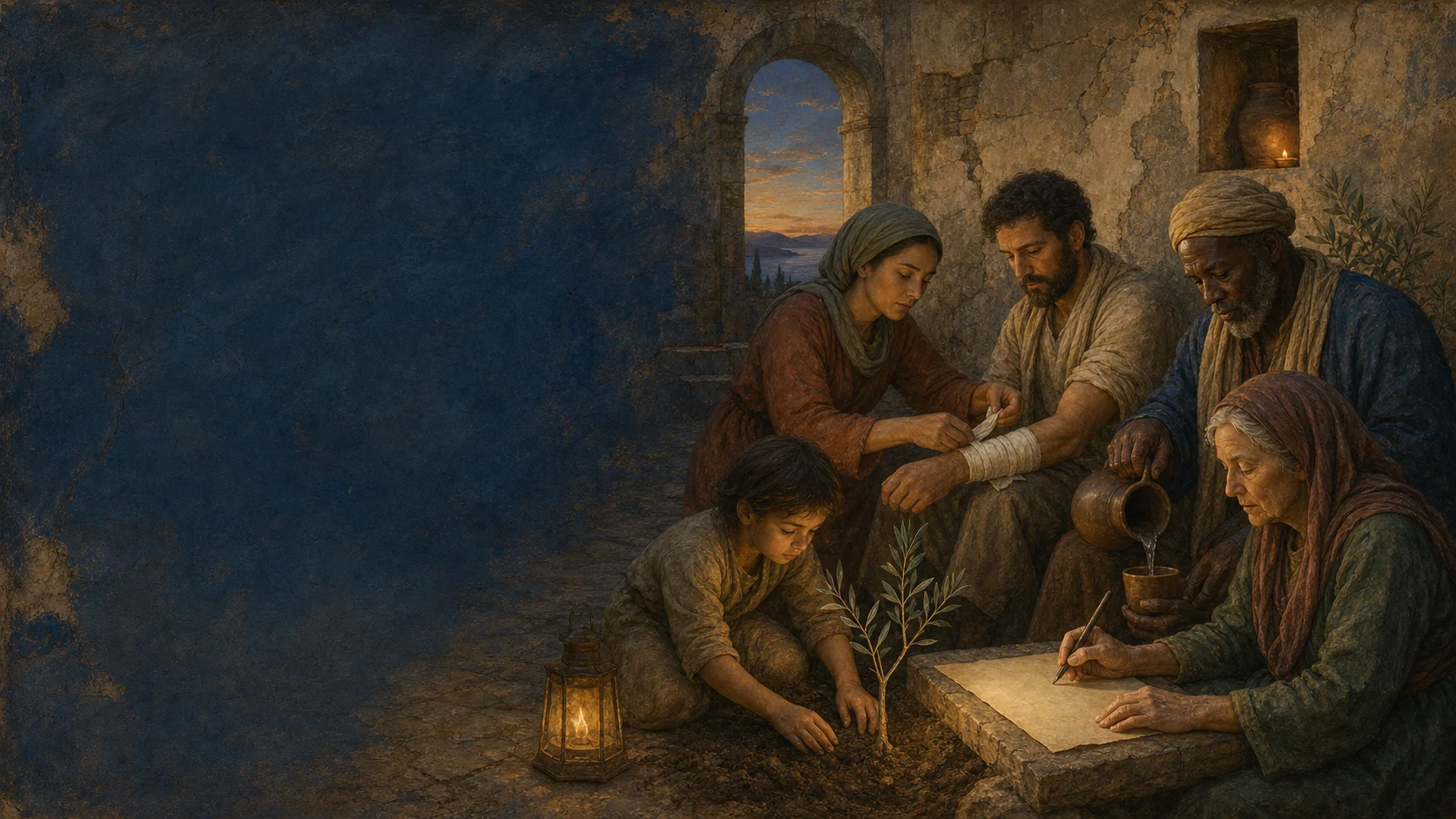
Imagine a courtyard whose wall has been repaired. The cracks are still visible. No one pretends that the damage never happened. There, one person bandages an arm, another offers water, someone carefully records what happened, and a child plants an olive tree. This is a truer image of peace than a hurried embrace.
Reconciliation requires safety and truth. Forgiveness does not erase justice. Nonviolent action is not standing still: it can denounce, protect, boycott, mediate, welcome, document, and resist without turning another life into an object of hatred. Pope Leo XIV described the peace of Christ as unarmed and disarming, humble and persevering. Such peace is not fragile; it refuses to copy the methods of violence.
Saint James warned that wishing peace to those who are hungry, without offering what they need, is not enough. Your prayer therefore ends when you say “amen”, but it also continues. It continues in the source you verify, the honest donation, the conscientious vote when your time comes, the prejudice you confront, and the face you refuse to call an enemy.
You cannot carry all the pain of the planet alone. You can, however, refuse to surrender your heart to indifference. Pray, listen to those who have been wounded, help someone, and choose the truth. Plant, together with others, the peace that will take time to give shade.
Sources and further reading
- Order of Friars Minor — An Invitation to Pray for Peace, 13 April 2026 — unites prayer, closeness to victims, and practical initiatives of solidarity and assistance.
- Pope Leo XIV — Message for the 2026 World Day of Peace — proposes a peace of Christ that is unarmed and disarming, humble and persevering.
- Saint John Paul II — Truth, the Power of Peace, 1980 — shows how lies, propaganda, and manipulated information fuel violence.
- Saint John Paul II — Message for the 2000 World Day of Peace — defends the protection of civilians, the right to humanitarian aid, negotiation, and mediation.
- Letter of Saint James 2 — teaches that wishing others well without meeting their practical needs is not enough.