
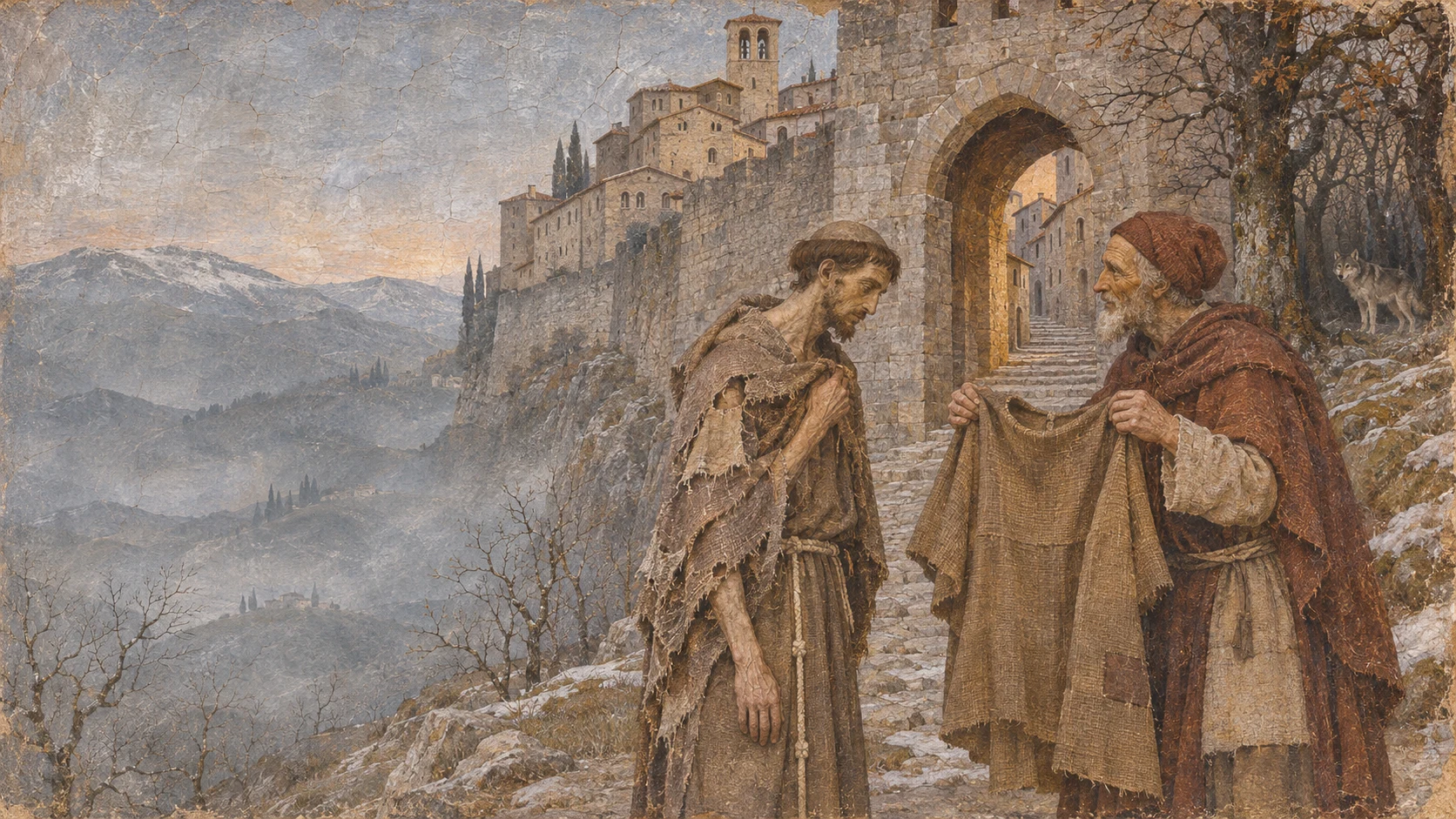
Gubbio rises among the mountains as though it were carved from a single gray stone. In winter, wind sweeps down from the Apennines, passes through the gates in the city wall, and makes the streets seem older still. Francis walked toward this stern city when he could no longer return to his old life in Assisi.
He did not arrive as the famous saint we see in paintings. He arrived as a young man with no money, no home, and almost no clothes. Shortly before, in front of the bishop of Assisi, he had given his father back even the clothes he was wearing. His decision was spiritual, but the cold was real. The freedom he had chosen now needed bread, shelter, and rough cloth.
Thomas of Celano, his first biographer, says that an old friend in Gubbio gave him a small tunic. This simple account is the historical ground beneath this pilgrimage. The earliest story does not name the friend. Yet the city would keep other memories: service to people with leprosy, the church of the Vittorina, and, much later, the story of a fierce wolf that found peace.
The road after giving everything up
The distance between Assisi and Gubbio does not look great on a modern map. On foot, through valleys, woods, and cold mountain passes, it was another matter. Celano describes Francis walking through a forest dressed in rags. According to the account, robbers attacked him, asked who he was, and threw him into a hollow filled with snow. He then sought out a monastery, worked in its kitchen, and left without even getting an old piece of clothing.
We do not know every bend in the road. Nor do we know the day he left or which trail he followed. Yet the heart of the story shows something important: poverty was no longer a beautiful word. Francis felt hunger, humiliation, and dependence. He had to accept help.
That is hard for someone who wants to be strong. Giving can make us feel needed; receiving makes us admit our own weakness. In Gubbio, the man who had once traded cloth did not choose the most elegant color. He wore what he was offered.
Local tradition calls this friend Giacomello Spadalonga and connects his house with the town square. The name does not appear in Celano. It may preserve a true memory, but we cannot treat it as though it were written in the earliest account. There is a gap between “an old friend” and “Giacomello, in this very house,” which devotion has filled. A historian needs to notice that gap.
A tunic that was not yet a uniform
We should not imagine the clothing Francis received in Gubbio as a fully developed Franciscan habit, exactly like those worn centuries later. The brothers’ movement was not yet organized. Francis was trying to live as a penitent and hermit: turning toward God through work, prayer, and service.
A rough tunic protected him from the cold and brought him closer to poor people who wore simple cloth. It was neither a medieval costume nor a ceremonial robe. It had weight, a smell, patches, and probably scratched his skin. When this chapter’s artwork shows his friend holding out the garment, it tries to restore that physical reality to the memory.
The gesture also challenges a dangerous idea: that Francis built everything alone. Even the story of someone who gave up his possessions begins with a gift received. A friend, almost lost from the written records, made the next step possible.
Perhaps that makes Gubbio a good city in which to think about brotherhood. Before the sermons to crowds, there was someone who noticed a man shivering.
Outside the walls
Gubbio’s traditions connect Francis with caring for people affected by leprosy. In the Middle Ages, the word covered several serious skin diseases. Fear of infection and society’s rules pushed sick people into places far from others. They might live near the roads, but outside the city’s safety.
Francis’s own Testament confirms that meeting people with leprosy changed his life. He writes that when he lived “in sins,” seeing them seemed bitter to him. Later, when he was led among them, he showed them mercy, and bitterness turned to sweetness. The text does not say this change happened only in Gubbio. It is therefore wise to make two points: service to people with leprosy is at the historical heart of his conversion; placing particular episodes in Gubbio comes from local memory.
The old church of Santa Maria della Vittorina, outside the town center, became one of the places associated with Francis and the first brothers. The building has changed over the centuries. It is not an untouched photograph of 1207. Even so, its position helps us understand how exclusion shaped the landscape: the wall on one side, the road and fields on the other.
Francis chose to cross that boundary. He did not heal every sick person or change medieval society on his own. He did something smaller and more demanding: he drew close, washed wounds, and stayed.
The wolf arrives later
For many people, Gubbio immediately means the wolf. The best-known account appears in the Fioretti, or Little Flowers of Saint Francis, a fourteenth-century Italian collection based on earlier traditions. In it, an enormous wolf terrorizes people and animals. Francis goes out to meet it, calls it “brother,” listens to its hunger, and makes an agreement: the townspeople will provide food; the animal will stop attacking.
The scene is unforgettable. But it does not appear in Celano’s First Life, written in the 1220s, or in Bonaventure’s official thirteenth-century biography. It appears much later, in the Latin Actus and the Fioretti. That delay does not prove that every memory was invented. Nor does it allow us to present the episode as a confirmed fact.
Perhaps there was a dangerous wolf. Perhaps the story preserves a memory of a conflict brought to a peaceful end. Some readers see the animal as a bandit, a political enemy, or human violence itself. None of these explanations can be proved. Honesty lets the story breathe without turning it into a news report.
What matters is noticing how the tale unfolds. Francis does not begin by denying the harm. He says that the wolf has done wrong and that the people are afraid. Nor does he solve the problem by killing the attacker. He looks for the hunger hidden behind the threat and gives both sides responsibilities. Here, peace does not mean pretending nothing happened. It means building a life in which attacking no longer seems necessary.
Bones, stone, and the wish for certainty
In Gubbio’s church of San Francesco della Pace, visitors are shown a grave traditionally connected with the wolf. An animal skeleton found nearby has been preserved. It is tempting for a visitor to think, “Here is the proof.”
But a set of bones cannot, on its own, confirm the story in the Fioretti. We would need to establish its date, species, archaeological setting, how it came to be buried there, and an independent link with the tale. The object gives reliable evidence of something else: for generations, local people wanted to give the wolf’s memory a physical form.
That deserves no mockery. Keeping stories in stones, festivals, paintings, and graves is part of being human. Careful questioning simply keeps our wishes from speaking louder than the evidence.
Art changes memory too. Painters placed the wolf’s paw in Francis’s hand, as though they were signing a treaty. That gesture need not have happened to express the power of reconciliation. An image can tell the truth of a parable without being a film of an event.
The welcoming city and the frightened city
Gubbio’s two great memories seem like opposites. In one, a friend welcomes Francis. In the other, a frightened population shuts its gates against an animal. In fact, both belong to the same question: what do we do when someone arrives from outside?
Francis arrived as a poor stranger and received clothing. The wolf arrived as a threat and, in the tale, received food on the condition that it keep the peace. Sick people lived beyond the wall and received care. In all these images, the city must decide whether its boundary will serve only as a defense or also as a way through.
We do not have to believe that a wolf held out its paw to understand the question. Every community has visible and invisible gates. Some protect children and vulnerable people; others hide those we do not want to see. Wisdom means learning when to open them, when to keep a distance, and how to stop fear from becoming cruelty.
Gubbio offers no easy formula. It offers cold stone. A small tunic. Wounds that need patient hands. Woods where something moves. And a later story that still asks whether enemies can be given another name.
As Francis walks through our painting, he has not yet met the wolf of the Fioretti. Perhaps he never met it in the way the tale describes. The animal stays far away, almost lost in shadow. In the foreground, the certain gesture is simpler: one man gives clothing to another.
Sometimes a great tradition begins like that. Not with a wonder impossible to prove, but with someone who notices another person’s cold and opens his hands.
Between documents and woods
Sources for this pilgrimage
- Thomas of Celano — First Life, chapters 7–8Medieval source close to the events. Written a few years after Francis's death, it records the journey, the monastery, his arrival in Gubbio, the tunic he received, and his service to people with leprosy.
- The Fioretti — chapter XXIFourteenth-century tradition. The best-known literary version of the encounter with the wolf; its late date means it must be read as tradition rather than an eyewitness account.
- William R. Cook — Images of St. Francis of AssisiArt history and the written sources. Places the Actus and the Fioretti in context and helps explain how images expanded Franciscan memory.
- National Gallery — Sassetta, The Wolf of GubbioA curator's interpretation. Explains that the scene comes from the Fioretti and notes its absence from Bonaventure's official biography.
- MeTU — Gubbio's Benedictine and Franciscan itineraryRegional heritage. Brings together places connected with Francis's welcome, the tunic, the Vittorina, and the Franciscan presence, while also preserving local traditions.
- Municipality of Gubbio — Church of Saint FrancisMunicipal source. Documents the Franciscan presence and the physical history of one of the city's main buildings.
- San Francesco della Pace — the cryptDevotional memory. Presents the grave and skeleton traditionally associated with the wolf; the object itself must be distinguished from historical proof of the tale.
How we read this place: the journey to Gubbio and the tunic are supported by a very early biographical source. Identifying the friend, the houses, and some routes depends on local tradition. The wolf belongs to a story written more than a century later. The image is a plausible reconstruction: it does not claim that the tunic and the wolf were present at the same moment.