
A mountain offered
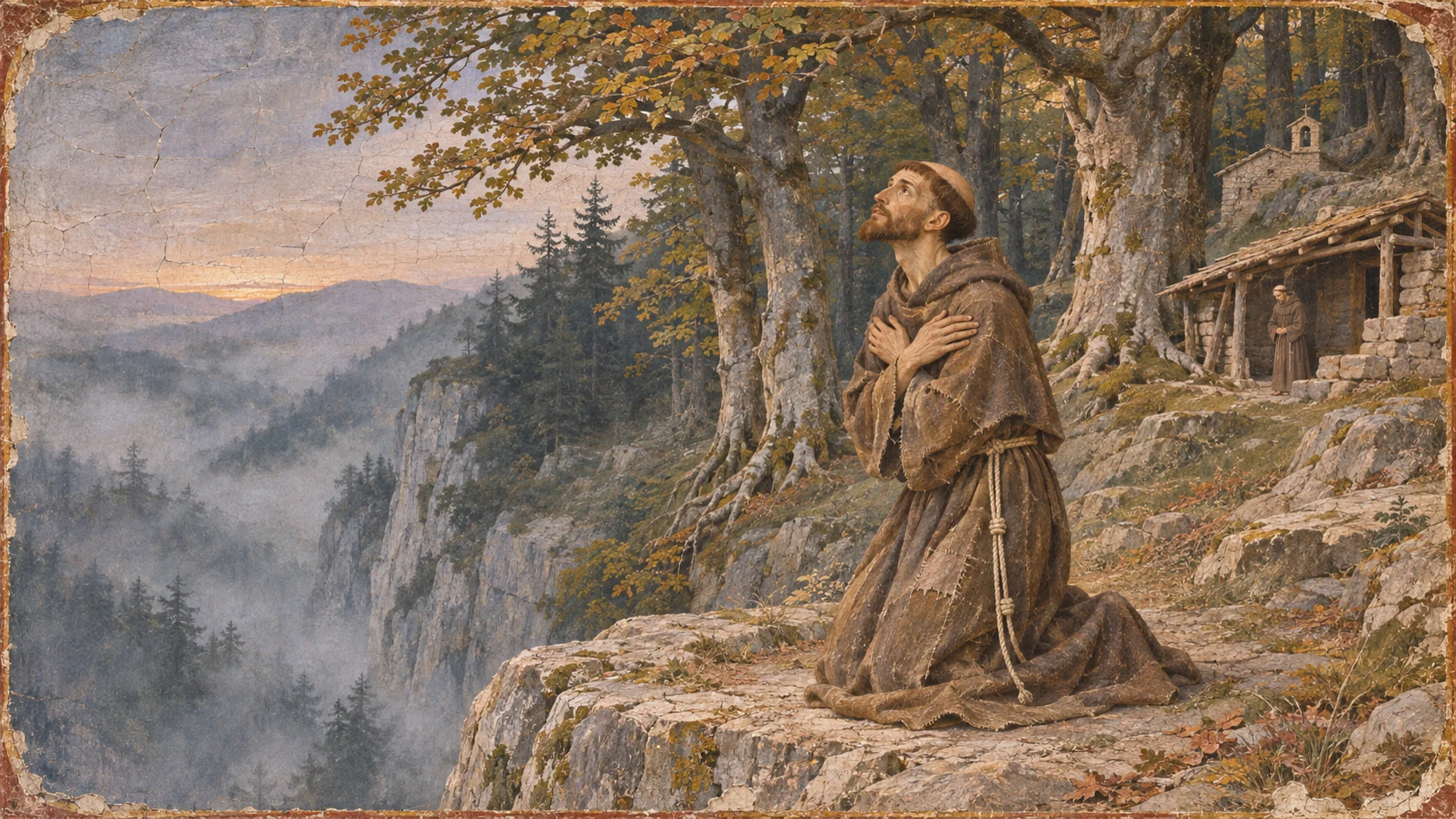
La Verna rises in the Tuscan Apennines, above the Casentino Valley. Its great mass of limestone is cut by cracks, caves, and blocks that seem to have tumbled over one another. Tall beech trees shut out the light. In winter, snow transforms the path. Even in summer, the shade can be cold.
In 1213, Count Orlando Cattani of Chiusi met Francis and offered him the mountain as a place of retreat. The sanctuary and local diocese preserve this date, and later documentation reaffirmed the gift. Francis accepted the use of the mountain as a place of prayer for the brothers, rather than as personal property to make him wealthy.
This gift is a firmly preserved historical fact. The exact conversations between Orlando and Francis appear in narrative traditions. Nobody was hiding nearby with a pen, taking down every word. We know the event; the conversation was embellished to convey its meaning.
Before the great churches
Today La Verna has a basilica, chapels, corridors, and works of art by the Della Robbia family. Almost none of this existed during Francis’s first retreats. There were simple huts and, from about 1216, a little chapel dedicated to Saint Mary of the Angels. The great basilica was begun much later and took centuries to acquire its shape.
When we imagine Francis, we need to remove the later buildings in our minds. What remains is forest, stone, a poor shelter, the little chapel, and a few brothers. Nature itself provided the most powerful architecture.
This care matters historically. The present sanctuary is precious, but it brings together layers from the thirteenth century onwards. Saying that Francis prayed in the “basilica” as it stands today would place the future inside the past.
The retreat of 1224
Francis visited La Verna more than once. The best-remembered retreat took place in 1224, around the feast of Saint Michael the Archangel, celebrated on 29 September. He regularly observed periods of fasting and prayer. His health was already failing, and changes within the brotherhood troubled him.
Brother Leo, a very close companion, was with him. Tradition describes Francis seeking deeper solitude and Leo approaching at appointed times. A small piece of parchment preserved in Assisi, on which Francis wrote a blessing for Leo, provides an extraordinary material link between the two.
We do not know their routine hour by hour. A scene in which Leo leaves bread near the hut or waits at a distance is a plausible reconstruction based on the hermits’ way of life. It should not be mistaken for a diary entry.
The desire to be like Jesus
Hagiographical sources say that Francis longed to experience, as far as possible, Christ’s love and pain. During prayer, he is said to have seen a figure like a six-winged seraph and, at the same time, the image of the Crucified Christ. Afterwards, marks resembling the wounds of crucifixion appeared on his hands, feet, and side.
This event is known as the receiving of the stigmata. In Catholic tradition, it is a unique gift of grace. Historians need to distinguish levels of testimony. Francis left no description of the event in his own writings. The early biographers told the story of the vision. Companions and people who saw his body, especially after his death, affirmed that the marks were there.
So the presence of wounds was attested very early; the full form of the vision reaches us through hagiographical narratives. Its religious meaning does not require us to pretend we possess a recording of the moment.
A secret kept
Francis does not seem to have tried to display the marks. The sources say he attempted to hide them, covering his hands and feet. This fits his habit of avoiding personal glory. The event did not turn him into a powerful ruler. He came down the mountain frailer than before.
Brother Leo and other companions noticed the signs. After Francis’s death, Elias, a leader of the Order, announced that he bore Christ’s five marks. Thomas of Celano also described them in the first biography. These texts were written close to the events, though for a community that already revered Francis as a saint.
It is accurate to say, “Early witnesses said they had seen the marks.” It is less accurate to say that we know their precise medical form or how they appeared. A responsible historian can acknowledge the testimony, its setting, and its limits without either mockery or exaggerated certainty.
The vision and its language
Why a seraph? In the Bible, seraphim are beings associated with the burning nearness of God. The image of wings and crucifixion seems to join love and suffering. The account offers spiritual language for something beyond ordinary words, rather than a fantastic creature to decorate the mountain.
Details vary between sources and works of art. Painters needed to make the invisible visible. So they created rays linking the heavenly figure to Francis’s body. These rays are an artistic and theological solution, rather than something all the texts describe in the same way.
Our imagination can fall silent before the rock. Perhaps it is more faithful not to fill in every second. Some stories ask for light; this one also asks for shadow.
Brother Leo, near and far
Leo matters because he prevents us from turning Francis into a completely solitary hero. A brother was nearby: someone who knew him when he was tired, prepared what he needed, received his words, and kept his memories.
The blessing written for Leo begins with the biblical blessing, “May the Lord bless you and keep you.” On the parchment Francis also drew the Tau, the sign he loved. This is a surviving historical object, although scholars debate the exact dates and circumstances of some writings associated with La Verna.
We can imagine Leo receiving the small piece of prepared skin, studying the uneven handwriting, and putting it away carefully. The gesture is reconstructed, but the parchment exists. La Verna holds that tension between an experience we cannot touch and an object that has crossed eight centuries.
Split stone
La Verna’s enormous cracks inspired stories. An old Christian tradition at the sanctuary connected the split rocks with the earthquake at Jesus’s death. Geology offers another explanation: the limestone mass underwent fractures and great natural shifts.
We do not have to make one reading destroy the other. The geological explanation describes how the rock formed and split. The tradition describes how medieval pilgrims interpreted the landscape in the light of Christ’s Passion.
Calling the cracks physical proof of Calvary would be a devotional claim, not a geological one. Understanding this does not make the path less impressive. The natural world is already astonishing.
The descent
After the retreat, Francis came down. His health was worsening. Walking was difficult, and he needed help. There were still letters to dictate, brothers to comfort, and songs to sing. The experience of La Verna did not separate him from everyday life.
One possible reconstruction shows the little group moving slowly through the forest. Leo watches where Francis puts his feet. The saint keeps his hands hidden in his sleeves. No choir fills the sky; there are leaves, pain, and the effort of each step.
We do not know every movement of the descent. But the sources agree that Francis continued among the brothers and that the marks became known. The mountain was not the end of his story. It was a passage into his last two years.
An event debated and cherished
Over the centuries, scholars, doctors, believers, and critics have proposed different explanations for the stigmata. Some receive them as a miracle. Others seek natural or psychological causes. The documentation does not allow us to repeat an experiment or examine the body today.
The French historian André Vauchez, quoted in Franciscan studies, observes how difficult it is to define precisely what occurred, while also recognising that the early testimonies cannot reasonably be ignored. This caution is valuable. It protects readers from two easy shortcuts: believing every late detail, or dismissing all testimony without examining it.
On this website, we distinguish between Francis’s historical presence at La Verna; very early tradition and testimony about the marks; religious narratives of the vision; and later interpretations in art and medicine. Each layer deserves its own name.
What La Verna asks
La Verna does not ask visitors to seek wounds. It asks them to contemplate a love willing to stay close to those who suffer. Francis did not want pain for its own sake. He wanted to resemble Jesus in his unguarded love.
For a twelve-year-old reader, this must be said carefully: nobody should hurt their own body to imitate a saint. Franciscan life cares for the sick and respects the body. The message is to stay beside those who suffer, rather than to seek suffering.
It is also all right not to understand everything. Medieval faith lived with signs, dreams, and visions differently from our own. Listening to that language does not require us to give up our questions.
The sheltering forest
Centuries passed. Other chapels rose beside the little one. Artists covered walls with images. Pilgrims opened paths. The forest remained like a great church aisle roofed with leaves, protected today within the Casentinesi Forests National Park.
Visitors may know the dates and still feel that the place is larger than them. The document of 1213 explains the gift of the mountain. The architecture explains the sanctuary’s growth. The biographies explain what the first brothers believed had happened. None of these alone can contain all of La Verna.
Up on the mountain, Francis became smaller still. He brought down no theory. He brought a fragile body and the decision to keep loving. Between the cold stone and the morning light, the secret remains—as a question rather than a hidden trick: how far can a heart go when it longs to become like love?
Annotated sources
- La Verna Sanctuary, “History”. The sanctuary’s own official source for the gift of 1213, the retreats, and the development of the buildings. Read
- Diocese of Arezzo-Cortona-Sansepolcro, “La Verna Sanctuary”. Institutional overview covering Orlando’s offer, the original chapel, the 1224 retreat, and the dates of the later basilica. Read
- Thomas of Celano, First Life of Saint Francis. Early hagiographical source for the marks seen on the body and their interpretation; close to the events, but written to proclaim Francis’s holiness.
- Brother Elias’s letter after Francis’s death. Early testimony announcing the five marks; important evidence of how quickly the news spread within the Order.
- Franciscan Intellectual-Spiritual Tradition, “Feast of the Stigmata”. Recent Franciscan study bringing together sources and quoting the caution of historian André Vauchez. Read
- Casentinesi Forests National Park, “La Verna Sanctuary”. Official source for the landscape, limestone formations, ravines, and forest that shape the experience of the place. Read
- Benedict XVI, address prepared for La Verna (2012). Official theological reading of the relationship between cross, love, and creation; not a medieval source, but shows how the tradition is interpreted today. Read
- Municipality of Chiusi della Verna, introduction to the sanctuary. Municipal reference for the mountain’s heritage and historical continuity. Read