
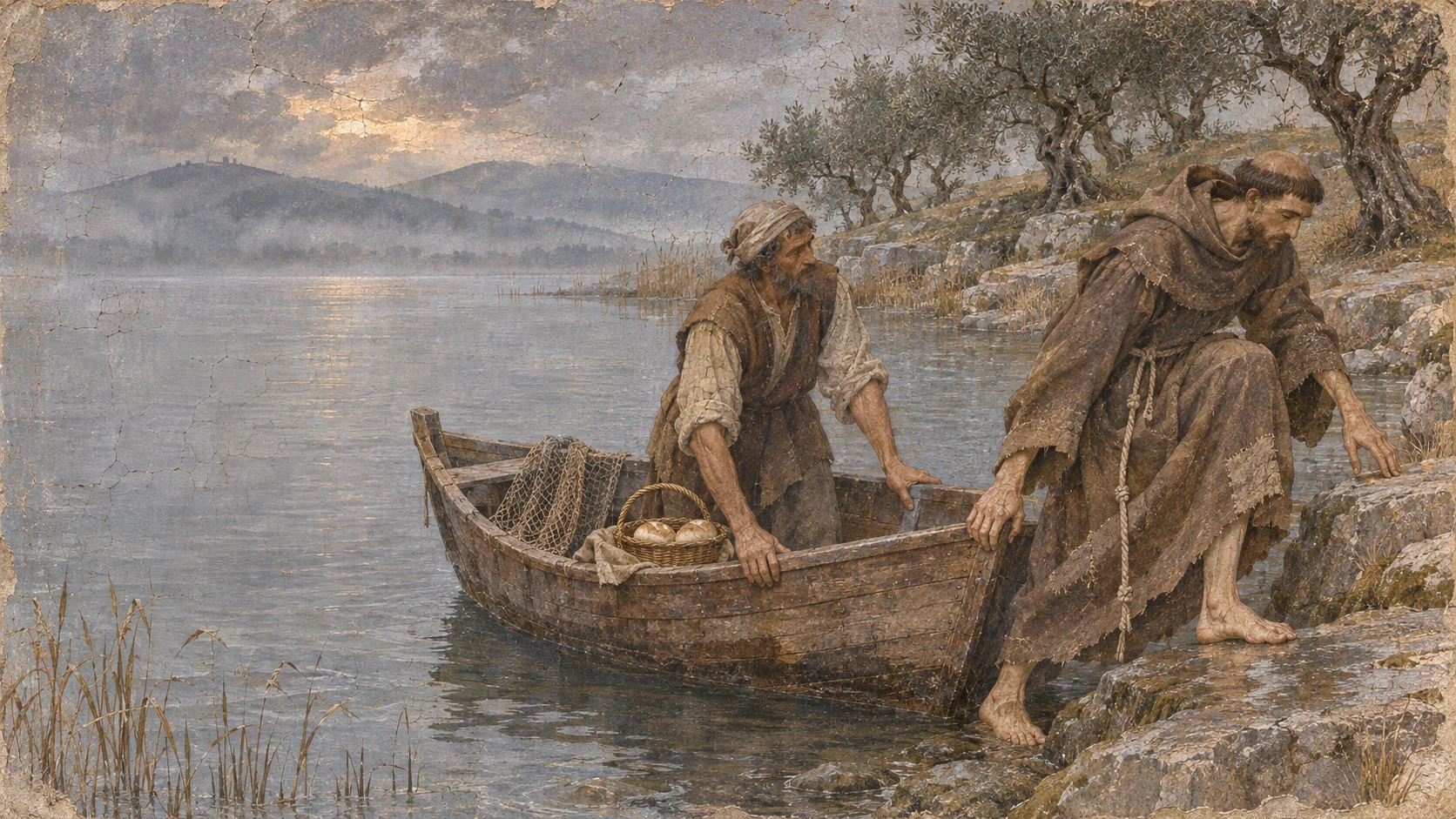
Lake Trasimeno is not a sea, but it knows how to seem vast. When the sky hangs low and wind pushes across the water, the opposite shore disappears. In the middle of that silver and gray space, Isola Maggiore rises with olive trees, stones, and a little village.
Tradition says that Francis came here to spend Lent in hiding. He asked a friend to take him by boat during the night and tell no one where he was. He brought two loaves of bread. When the boatman returned weeks later, he found one loaf whole and only half of the other eaten.
The silence in this story is so powerful that we can almost hear water lapping against the hull. Yet it does not appear in the texts written closest to Francis’s lifetime. The version we know is in the fourteenth-century Fioretti. More than a century separates the possible retreat in the early thirteenth century from the account we have.
That does not mean readers must throw the memory away. It means approaching it by two lights: the light of devotion and the light of history.
An island that was not always empty
“Maggiore” means “larger,” but this is not Trasimeno’s largest island. It is the second largest and the only one that still has a small inhabited village. In the Middle Ages, fishing families learned to read shifting winds, the places where fish gathered, and the danger of storms.
The island’s appearance today blends many ages. There are medieval churches, altered houses, Franciscan ruins, and later buildings. Visitors should not imagine that Francis found the same landing stage, the same house fronts, or the castle visible today. The landscape of water and hills remains; the buildings tell the stories of different centuries.
The Fioretti describe the island as uninhabited and covered in vegetation. Local history records human life there long ago. Perhaps the author wanted to emphasize the secluded part where Francis was said to have stayed, rather than provide a population survey. Perhaps he was passing on an image that had already changed. A spiritual story does not necessarily ask the same questions as a map.
That is why this chapter’s artwork leaves out the later village and focuses on a rocky shore. It does not try to reconstruct the whole settlement of 1211. It chooses the symbolic moment when a boat pulls away and someone is left alone.
The boatman’s night
According to the Fioretti, Francis was staying near the lake in the home of a devout man when he wished to spend Lent on an island. He asked his host to take him there on the night of Ash Wednesday and keep it secret. The man was to collect him only when Holy Week drew near.
The tale depends on a person whose face we can barely make out. The boatman rows, leaves Francis, and goes home. Then he keeps the secret for weeks. At last he returns and becomes the witness to the loaves.
Without him, there would be neither retreat nor story. Like the friend who offers a tunic in Gubbio, this figure reminds us that Francis’s solitude never meant complete independence. Someone grew the wheat, baked the bread, knew the water, and agreed to come back.
On a real crossing, the boat would have been small and the cold damp. We do not know whether there was a storm. Local memory points to a landing rock and speaks of dangerous waves; this detail does not belong to the central Fioretti account in the same way. It may have grown to make the arrival more dramatic, or it may preserve memories of the lake’s real dangers.
Our painting chooses water after rain rather than a miracle amid enormous waves. The fishermen’s everyday lives already held enough danger.
A shelter among thorns
The text says that Francis found thick undergrowth, thorn bushes, and tangled plants forming a kind of hut. There, it says, he prayed and contemplated throughout Lent. There is no description of a comfortable little room. There is earth, branches, and time.
Today, a cave and other spots on the island are shown as places where he rested. Devotion makes a place something we can touch: this stone, this spring, this path. Archaeology, however, cannot securely connect every detail with a man who may have stayed there briefly eight centuries ago.
The difference between “a place held sacred” and “a proven location” does not lessen a visitor’s prayer. It simply changes the sentence. Instead of saying, “Francis slept right here,” we can say, “For many generations, people have come here to remember his search for silence.” That statement is true, and already profound.
Medieval silence was not a complete absence of sound, either. There were birds, insects, rain on leaves, snapping wood, distant oars, and bells carried by the wind. Solitude did not mean erasing the world. It meant listening to it with fewer voices competing for the heart.
Two loaves and a half-measure of humility
The detail of the loaves is the tender heart of the account. Francis is said to have brought two small loaves and eaten only half of one by the end. The Fioretti explain that he did not want to match Jesus’s forty-day fast perfectly. Eating a little was a way of rejecting vanity.
This extreme fast must not become an instruction for children or adults. Going for weeks with almost no food is dangerous. The medieval tradition uses bread to speak about following Christ and being humble, rather than to offer a health plan.
Nor can we check the amount. The boatman in the tale would be the witness, but we have no separate statement from him. The episode appears in a work intended to show similarities between Francis and Jesus. The number forty already carried enormous biblical meaning: it recalled the Flood, Moses, Elijah, and Jesus’s time in the desert.
This helps us read the text. Perhaps a true memory of a retreat was shaped into a biblical pattern. Perhaps the episode grew entirely within tradition. There is not enough written evidence to choose between those possibilities with certainty.
We can, however, keep the question rather than the count: why did Francis seek places where no one would applaud him? The Fioretti answer with half a loaf. Even an admirable practice can feed pride. True poverty includes refusing to make a trophy of what we give up.
The Franciscan presence came later
A community of Friars Minor settled on the island in the late thirteenth century. The church and friary associated with Saint Francis date from after the time when he is said to have made his retreat. Other chapels and markers were built to preserve the memory.
This happens in many Franciscan places. First there is a visit or a tradition. Then pilgrims come. Next, walls rise to protect, welcome, and explain. In time, a building can seem as old as the story, though it belongs to another generation.
On Isola Maggiore, that sequence is especially clear. The story of solitude eventually drew a community. The hiding place became a destination. A story about going unseen came to be put on display.
We need not call this hypocrisy. People build because they want to care for something. Still, the place offers a warning: a monument to silence can become noisy. Visitors must recreate within themselves the space that the walls can no longer provide.
The lake teaches limits
An island has a clear boundary. To leave, you need a boat. To find bread, help, or company, you must cross water. This limit can protect a retreat, but it also reveals our dependence on others.
Francis did not live there forever. Tradition tells the boatman to return. Lent ends; the journey begins again. Franciscan solitude is not a permanent escape from people. It is a pause that lets someone return with a heart less occupied by itself.
The lake also teaches that no surface stays still. The water changes with light, wind, and clouds. Anyone who tries to hold on to a single picture of the place misses what makes it alive. Memory works in a similar way: it reflects the sky of each age, preserves some depth, and also distorts.
So we need not choose between believing everything and feeling nothing. We can look at the traditional rock without demanding that it prove the impossible. We can read the Fioretti without pretending they were written in 1211. We can admire the fast without copying a physical danger. We can enter the silence without forgetting the boatman who made the journey possible.
In this pilgrimage’s image, there are loaves inside the boat. We do not claim there were exactly two, or that they returned almost untouched. They represent the familiar tradition. What the scene offers as reality is more modest: cold water, wet stone, one man helping another ashore, and an island large enough to let him disappear for a while.
When the boat pulls away, Francis does not carry an answer. He carries questions, prayer, and what he needs to avoid confusing trust with recklessness. The lake remains between him and the world — a pause rather than a wall of scorn.
Perhaps this is Isola Maggiore’s most certain legacy. Every heart needs a shore where the noise does not reach it at full strength. But even there, we arrive thanks to someone else. And when the time comes, we must accept the boat’s return.
Water, words, and memory
Sources for this pilgrimage
- The Little Flowers of Saint Francis — chapter VIILater narrative source. Preserves the story of the boatman, the two loaves, the shelter of plants, and the Lenten retreat; it was written more than a century after the traditional date.
- Umbria Tourism — Isola MaggioreRegional heritage. Presents the island, its village, the tradition of the retreat, and the later arrival of a Franciscan community.
- Trasimeno APP — park and islandLocal memory. Records the traditional date of 1211, the landing chapel, and the revered rock, details that require us to distinguish devotion from proof.
- Union of Trasimeno Municipalities — park and islandsOfficial geography. Helps place the island within the lake's natural environment, history, and human life.
- Noel Muscat — “The Places of Saint Francis”Critical Franciscan study. Discusses the links between places, worship, and memory, and why traditions about locations need to be compared with written sources.
- Franciscan Archive — chronological guide to the sourcesGuide to the documents. Allows readers to compare the dates of Francis's earliest biographies with the later writing of the Fioretti.
- A. G. Little — “The Sources of the History of St. Francis”Academic study of historical writing. A classic study of how to weigh Franciscan biographies and collections from different periods.
How we read this place: the geography and the later Franciscan presence can be documented. Francis's retreat, the loaves, and the boatman's secret come to us through a later literary tradition rather than a contemporary witness. The image is an artistic reconstruction and includes no later buildings.