
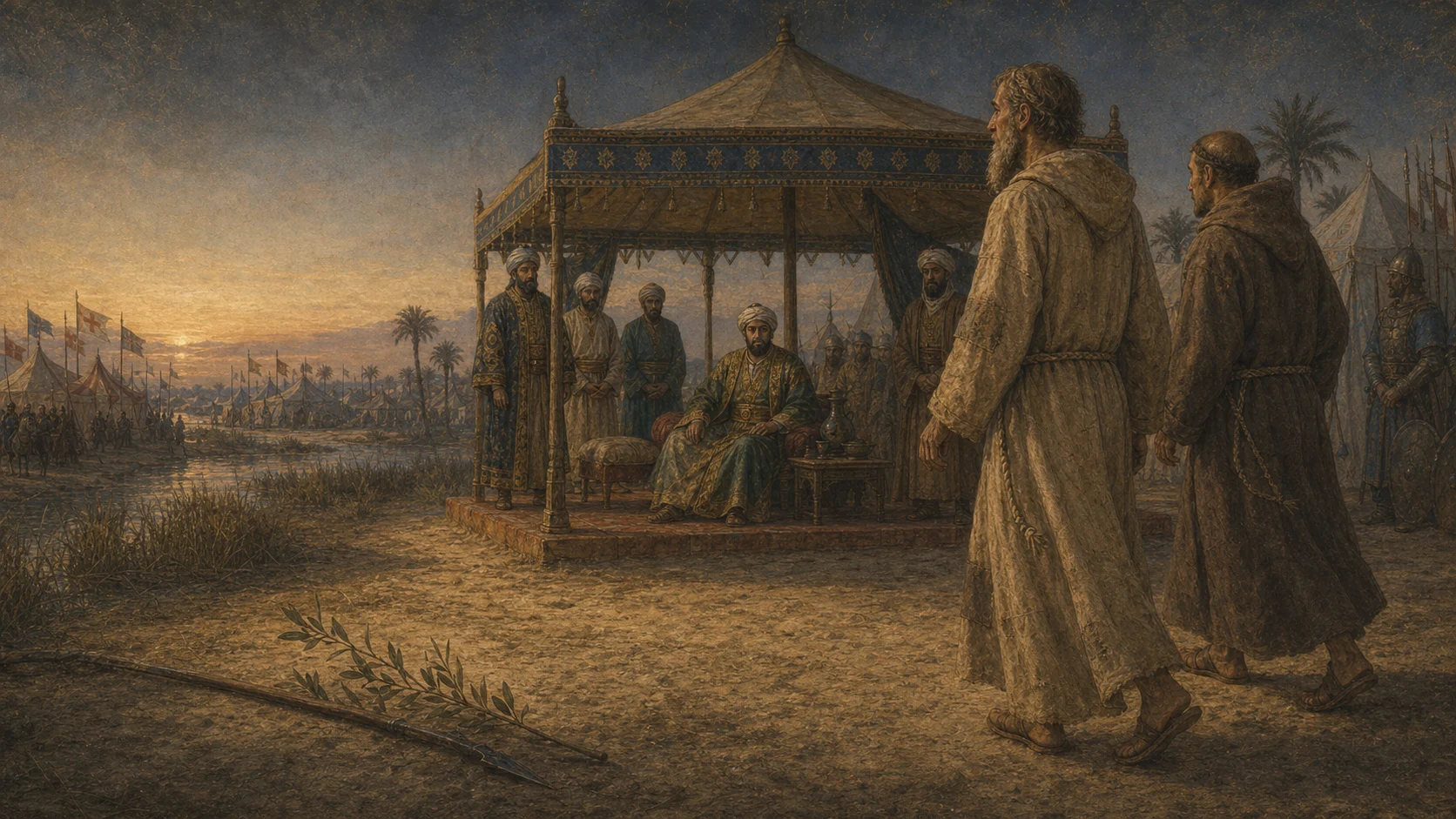
The noise of a new war
Saint Francis of Assisi knew war before he wore a poor tunic. He had fought between Assisi and Perugia, been captured, and spent about a year in prison. The memory of violence was part of his story.
Years later, another war brought much larger armies together in Egypt.
It was the Fifth Crusade. Christian forces from Europe were trying to conquer Damietta, a strategic city near the mouth of the Nile. On the other side stood the Ayyubid army commanded by Sultan al-Malik al-Kamil.
The Crusades mixed faith, politics, trade, territory, and the desire for power. Christians and Muslims were taught to see the other side as the enemy. Around Damietta there were weapons, hunger, disease, and fear.
Saint Francis traveled to this place in 1219.
Why did Saint Francis go?
The early Franciscan sources state that Saint Francis wished to proclaim his faith and accepted even the risk of martyrdom. Modern authors also see an impulse toward peace in his journey. We cannot place a single intention within him as though we had read his diary.
Perhaps proclamation, the desire for encounter, and courage in the face of danger were joined in a way we can no longer separate.
What we know is extraordinary in itself: Saint Francis did not travel to Egypt as a soldier. He carried no sword. He crossed the sea as a friar.
Other companions were with him. When he decided to cross the lines between the armies, he went with Brother Illuminatus.
Two unarmed men would walk through a place where almost every stranger could be treated as a threat.
The attempt to stop the battle
A biography written by Thomas of Celano says that Saint Francis tried to warn the Christian fighters before an attack. According to the account, he realized the assault would end badly.
The leaders did not listen to him. The fighting brought many losses.
We do not know exactly what Saint Francis saw or said. But the scene fits something he had learned since his youth: a battle is never as clean as the speeches delivered before it.
In the camp, talking about peace could seem like weakness. Each side carried reasons, fears, and wounds. When everyone expects courage to produce an attack, it is difficult to recognize the courage that tries to stop it.
Saint Francis chose to cross over.
Between two camps
He and Illuminatus left the Christian side and advanced toward the Muslim positions. They were probably detained and mistreated by soldiers before explaining that they wished to speak with the sultan.
They did not walk across a golden bridge. They walked over ground marked by war.
Imagine the moment: Christian banners behind them. Ayyubid guards ahead. Around them, languages they may not have fully understood. Any wrong gesture could be interpreted as a threat.
They had no way to force anyone to receive them.
Al-Malik al-Kamil decided to receive them.
The sultan was not merely a figure in the background of Saint Francis’s story. He was a real Muslim ruler, with political responsibilities and a life of faith of his own. During the Crusade, he had proposed peace agreements that included significant territorial concessions, but the Christian leaders rejected them.
To reduce him to the role of “the man who listened to Saint Francis” would be to lose half the encounter.
What did they say to one another?
This is the part where we must respect history’s silence.
Christian sources say that Saint Francis spoke about his faith. Some add debates, challenges, and miracles. Later accounts make the scene increasingly dramatic. We do not have a transcript of the conversation. Muslim sources close to the period do not clearly identify Saint Francis, although there are indications that Christian religious figures were present at the sultan’s court.
We therefore do not know the exact words.
We know that the encounter lasted long enough to make an impression. We know that Saint Francis and Illuminatus left alive. Some sources say that the sultan offered gifts, which Saint Francis did not accept for himself. We also know that neither man abandoned his religion.
This may seem less spectacular than a story of victory. In fact, it is more human.
A poor Christian spoke about his faith. A Muslim ruler listened. There was difference without massacre, conviction without a sword, and hospitality where war expected to produce only enemies.
Encounter does not mean pretending that every difference has disappeared. It means refusing to let difference turn a person into a thing.
The sultan who also sought peace
Al-Kamil ruled in a difficult situation. His power was threatened by the invasion, political disputes, and the risk of losing Damietta. Even so, he tried to negotiate.
At different times, he offered the crusaders the return of Jerusalem and other territories in exchange for their withdrawal from Egypt. The Crusade’s leaders rejected proposals that could have prevented deaths.
This does not make the sultan a perfect character. Medieval rulers made decisions within violent worlds. But it prevents us from repeating an unjust picture: one side portrayed as fully human before another side without a face.
Al-Kamil had a face, a family, faith, intelligence, and a desire to protect his people. Saint Francis met someone, not a category.
Perhaps that was one of the greatest events of that crossing.
No victor before the tent
Old paintings sometimes present the encounter as a religious duel. In some of them, Saint Francis faces a trial by fire. That scene appears in later sources, and its historicity is much debated.
Here we choose another image: two people separated by war and united for one moment of listening.
Saint Francis did not defeat al-Kamil. Al-Kamil did not capture Saint Francis. The encounter did not end the Crusade. Damietta would still fall, and further suffering would continue.
So did he fail?
Not every seed can stop a storm on the day it is planted. The gesture has crossed eight centuries and continues to ask whether faith must produce hostility.
Saint Francis returned from Egypt carrying an experience that may have deepened his way of thinking about mission. The Earlier Rule of 1221 contains a remarkable instruction for brothers who went among Muslims and other non-Christians.
One way of being among them was to create no disputes, to be subject to every human creature for God’s sake, and to bear witness that they were Christians. Only afterward, when they saw that it pleased God, could they proclaim their faith more directly.
Presence before argument. Humility before victory.
Peace is not a calm setting
Sometimes we imagine a peaceful person sitting far from every conflict. Saint Francis walked into one.
Peace does not mean ignoring injustice or demanding silence from those who suffer. Nor does it mean agreeing with everything. It means seeking a path that protects dignity even when the truth must be spoken.
The meeting at Damietta offers no ready-made formula for every war. It offers a posture: approach without a weapon, listen without erasing your own identity, and discover that the other person has a story larger than our fears claimed.
It is a difficult gesture at school, in the family, online, and among peoples.
When we call someone only an “enemy,” we stop asking questions. When we encounter their name, pain, and hope, a bridge begins to exist.
What Damietta teaches us
Saint Francis crossed a visible boundary between two armies. We cross smaller boundaries every day.
There is the person with whom we disagree. The classmate who belongs to another group. The religion we do not know. The family that learned different customs. The opinion that frightens us before we even hear it.
The first step does not have to be winning an argument. It can be asking sincerely: how do you see this?
Listening does not require you to abandon your convictions. It asks only that you remember there is a person before you.
At Damietta, weapons still surrounded the horizon. But for a while, inside a tent, war did not decide everything.
The bridge no weapon can build
Cross without causing harm.
Between Saint Francis and al-Kamil stood armies, languages, and different beliefs. An encounter began when courage laid the sword on the ground.
The two shores still watch each other through fear.
For those who wish to go deeper
Sources for this chapter
- Ancient Model for Modern Dialogue — Order of Friars MinorExamines the 1219 encounter, the Christian traditions, and the limits of the available Muslim sources.
- Letter for the 800th Anniversary of the EncounterAn official Franciscan reflection on dialogue, witness, and respect between Christians and Muslims.
- Address of Pope Francis in MoroccoPresents the encounter as a sign of courage, friendship, and a path of peace.
- St. Francis and the Sultan, 1219–2019A historical booklet from the Order with studies on al-Kamil, the Fifth Crusade, and the memory of the encounter.
There is no transcript of the conversation between Saint Francis and al-Kamil. Dramatic details found in later biographies are debated. This chapter retains the historically secure core and identifies as interpretation what cannot be confirmed.
Historical note: Saint Francis and Brother Illuminatus met al-Malik al-Kamil near Damietta in 1219, during the Fifth Crusade. The encounter is attested by different Christian sources; its interpretation has changed over the centuries. No reliable source says that the sultan converted, and this page does not suggest that he did.