
A voice from the other side of the city
While Saint Francis of Assisi and the first brothers walked the roads, a young woman watched them from within the walls of Assisi.
Her name was Clare. She belonged to the Offreducio family, which was connected to the local nobility. She grew up in a house very different from the friars’ huts. She knew fine clothes, servants, social rules, and the plans an important family could make for a daughter.
In that world, the marriage of a young noblewoman was not only about love. It could unite families, property, and influence. Other people took part in deciding her future.
But Clare was listening to another voice.
The early sources speak of her concern for the poor from a young age. They also say that she heard Saint Francis preach in Assisi. Perhaps in a church. Perhaps in a square. We do not know the exact first moment when their paths crossed.
We do know that his message found something already awake within her.
It was not only admiration
Clare did not want to watch a courageous life from a distance. She wanted to answer with her own life.
She secretly sought out Saint Francis, accompanied by someone she trusted. They spoke about Jesus, poverty, and a freedom that did not depend on dresses, marriage alliances, or social position. Saint Francis recognized earnestness in the young woman. Clare recognized in the brothers’ path the form of life she desired.
It is important not to tell this story as a hidden romance. The friendship between Clare and Saint Francis was profound, but it grew from their search for God and a shared Gospel vision. They would help one another for many years without either becoming the other’s shadow.
Clare was not a secondary character in the story of Saint Francis. She became a founder, leader, writer, and guardian of her own way of living poverty.
At that beginning, however, she was still a young woman facing an immense decision.
Palm Sunday
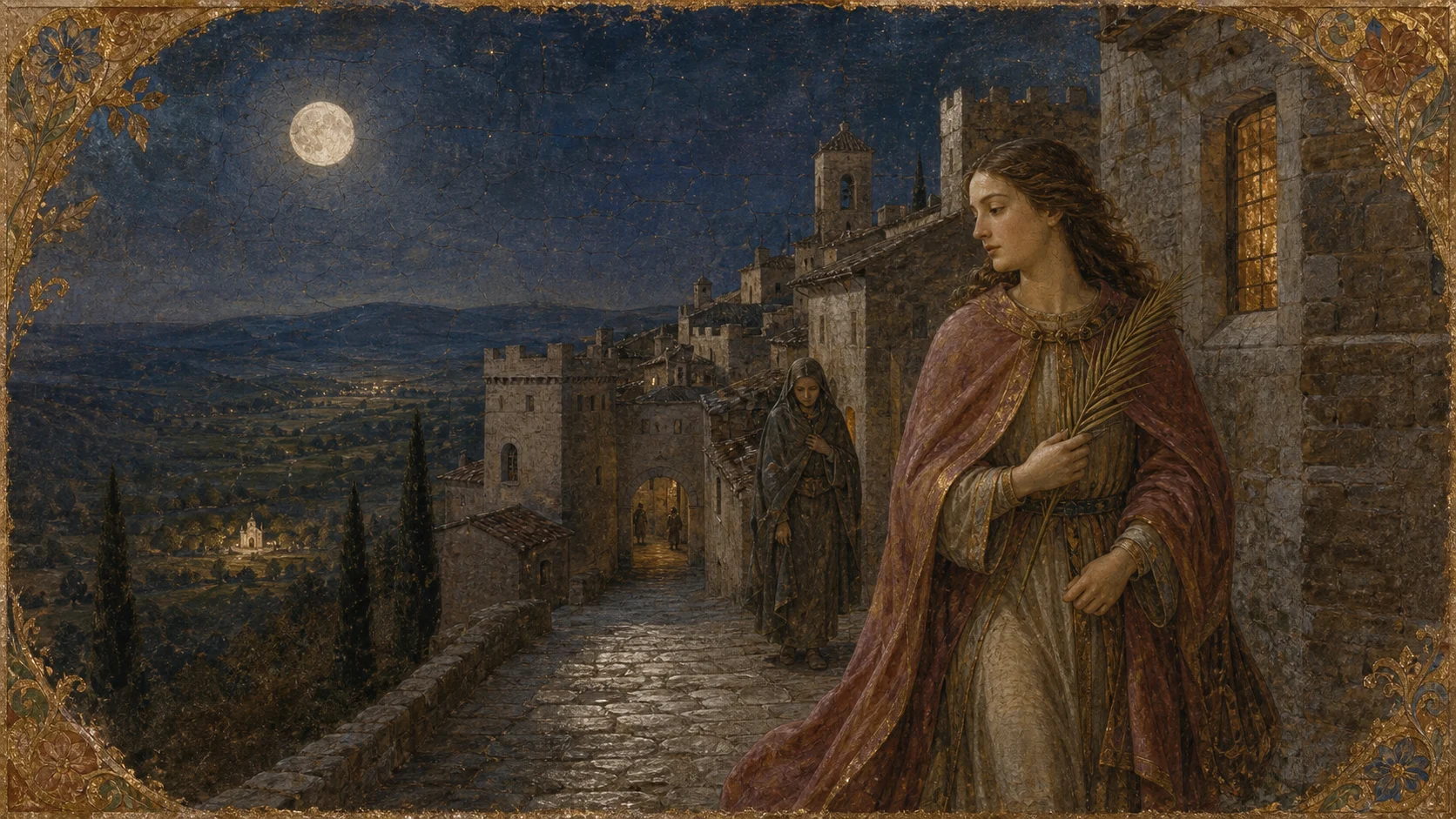
Tradition places her departure on the night of Palm Sunday, in 1211 or 1212. That morning, Clare took part in the celebration at the Cathedral of San Rufino.
An early biography says that while other people went forward to receive their palms, she remained in her place. The bishop of Assisi came down and placed the palm in her hands.
We do not know what Clare thought at that instant. We can only imagine the weight of that palm.
It recalled Jesus’s entry into Jerusalem, where he was welcomed as a king. A few days later, the crowd would change, his friends would flee, and Jesus would follow the way of the cross.
The palm spoke of joy and also of courage. Of welcome and also of self-giving.
Perhaps Clare carried it with her when night came. Some traditions suggest this; others do not say. On this page, the palm is also an image of what she kept in her heart: a choice she could not yet show everyone.
The hidden door
When the city fell asleep, Clare left her family home.
Medieval sources speak of a difficult departure through a door that was usually kept blocked. By crossing it, she was not simply changing her address. She was leaving a future defined by her social position.
A companion accompanied her for part of the journey. Details and names vary among the accounts. What matters remains: Clare did not make that crossing before a crowd. She made it in the dark.
Imagine Assisi without electric lighting. Moonlight touches the stones but leaves wide areas hidden. The windows are closed. Every sound seems louder. The road descends from the city into the valley.
Below, near the little Portiuncula chapel, Saint Francis and the brothers waited for her with torches.
Each step carried Clare farther from familiar security. Each step also brought her closer to the freedom she had chosen.
Courage does not mean walking without feeling the weight of the night. It means continuing when a small light has already shown the way.
At the little Portiuncula
The Portiuncula was not a palace. It was a modest chapel dedicated to Mary, surrounded by fields. The brothers prayed and gathered there.
Clare arrived wearing the clothes of her position. During a simple ceremony, she exchanged them for a poor garment. Her hair was cut as a sign of consecration.
Today, cutting one’s hair may seem an ordinary gesture. At that time, a young noblewoman’s hair, jewelry, and clothes were part of her public identity and her prospects for marriage. The gesture declared that Clare now belonged to a different path.
Saint Francis did not keep her living among the friars. First, Clare was taken to a community of Benedictine women at San Paolo delle Abbadesse, where she would have protection and could begin religious life.
Her family tried to make her return.
The sources describe outraged relatives arriving at the monastery. Clare clung to the altar and showed her cropped head, affirming the decision she had made. The account uses a powerful image: that young woman would not be carried back to a life she had not chosen.
Agnes’s courage
Soon afterward, her sister Caterina, who would receive the religious name Agnes, joined her. The family’s reaction was even more intense. One tradition recounts an attempt to drag Agnes away by force.
These stories were written in the language of sainthood and include miraculous elements. Even so, they reveal a real conflict. The sisters’ choice went against powerful family interests and social norms.
Clare did not cross the night simply to find a ready-made life. She had to open a path where there was hardly any road.
After stays in other religious houses, she settled at San Damiano, the church Saint Francis had repaired. There the community of the Poor Ladies was born, later known as the Order of Saint Clare.
Other women arrived. The little light carried through the night became a lit window for many lives.
Clare did not copy Saint Francis
Saint Francis and Clare shared the desire to follow the poor Jesus. But Clare had to discover how this call would be lived by a stable community of women devoted to prayer and fraternity.
The friars walked among towns. The sisters remained at San Damiano. That did not make their life lesser. Their mission had a different rhythm.
Clare cared for sick sisters, guided the community, and wrote letters of great beauty. For years, she fought for the Church to recognize the Privilege of Poverty: the right of her community not to be required to own income and property as a form of security.
She did not defend poverty because hunger was beautiful. She defended a communal trust that, for her, made it possible to follow Christ without being controlled by wealth and alliances.
Near the end of her life, Clare wrote a Rule for the sisters. It was the first known religious rule written by a woman for a community of women to receive papal approval.
The young woman who left in secret became a voice the Church had to hear.
A friendship of mirror and light
Clare compared contemplating Christ to looking into a mirror. Not a mirror used to admire one’s own appearance, but one in which to discover the beauty of humility, poverty, and love.
Her spirituality invites us to look, consider, contemplate, and transform our lives according to what we see in Jesus.
Saint Francis also needed Clare. When he faced doubts and needed to discern between a more withdrawn life and preaching along the roads, he sought her counsel and that of other brothers. Franciscan tradition preserved their friendship as a conversation between whole vocations.
They were not two incomplete halves. They were two free people helping each other remain faithful.
The night did not disappear
We usually tell courageous choices while looking at the outcome. We know that Clare became a saint. We know the churches, paintings, and communities that bear her name. Her departure can therefore seem inevitable.
For her, it was not.
As she crossed the door, Clare did not possess the story of the future. She had a call, a few friends waiting in the valley, and enough light for the next stretch.
Courage rarely comes with a guarantee. Sometimes it looks like a hand holding a palm while feet search for the next stone in the dark.
What Clare’s crossing teaches us
Some decisions cannot be made by anyone else in our place.
That does not mean ignoring all advice or acting without care. Clare talked, discerned, and sought support. But when the moment came, she had to offer her own response.
We also learn that following an inspiration does not mean copying another person. Clare saw a light in Saint Francis and received it in a way entirely her own. She brought forth a community with its own voice, form, and beauty.
Perhaps you cannot yet see the entire road. Ask only: what is the next true step that the light already allows me to take?
The crossing beneath the moon
Open a path through the night.
Clare did not wait for daylight to reveal every answer. She walked with the light she had and made her own choice a lamp for other women.
The city sleeps. A band of moonlight waits by the door.
For those who wish to go deeper
Sources for this chapter
- Letter of Benedict XVI for the Year of ClareProvides context for her encounter with Saint Francis, Palm Sunday night, and Clare's vocation.
- Lent with the Saints: ClareRecounts the walk from Assisi to the Portiuncula and her commitment to an evangelical life.
- Saint Clare of AssisiAn overview of Clare's life, her consecration, and her community at San Damiano.
The chronology of Clare's early life varies: many works indicate 1212, while others give 1211. Details such as the door, the palm carried during her departure, and the exact reactions come from biographical traditions and are presented with caution.
Historical note: Clare was born around 1193 or 1194 and died in 1253. Her Rule was approved by Pope Innocent IV shortly before her death. This narrative avoids reducing her vocation to the influence of Saint Francis: Clare’s own writings bear witness to her voice and discernment.