
A night that still shines
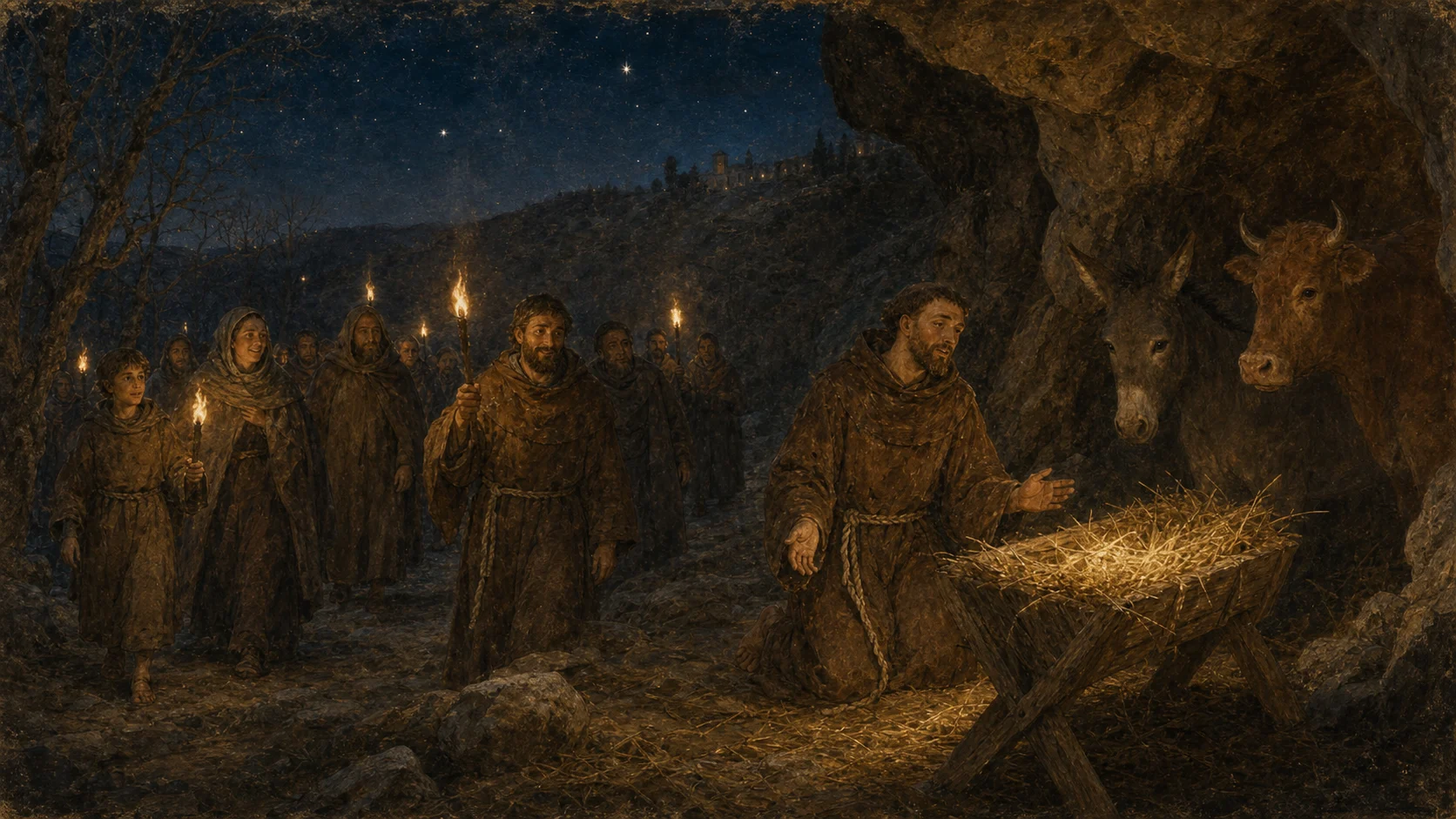
It was December 1223. In the mountains near Greccio, the cold crept into people’s sleeves and made their breath look like smoke. There were few houses. The paths were dark. To reach a cave, people had to climb while carrying torches and lanterns.
Saint Francis of Assisi had recently returned from Rome. That same year, Pope Honorius III had confirmed the friars’ Rule. The fraternity had grown greatly, but he remained in love with small things: a poor church, a piece of shared bread, a word from the Gospel truly lived.
Christmas was approaching. Saint Francis did not want merely to explain that Jesus had been born poor. He wanted to help people see and feel that poverty.
So he called a friend from the area named John and asked for his help. He did not order a throne, an embroidered garment, or a great painting. He asked for a manger, straw, an ox, and a donkey.
It was almost nothing.
And that was precisely why it could reveal so much.
The desire to see with his own eyes
The earliest Franciscan accounts say that Saint Francis wished to recall the Child of Bethlehem and contemplate with his own eyes the hardships of a baby without a cradle or a comfortable home.
He knew the Christmas story well. He knew that Christians heard it every year. But he also knew that a story repeated many times can pass through the ears without reaching the heart.
At Greccio, the manger placed a question before everyone:
If God chose to arrive small and poor, why do we imagine that only what is great, expensive, and powerful has value?
Saint Francis was not trying to make Christmas prettier than it was. He was doing the opposite. He wanted to remove the decorations that concealed its truth.
Jesus was not born protected from human hardship. He entered it. He needed care. He accepted dependence on other people’s arms.
For Saint Francis, this said something extraordinary about God: the Most High was not afraid to be small.
What was in the cave—and what was not
Today we arrange Nativity scenes with Mary, Joseph, shepherds, angels, and the Child Jesus. This tradition is very beautiful. The scene prepared at Greccio, however, was probably simpler.
There was a cave. There was straw in a manger. There was an ox and a donkey. There were no actors playing the Holy Family, and no image of the Child was placed in the feeding trough.
Mass was celebrated at the center of the night.
Saint Francis was a deacon. According to Thomas of Celano, his first biographer, he sang the Gospel and spoke to the people about the birth of Jesus. When he said “Bethlehem,” he seemed to savor the word. When he spoke of the Child, his voice carried tenderness.
This helps us understand what happened: it was not a play. It was a living remembrance, created so that the celebration would touch the senses.
The people saw the straw. They felt the cold. They heard the animals and voices echoing among the stones and trees. Torchlight transformed the dark woodland.
For a few hours, Greccio seemed like Bethlehem.
A celebration made by many hands
Saint Francis had the idea, but he did not accomplish everything alone. John prepared the place. Villagers climbed the mountain. Friars sang. Someone brought the straw. Others tended the animals and lit the lights.
This too is part of Greccio’s teaching.
Christmas did not appear there as something a powerful person delivered to spectators. It was born from a community’s participation. Each person brought what they could.
Perhaps a child held their mother’s hand to keep from stumbling. Perhaps an older person walked more slowly. Perhaps someone arrived tired from work. The early texts do not describe every face, but they make the people’s joy clear.
Thomas of Celano described the forest resounding with song. The night, normally silent and frightening, became luminous.
When different people gather to care for something good, even an ordinary place can become sacred.
The child awakened
Celano also recorded a vision. A man present was said to have seen a sleeping child in the manger and Saint Francis drawing near to wake him.
The account need not be understood as if everyone saw a baby physically appear. The biographer himself offers a meaning: the memory of Jesus lay asleep in many people’s hearts, and Saint Francis helped awaken it.
That image remains powerful.
We can know a story and still let it sleep. We know it is right to share, but we keep everything. We know someone needs companionship, but we hurry past. We know Jesus chose humility, but we continue wanting to seem superior.
Awakening the Child means allowing Jesus’s way to change our way of living.
Did Saint Francis invent the Nativity scene?
It is common to hear that Saint Francis “invented the Nativity scene.” The phrase helps us remember Greccio, but it needs an explanation.
Christians had already portrayed the birth of Jesus in paintings, mosaics, and celebrations before 1223. What made Greccio special was its concrete way of recalling Bethlehem, using a manger, straw, and real animals in the midst of the community.
This experience helped inspire the tradition of Nativity scenes that would spread to many places.
Saint Francis therefore did not create every representation of Christmas from nothing. He offered a new and unforgettable way to bring the scene close to people.
And perhaps his greatest gift was not the format. It was the way of seeing.
After Greccio, a manger could say: God draws near without crushing anyone. The straw could say: love finds a place even when comfort is absent. The night could say: one small light can gather an entire village.
The Christmas that fits in a small home
Sometimes we think a celebration will be good only if there are many presents, perfect food, and beautiful photographs. When something goes differently, it seems that the celebration has lost its value.
Greccio tells another story.
The center of Christmas is not having much. It is making room.
A family can make room to listen to the person who speaks little. A child can set aside a toy in good condition for another child. Someone can apologize before dinner. Someone can visit a person who would otherwise spend the night alone.
These gestures do not imitate the appearance of the cave. They imitate its teaching.
Bethlehem begins again wherever someone agrees to draw near.
The poverty that welcomes
Saint Francis did not love poverty because he liked hunger or suffering. He knew that deprivation hurts and that people in need must be helped.
What he saw in Jesus was a freedom: God did not need luxury in order to love. No person was too simple to draw near. No place was too poor to receive his presence.
Greccio’s poverty is therefore not an excuse to abandon those who suffer. It is a call to remove barriers, share, and welcome.
If our table is full, is there room for someone else? If we receive a gift, can we remember someone who did not? If we have a voice, can we use it to defend a forgotten person?
An empty manger can ask very full questions.
What Greccio teaches us
Saint Francis turned a cold mountain into a school of tenderness. He did this not by covering the night with riches, but by showing that God had chosen fragility.
The Child of Bethlehem does not ask us to pretend we are smaller. He asks us not to use our strength to make others small.
Greccio teaches that the eyes can pray too. Straw, stone, animal, flame, and community helped people understand a truth that words alone might not have reached.
And it teaches something even simpler: when love seems asleep, we can help awaken it.
The star of Greccio
Prepare a place for tenderness.
Think of someone who needs to feel they are not alone. As you light up this night, choose one small gesture to welcome that person.
The night still waits for your small light.
For those who wish to go deeper
Sources for this chapter
- Commission on the Franciscan Intellectual-Spiritual Tradition — GreccioPresents Thomas of Celano's account and explains the simple form of the 1223 celebration.
- Apostolic Letter Admirabile signumRevisits the Franciscan sources, the request made to John, and the spiritual meaning of the manger.
- The Nativity Scene of Greccio, a School of Simplicity and JoyA historical and pastoral reflection published for the celebration's eighth centenary.
The episode is known chiefly from the First Life by Thomas of Celano, written a few years after Saint Francis's death. Imaginative details used to bring the reader closer to the night are not presented as documented facts.
Historical note: Greccio took place on Christmas night in 1223. The celebration had a manger, straw, an ox, and a donkey, but probably no actors portraying Mary, Joseph, and Jesus. Some historians therefore prefer to call it a devotional representation of the Nativity rather than the “first living Nativity scene” in the modern sense.