
The mountain of silence
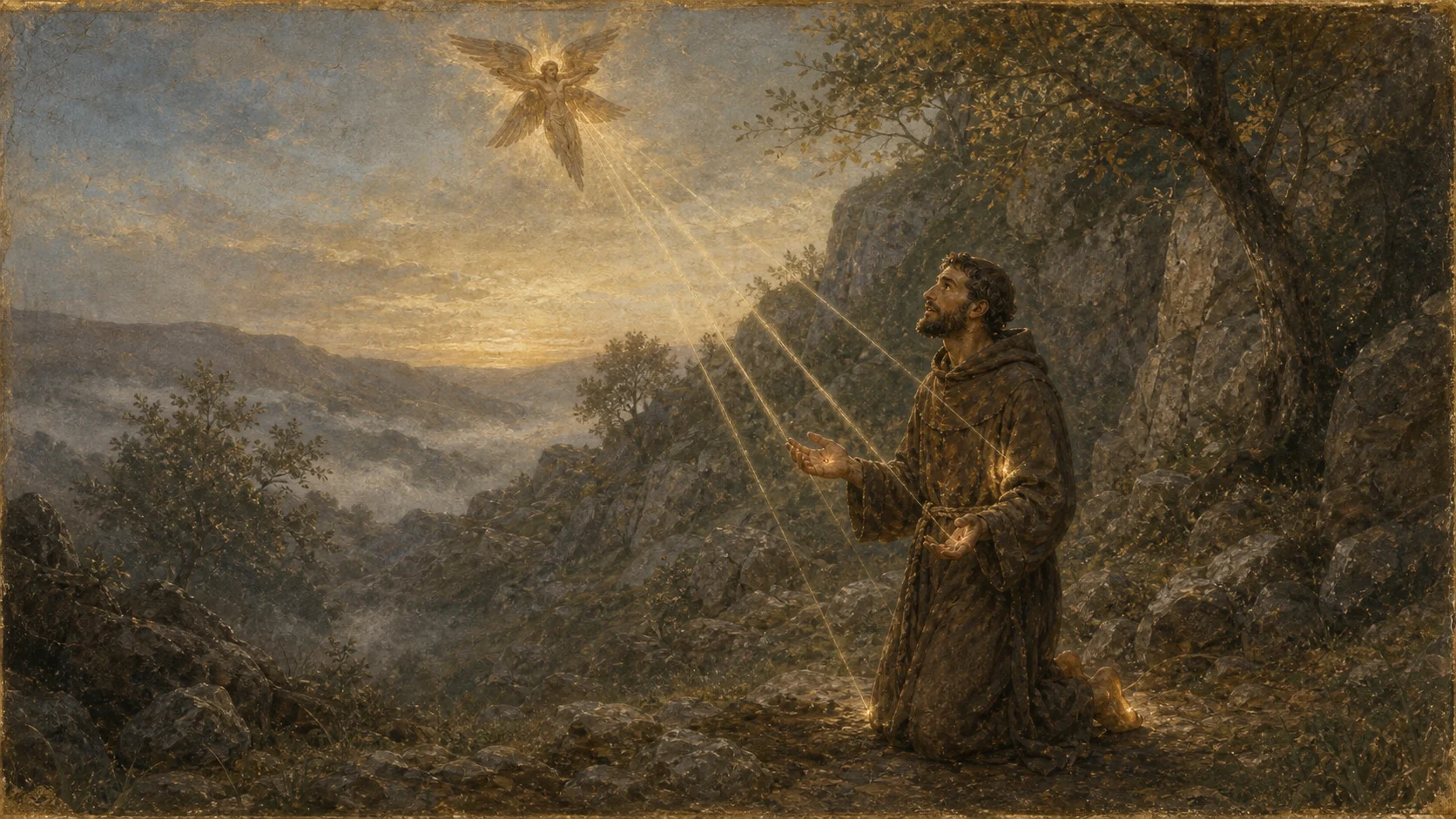
La Verna is a mountain of high rocks, ancient trees, and narrow paths. It lies in Tuscany, far from the bustle of towns. A man named Count Orlando had allowed Saint Francis of Assisi and the friars to use that place for prayer.
In 1224, Saint Francis climbed the mountain for a period of silence. He was tired. Illnesses had accumulated in his body. The fraternity that had begun with a few friends was now enormous, and not everyone understood poverty and simplicity in the same way he did.
Perhaps you have loved something deeply and then realized that you could not control the direction it was taking. Saint Francis knew that pain.
On the mountain, he did not flee people out of contempt. He sought space to return to the center: Jesus.
He took several companions with him, including Brother Leo. At times, they stayed nearby. At others, they respected Saint Francis’s solitude.
There, surrounded by stone and forest, he prayed with a question that had run through his whole life: how can I love as Christ loves?
Joy and suffering in the same prayer
The earliest biographies say that Saint Francis asked to experience two things: the love that led Jesus to give his life and the pain he suffered on the cross.
It is important to understand this carefully. Saint Francis was not teaching that we should seek wounds or hurt the body. His life shows precisely the opposite: he cared for sick people, asked for food for weak brothers, and acknowledged that he had been too harsh with himself.
His desire was for closeness, not violence.
He wanted Jesus’s love to cease being merely a story observed from a distance. He wanted to answer that love with his whole self.
For Christians, the cross brings suffering and self-giving together. It shows human cruelty, but also a faithfulness that does not abandon. Saint Francis’s prayer therefore held sorrow and joy at the same time.
The vision of the seraph
According to the Franciscan accounts, while praying Saint Francis saw a mysterious figure in the sky: a seraph with six wings and the image of the Crucified Christ.
Seraphim appear in the Bible as beings close to God. In Saint Francis’s experience, the figure seemed to unite fire and cross, beauty and suffering.
He was filled with wonder. How could a vision bring such great joy and, at the same time, such painful compassion?
When the experience ended, marks like the wounds of the Crucifixion appeared in his hands, feet, and side. These marks became known as the stigmata.
Saint Francis did not write a description of the event. He also avoided displaying it. He covered his hands and tried to hide his feet. Very few companions are said to have seen the marks while he was alive.
This fits something we already know about him: what was most sacred did not need to become a spectacle.
What we can affirm
The stigmata are among the best-known and most difficult episodes to study in the life of Saint Francis.
Medieval sources report the vision and the marks. After his death, people close to him said that they had seen them. Brother Leo, who was at La Verna, is an important witness in the tradition connected with that period.
At the same time, Saint Francis remained silent about the experience in his own writings. We have no medical examination, photograph, or account written by him stating exactly what he felt.
People of faith and historians can therefore ask different questions. Christian faith recognizes the stigmata as a spiritual gift and a sign of union with Christ. Historical research studies the available testimonies, when they were written, and how they were transmitted.
This portal need not hide any of these questions. Honesty does not diminish the mystery. It prevents us from using mystery irresponsibly.
Five wounds, no weapon
Saint Francis had dreamed of becoming a knight. In his youth, he desired armor, a banner, and victory. Many years later, his body carried five marks—but they were not trophies won over an enemy.
They pointed to someone who refused to win by force.
It is as though the whole old idea of heroism had been turned inside out. The young man who wished to wound in battle became a man marked by compassion.
But take care: this does not make pain good in itself. Pain remains pain. Wounds need care. Violence must never be romanticized.
The sign lies in the love that remains close to those who suffer.
A person “marked by love” does not need to have visible wounds. It may be someone who learned to listen after being ignored. It may be someone who went through a loss and, instead of becoming hard, grew more attentive to the sorrow of others.
Love leaves marks when it changes our choices.
Coming down the mountain
After La Verna, Saint Francis did not remain hidden forever. He had to come down.
His body was weaker. His difficulties walking and seeing increased. The brothers helped him. On some journeys, he had to ride an animal.
Receiving help can be difficult for someone who has spent a lifetime helping. Yet this too was a stage in his poverty: accepting that he was not self-sufficient.
Saint Francis had taught that we are all brothers and sisters. Now he had to let the brothers care for him.
There is humility in offering water. There is humility too in saying, “I need water.”
La Verna did not turn him into someone beyond human limitations. It made more visible that holiness and fragility can inhabit the same person.
When faith does not erase pain
Sometimes we hear that a person with great faith never feels fear, sadness, or weariness. The life of Saint Francis does not support this.
He loved God deeply and remained ill. He prayed and still faced conflicts. He received an experience he considered precious and still needed treatment, rest, and company.
Faith is not pretending that nothing hurts. It is refusing to let pain have the last word about who we become.
If someone is suffering, we should not respond only, “Have faith.” We can sit beside them, find a responsible adult, offer care, and seek professional help when necessary.
Compassion does not observe a wound from far away. It draws near with respect.
The secret Brother Leo kept
Brother Leo was a very close companion of Saint Francis. A small blessing written by Saint Francis for him has survived to this day. On the same parchment is a drawing of the Tau, a sign Saint Francis loved.
Their friendship reminds us that even deeply personal experiences sometimes need a safe presence nearby.
Leo did not need to understand everything in order to remain. He could accompany him, protect the silence, and help on the way back.
Being a friend does not mean demanding access to every secret. It means creating a place where the other person need not face alone what they still cannot explain.
What La Verna teaches us
La Verna is not a story about special powers. It is a story about likeness.
For years, Saint Francis tried to live like Jesus: he drew near to those who were rejected, shared, forgave, and announced peace. In Christian tradition, the stigmata make visible what had already been engraved in his choices.
The important marks in our lives may not appear on the skin. They appear in how we treat someone after learning compassion. They appear when we refuse to return an insult. They appear when we use our strength to protect.
We do not need to ask for suffering. We can ask for a heart that does not flee from those who suffer.
The five lights
Let love reach your choices.
Each light recalls a form of care: hands that help, feet that draw near, and a heart that does not close the door.
The lights still rest in the silence of La Verna.
For those who wish to go deeper
Sources for this chapter
- Commission on the Franciscan Intellectual-Spiritual Tradition — The StigmataPresents the testimonies, the limits of the sources, and the caution of modern historians.
- The Eighth Centenary of La VernaA document that places the tradition of the stigmata in September 1224 and reflects on its meaning.
- Audience on Saint Francis of AssisiA biographical synthesis relating La Verna to Saint Francis's spiritual identification with Christ.
Saint Francis did not describe the stigmata in his writings. This chapter follows the earliest biographers and distinguishes religious interpretation from what the historical documentation allows us to affirm directly.
Historical note: tradition places the experience at La Verna in September 1224, about two years before Saint Francis’s death. The best-known liturgical date is September 17, although recent commemorative documents also refer to September 14. Physical descriptions vary among the medieval sources.