
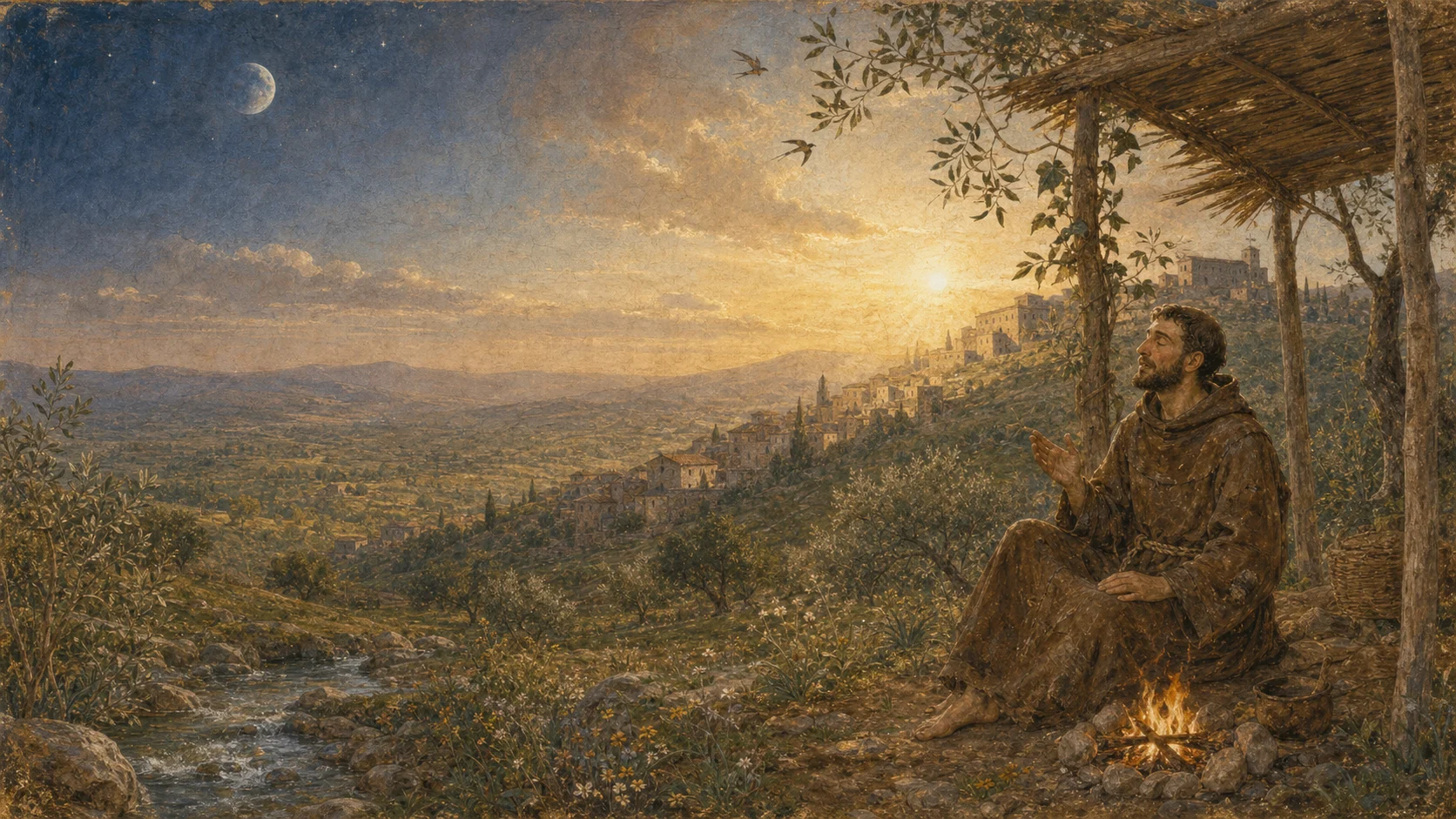
When his eyes could barely see
Near the end of his life, Saint Francis of Assisi was very ill. His eyes hurt, and light could trouble him. In some accounts, he was already almost unable to see.
Clare and the sisters at San Damiano helped care for him. They prepared a simple shelter of mats where he could rest. The place was not comfortable. There were mice, long nights, and pains that kept him from sleeping.
It is difficult to imagine that one of history’s most luminous songs was born during this period.
Saint Francis did not write the Canticle of the Creatures after a perfect day, seated before a landscape without problems. Tradition places it after a night of great suffering, when he received an inner assurance that his life was held in God.
At dawn, the pain had not magically disappeared. But something within him found room to sing.
That detail changes everything.
His praise was not a distraction. It was resistance. Saint Francis did not deny the darkness; he discovered that it could not extinguish every reason for gratitude.
A song in the language of the people
Many important texts of the medieval Church were written in Latin. Saint Francis composed the Canticle in an early form of the language spoken in Umbria, close to the Italian that would later emerge.
It was the language of streets, families, work, and popular songs.
This suited him. Saint Francis wanted the message to travel. The friars were to sing the Canticle and then announce peace.
The poem begins by placing God at the center. Saint Francis does not worship the sun, water, or fire. He praises the Creator with, through, or because of his creatures—the small original word allows more than one translation.
The creatures become companions in praise.
They are not there as objects Saint Francis owns. They receive family names.
Brother Sun
The sun is called brother. It brings the day, warms the earth, and allows colors to appear.
Saint Francis describes it as beautiful, radiant, and full of splendor. But the sun is not the owner of the world. Its light points toward a greater light.
Calling it brother changes our position. A brother is not a tool to be used and discarded without limits. He has a relationship with us.
This does not mean that the sun and human beings are alike in every way. It means that we are not strangers on our planet. We come from the same Creator and depend on a web we did not make by ourselves.
You can spend an entire day without buying anything. You cannot live without energy from the sun, air, and water.
What is most valuable does not always have a price tag.
Sister Moon and the stars
After the sun, the poem looks toward the night. The moon and stars are bright, precious, and beautiful.
Saint Francis does not exclude darkness from his song. He finds other kinds of light within it.
Perhaps this reveals something about that moment in his life. His eyes were losing the ability to see, but his spiritual attention seemed to perceive ever wider relationships.
There are days when our light will be strong like the sun. On others, we will manage to offer only a small point, like a distant star.
Both can guide someone.
We do not need to wait until we are radiant to do good. A message, a listening ear, or an apology can be the star possible on that night.
Brother Wind
The wind cannot be held in the hand. We know it has arrived when a leaf moves, a cloud travels, or our skin feels the air change.
In the Canticle, Saint Francis includes the wind, air, clouds, clear skies, and every kind of weather.
He does not praise only the weather he likes. He recognizes that life is sustained by changes he does not control.
This is deeply Franciscan. Young Giovanni wanted to direct his own story toward glory. The elderly Saint Francis had learned to receive clear days and cloudy days without believing that everything existed to obey his plans.
Accepting that we do not control the wind does not mean standing still. It means adjusting the sail without imagining that we own the sea.
Sister Water
Saint Francis calls water useful, humble, precious, and pure.
“Humble” is a surprising word for water. It seeks low places. It adapts to the vessel. It serves without making noise. One drop seems small, but many drops feed rivers, wash wounds, and sustain cities.
Water’s humility is not weakness. It is a life-giving strength.
Today we know even more clearly how water must be protected. Some people do not have safe access to it. Rivers receive rubbish and poison. The Canticle does not offer a modern list of environmental policies, but it educates the heart without which no policy endures: the heart that recognizes water as a precious sister, not as an infinite thing at our disposal.
Not wasting water can be a form of prayer made with our hands.
Brother Fire
Fire lights the night. Saint Francis calls it beautiful, joyful, strong, and vigorous.
He knew its warmth on cold nights and its light in small churches. He also knew that fire demands care. The same flame that warms can burn.
Every human strength holds something of this ambiguity. Our voice can defend or humiliate. Our intelligence can solve a problem or deceive someone. Our courage can protect or dominate.
The Canticle teaches us to give thanks for strength without turning it into permission to harm.
Fire becomes brother when its energy serves life.
Sister and Mother Earth
Earth is sister because she belongs to the same family. She is also mother because she sustains, governs, and produces fruit, flowers, and plants.
Saint Francis does not look at her merely as scenery. The ground feeds. The seed disappears into it and returns transformed. Even our body depends on elements that came from the earth.
Calling her mother is not a scientific explanation. It is a language of gratitude and responsibility.
No one puts rubbish on their own mother’s table and calls it love. No one destroys the home of their brothers and sisters and says it is not their problem.
Care for creation is not an ornament added to the life of Saint Francis centuries later. It springs from a way of seeing: everything is related, everything has been received, and no creature exists only to feed our greed.
The verse about forgiveness
The Canticle grew along with events.
There was a serious conflict between the bishop and the ruler of Assisi. Saint Francis added a verse about those who forgive for love of God and endure weakness and difficulty in peace.
He then sent friars to sing before the two men. Tradition says that they were reconciled.
This reveals that the poem’s harmony was not naive. Saint Francis saw the beauty of the sun, but he also saw human quarrels. For him, praising creation and building peace were part of the same song.
There is no point in calling the wind brother while treating a person as an enemy undeserving of dignity.
Peace with Earth and peace among human beings must walk together.
The most difficult verse
When Saint Francis realized that death was approaching, he added praise for Sister Bodily Death.
He was not saying that losing someone is easy. He did not teach that we should hasten death or stop caring for our health. His companions wept. Death remains separation and mystery.
By calling her sister, Saint Francis refused to treat her as the absolute owner. For his faith, she was a passage that also belonged to the great family of things we do not control.
The Canticle began amid illness and darkness. It ended able to look at the final limit without abandoning praise.
It is a whole song because it does not erase the difficult parts of life.
What the Canticle teaches us
Saint Francis did not need perfect sight in order to pay attention. He heard the wind. He felt the warmth. He remembered the water. He recognized the earth beneath his body.
We see many images every day and yet may not truly look at anything.
The Canticle invites us to recover attention. Not to turn nature into decoration, but to discover kinship, limits, and gratitude.
A creature need not be rare to be precious. The water in a glass, the tree on the street, and the air passing through the window already take part in the ordinary miracle of our being alive.
Anyone who learns to say “brother” and “sister” also begins to ask: how can I care?
The chorus of creation
Listen as the world enters the song.
Sun, water, wind, fire, and earth are not a silent background. Each creature offers a way to give thanks and a plea for care.
The first sound begins when you pay attention.
For those who wish to go deeper
Sources for this chapter
- Laudato si’Presents the text of the Canticle and develops its vision of a related creation entrusted to human care.
- Commission on the Franciscan Intellectual-Spiritual Tradition — Liturgical LifePlaces the composition of the Canticle near the end of Saint Francis's life, amid illness and loss of sight.
- Address on the Canticle and Care for CreationSummarizes the tradition of the night of suffering and the transformation of pain into praise and commitment.
The Canticle is an authentic writing by Saint Francis in the Umbrian language. Biographical tradition helps place the stages of its composition, but exact dates and circumstances may vary among historical reconstructions.
Historical note: the main part of the Canticle is usually dated to 1225, near San Damiano. The verse about forgiveness is said to have been added during a conflict in Assisi, and the verse about death during the final days of 1226. The title is also translated as Canticle of Brother Sun or Canticle of the Creatures.