An almost forgotten house
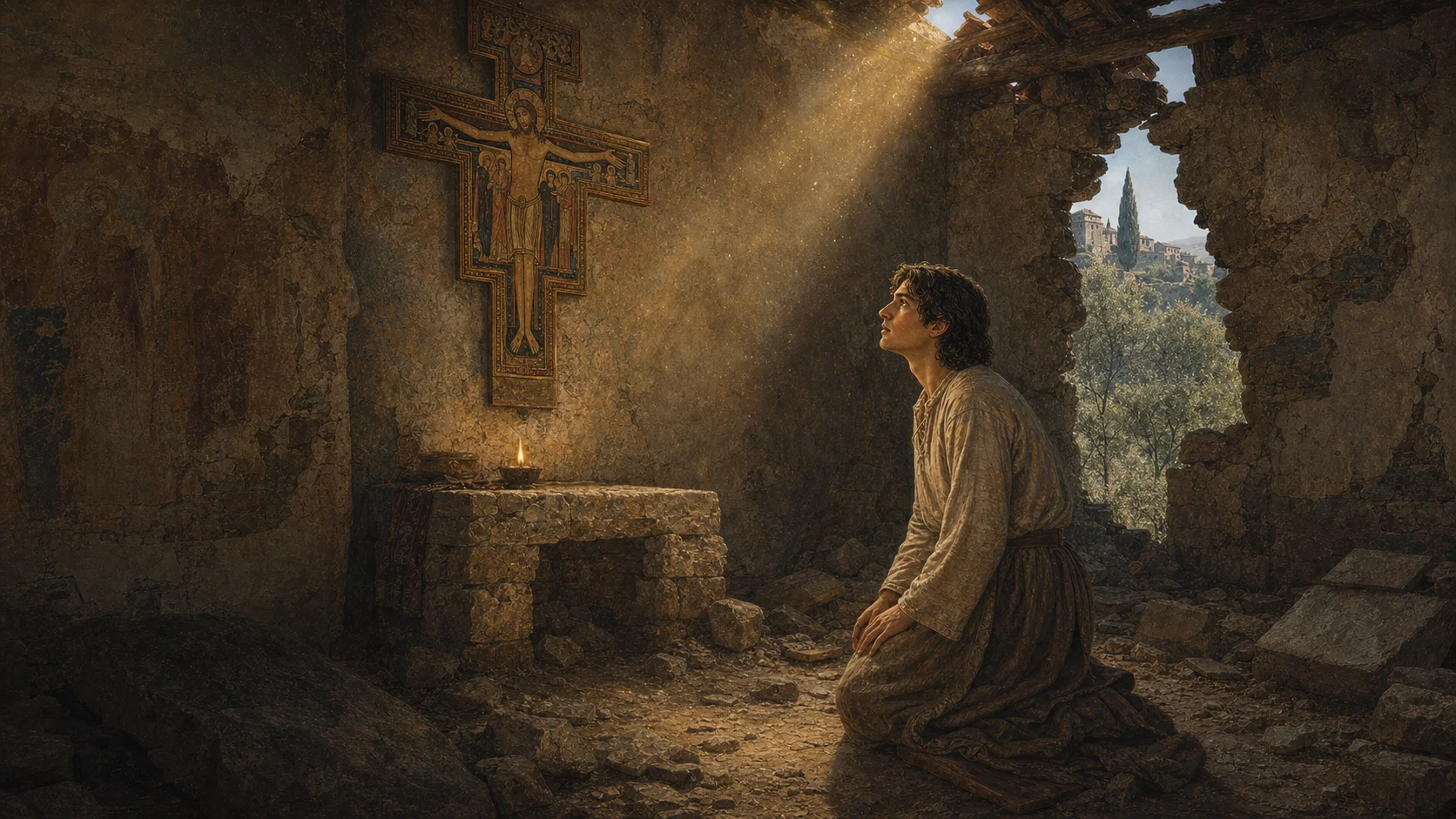
Outside the walls of Assisi, down the hillside among olive trees, stood a small church called San Damiano.
It was not a great basilica. It did not draw crowds. Its walls were worn, parts of the building threatened to collapse, and the silence seemed larger than the place itself. A poor priest still cared for the chapel as best he could.
Francis sought places like this. After the war, prison, illness, and his encounters with people he had once feared, the parties of Assisi could no longer answer the questions growing within him.
He wanted to listen.
When he entered San Damiano, he found a large image of the crucified Christ before the altar. This was not a Christ with closed eyes. The icon showed Jesus alive, his eyes open, surrounded by people and signs of Christian hope. Even on the cross, he seemed to look at the person praying.
Francis knelt.
The prayer of someone who does not yet know
Perhaps you have tried to pray but could not find the words. Francis knew that experience. He did not arrive at San Damiano with a finished plan. He arrived willing to receive.
A prayer traditionally connected with this moment begins: “Most High and glorious God, enlighten the darkness of my heart.” It asks for faith, hope, love, wisdom, and understanding.
Notice the request: Francis did not say, “show me how important I am.” In other words, he said: there is darkness within me; give me light to discover what I should do.
That required humility. When someone believes they already know everything, no new answer can enter.
In the broken chapel, Francis looked at the Crucified. Then, according to Thomas of Celano and Franciscan tradition, he heard a call:
“Francis, go and repair my house which, as you see, is all in ruins.”
His name was spoken before the mission.
He was not merely another confused young man in an empty church. He was someone seen and called.
What did those words mean?
Today, when we hear “repair my Church,” we may think of the entire Christian community. That understanding became an essential part of Francis’s story. His simple way of living the Gospel would help people in many places rediscover Jesus.
But Francis did not understand everything at that moment.
He looked around. He saw fallen stones, old wood, cracks, and a roof in need of care. He understood the mission in the most direct way possible: this chapel needs to be rebuilt.
That was not a useless mistake. Before helping to renew a great community, he had to learn to care for a small wall. Before speaking to crowds, he learned to carry stone. Before understanding every meaning of a call, he answered the meaning he could see.
God did not give him a crown. He gave him a broken house.
The response began quickly
Francis was deeply moved. The early sources use intense language to describe this moment. He left determined to obtain resources for San Damiano.
He returned to his family home, took valuable fabrics from the shop, and went to sell them in Foligno, a nearby town. He sold his horse as well. Then he walked back and offered the money to the chapel priest.
To Francis, everything seemed simple: the church needed repairs, and the money could pay for the work.
To the priest, the situation was dangerous. Those fabrics belonged to the business of Pietro di Bernardone, Francis’s father. Accepting the money could lead to an enormous dispute. He therefore hesitated and ultimately refused it.
Francis, already beginning to despise what had once ruled his dreams, cast the money aside as though it were dust.
But the problem did not disappear.
A good intention also needs justice
Francis wanted to do something good, but he used property that was not his alone. His enthusiasm did not erase his father’s right to demand its return.
This detail matters. A true mission does not automatically make all our choices right. We may want to help and still act without prudence. We may hear a call and need to learn how to answer it better.
Francis’s faith was growing, but he was still impulsive. Throughout his life, his conversion would remain a journey, not a button pressed once and for all.
When Pietro learned what had happened, he was furious. To him, his son was wasting the family’s property and bringing public shame. To Francis, money could no longer be more important than the call he had received.
Two ideas of life collided: security and self-giving; inheritance and freedom; the family name and a voice heard in silence.
The Crucifix did not provide a map
It is tempting to tell this story as though Francis never doubted again after San Damiano. But the first steps of a vocation are almost never so clear.
He knew that he needed to repair. He would still discover what, how, and with whom.
He began with stone because stone was before him. Later, he would understand that a church is also made of people. Walls can be raised with mortar; communities are rebuilt with truth, service, reconciliation, and love.
The two need not be enemies. Caring for a place of prayer could teach Francis to care for the people who would gather there. The visible work trained his heart for an invisible and greater mission.
Every great task has a first stone. Sometimes it seems far too small. Even so, that is where we begin.
The house within us
Parts of a life can also fall into ruin.
A friendship breaks after cruel words. Trust weakens when we lie. A family stops talking. A student begins to believe they will never be able to learn. A person prays but feels that God is very far away.
To rebuild is not to pretend that nothing happened. It is to look courageously at the crack and ask what care is possible now.
Perhaps it means apologizing. Perhaps it means telling the truth to a trusted adult. Perhaps it means returning to an abandoned task for ten minutes each day. Perhaps it means visiting someone. Some rebuilding also requires professionals—doctors, psychologists, teachers, or trained leaders. Asking for help may be the bravest stone.
Francis did not try to repair the chapel merely by thinking about it. His prayer became movement.
Called by name
In the story of San Damiano, Jesus calls “Francis.” He does not first say “hero,” “knight,” or “saint.” He says his name.
This reminds us that a mission need not be born from the desire for fame. It is born when someone knows they are loved enough to care for something.
What near you needs care?
You do not have to save the entire world by tomorrow. Picking up what you scattered, repairing what you damaged, defending someone, watering a plant, studying so that you can serve better: all these things can train the hands.
Francis would discover a mission that crossed centuries. That day, however, he saw a small, broken church.
And he decided to begin.
What San Damiano teaches us
Listening does not mean waiting for an extraordinary voice. Often the call appears as a need that we finally agree to see.
It usually makes three movements:
- It enlightens: we notice something we had previously ignored.
- It unsettles: we can no longer pass by in the same way.
- It invites: a first possible gesture appears.
Not every impulse comes from God, and important decisions need time, prayer, and guidance. Francis would seek the bishop of Assisi and learn from mistakes. Discernment means testing the path in truth.
But there is a question we can ask now: what small part of the house has been entrusted to me today?
The secret workshop of San Damiano
Raise the first stone.
Silently choose something that deserves care. You do not have to finish the work: simply do not leave the first stone on the ground.
Every renewed house begins when someone believes that ruin is not the end.
For those who wish to go deeper
Sources for this chapter
- Thomas of Celano — Second Life of Saint FrancisAn early account of the call before the San Damiano Cross and Francis's gradual understanding of it.
- Saint Francis, Restorer of ChurchesA detailed Franciscan narrative about the chapel, the sale of the fabrics, and the beginning of the rebuilding.
- Testament of Saint FrancisFrancis's own recollection of his faith in churches and his prayer before them.
The experience before the Crucifix belongs to the earliest biographies and Franciscan tradition. The wording varies slightly among translations. This chapter preserves its meaning and avoids presenting thoughts not recorded in the sources as certain.
Historical note: the San Damiano Cross is an icon in the Syriac-Byzantine tradition, probably painted in the twelfth century. The original is kept in the Basilica of Saint Clare in Assisi; the small church of San Damiano has a reproduction.