
The door of the house closed
When Pietro di Bernardone discovered that Francis had sold fabrics and the horse to help San Damiano, he did not see a beautiful religious gesture. He saw his shop’s property disappear and the future he had planned for his son collapse.
Pietro had worked to become wealthy. He traveled, negotiated, took risks, and knew the value of every piece of cloth. He expected Francis to continue the business and make the family name grow.
Now his son wandered among poor churches, spent time with rejected people, and said he wanted a completely different life.
The early accounts portray the father’s reaction as very harsh. He sought Francis, took him home, and tried to make him abandon that path. One tradition says that his mother freed him while Pietro was away. Francis then returned to San Damiano.
We do not need to choose a simple villain. The father acted in ways that hurt Francis. At the same time, he was also a frightened man watching a beloved son suddenly break with everything the family understood as security.
A dispute all Assisi could see
Pietro decided to take the matter to the city authorities. Francis maintained that, because he wished to serve God, he should answer before the authority of the Church. The conflict therefore reached the bishop of Assisi, named Guido.
Imagine the weight of that day. The city knew the family. Many had seen Francis at parties, dressed in expensive colors. Now people gathered to watch the dispute between father and son.
The bishop did not tell Francis that a good intention allowed him to keep the money. He advised him to return everything and trust in God.
That guidance brought clarity. Francis did not need to finance his vocation with what his father claimed. If the call was true, it would not depend on Pietro’s fabrics.
Francis retrieved the money and placed it before him.
Then he did something no one expected.
Not only the money
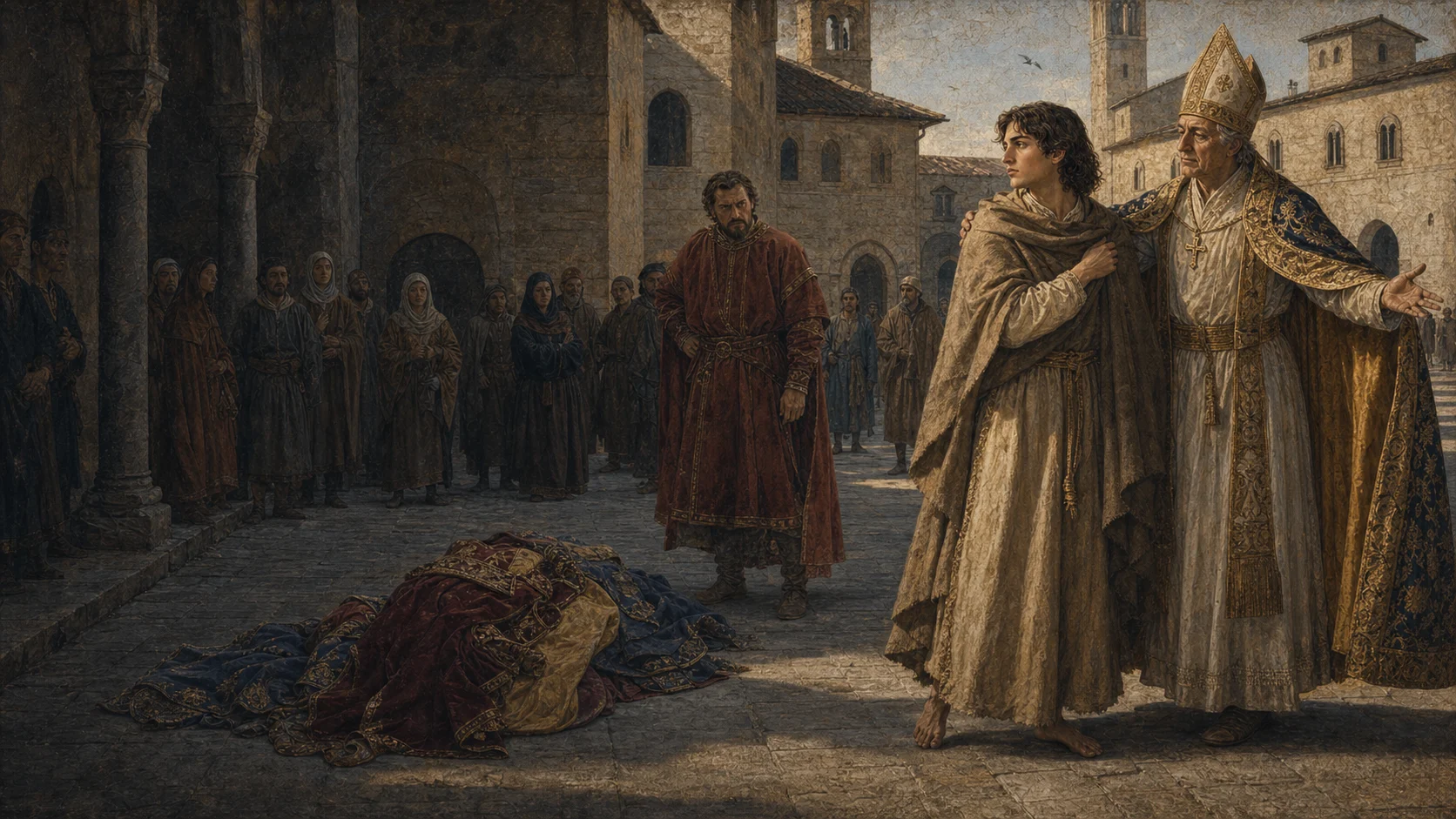
According to the tradition of the Three Companions, Francis said that he would return not only the money but also the clothes he had received from his father.
He removed his garments and left them beside the money.
It is a powerful scene, frequently painted across the centuries. It must be told with respect. This was not a spectacle or contempt for the body. It was a legal and symbolic gesture: Francis renounced his inheritance and the family’s financial protection.
The bishop immediately covered him with his own cloak. The image matters. As a relationship broke before everyone, someone protected the young man’s dignity.
Francis declared that from that moment he could freely say “Our Father in heaven” instead of calling Pietro his father.
Those words may sound beautiful in a painting. In real life, they must have hurt.
A freedom that also held tears
It is easy to turn the scene into a clean victory: Francis on the right side, Pietro on the wrong. But people are not pieces on a board.
Francis chose radical freedom. Pietro lost the future he had imagined for his son. We do not know everything Francis felt as he looked at him. Nor do we know everything his father carried as he returned home.
Francis’s holiness does not require us to celebrate a family wound. It invites us to recognize the cost of his choices and the still imperfect way in which he was learning to live them.
Later, his message would be filled with fraternity and peace. In that courtyard, however, there was a conflict that he did not know how—or was unable—to resolve.
Some right decisions remain painful. Pain does not prove that a decision is wrong; neither does it authorize us to ignore those who were hurt. Maturity can hold both truths.
What remained on the ground
On the ground lay fabrics, coins, and perhaps the last image of the wealthy young man Francis had been.
Clothes communicate things. They can show profession, group, wealth, taste, and social position. Francis liked to dress well. When he returned his garments, he did not set aside only cloth. He abandoned the attempt to build his worth on what others admired.
We also wear invisible things.
There is the outfit of someone who must always seem funny. The armor of someone who never asks for help. The cloak of someone who feels important only when they win. The costume of a perfect life on social media.
Not every garment needs to be thrown away. Nor is owning something automatically wrong. The Franciscan question is different: do I possess this, or does this possess me?
When something begins to control our choices, it weighs more than it seems.
Covered by a simple cloak
The bishop covered Francis. Some sources say that he was later given a poor garment, perhaps one that belonged to the bishop’s gardener. Francis marked a simple cross on it.
He who had desired the gleam of armor now wore worn cloth.
This did not immediately turn him into the friar in a brown habit seen in so many images. The form of Franciscan clothing would emerge over time. At that moment, he looked more like a penitent or hermit.
But an essential change had already occurred: poverty ceased to be only a condition suffered by other people and became a choice that would guide his life.
We must speak about this carefully. Imposed poverty is not romantic. Hunger, homelessness, and lack of care are injustices that must be fought. Francis did not want people to be abandoned. He chose to live with little so that he would not build his security on excess and could stand beside those who had little.
Joy crosses the forest
After the break, the accounts say that Francis walked through the forest singing praises in French, a language he had learned through songs connected with his mother’s homeland.
The road did not become easy. In one passage, robbers attacked him, mocked him, and threw him into a place filled with snow. He climbed out and continued singing.
We do not know how his body endured every moment. The tradition seeks to show a freedom that no longer depended on applause. Before, Francis sang to be the center of the party. Now he sang even when no one admired him.
He would still need help. In Gubbio, a friend gave him clothes. Elsewhere, he would work in exchange for food. Choosing not to own did not mean ceasing to depend on human generosity. On the contrary, he discovered that life is a network of gifts received and offered.
Freedom is not escaping every responsibility
A child or teenager should not imitate Francis by leaving home, giving away their belongings, or disobeying those who care for them. This event belongs to the life of a young adult in a very different society, faced with an exceptional vocation.
What can be lived today is the heart of the gesture:
- tell the truth about what holds us captive;
- return what is not ours;
- refuse to measure our worth by brands and appearance;
- share what we have responsibly;
- seek guidance when a decision changes our life.
Francis himself listened to the bishop. Freedom did not mean doing anything he wished. It also meant accepting guidance that required him to return the money.
The name that did not depend on an inheritance
By choice, Francis had lost the security attached to the Bernardone name. But he did not lose his identity.
He was beginning to discover that his worth came before his clothes, his money, and the city’s approval. In Christian faith, every person is a beloved child of God before earning any title.
This truth does not make us superior to others. It does the opposite: if my worth is a gift, I do not need to diminish anyone in order to feel greater.
In the bishop’s courtyard, Francis seems to have been left with nothing. In fact, he carried a question capable of freeing any heart: what remains of me when I remove what I use to impress others?
Perhaps what remains is what is most true.
The cloak of freedom
Let what weighs you down fall.
Silently name an appearance you are tired of maintaining. You do not need to prove your worth to deserve love.
What falls to the ground does not take who you are with it.
For those who wish to go deeper
Sources for this chapter
- Legend of the Three CompanionsA medieval source for the family dispute, the bishop's advice, and Francis's renunciation.
- Saint Francis, Restorer of ChurchesFranciscan narrative context for the return of the property and the first days of poverty.
- Seven Key Moments in the Life of Saint FrancisA contemporary summary of the renunciation before the bishop of Assisi.
The sources were written within a religious tradition and emphasize the gesture's spiritual meaning. They record little about the feelings of Pietro and Francis's mother, so this chapter does not invent certainties about their inner lives.
Historical note: the bishop of Assisi in this period is generally identified as Guido. The exact date and some details of the scene vary among chronologies, but the return of the property and clothes and the protection offered by the bishop are central elements of the earliest tradition.