
There was a road he avoided
Below the walls of Assisi were roads that Francis preferred not to travel. Some led to the places where people affected by leprosy lived.
In the Middle Ages, the word leprosy was used for several visible skin diseases. Those who were ill suffered not only physically. Many were separated from the city, their families, their work, and even the life of the church. They were treated as though the disease had erased their names.
Francis felt fear and revulsion. Years later, in his Testament, he himself wrote that the sight of people with leprosy seemed very bitter to him. This confession is precious because it does not turn the saint into someone born without fear. He acknowledged the truth: for a long time, he wanted to keep his distance.
Perhaps he covered his nose as he passed far from the shelters. Perhaps he urged his horse onward. His earliest biographers include such details, but what matters most comes from Francis himself: he did not want to come near.
The man who would one day call all creatures his brothers and sisters was still learning to call another human being his brother.
When fear appeared before him
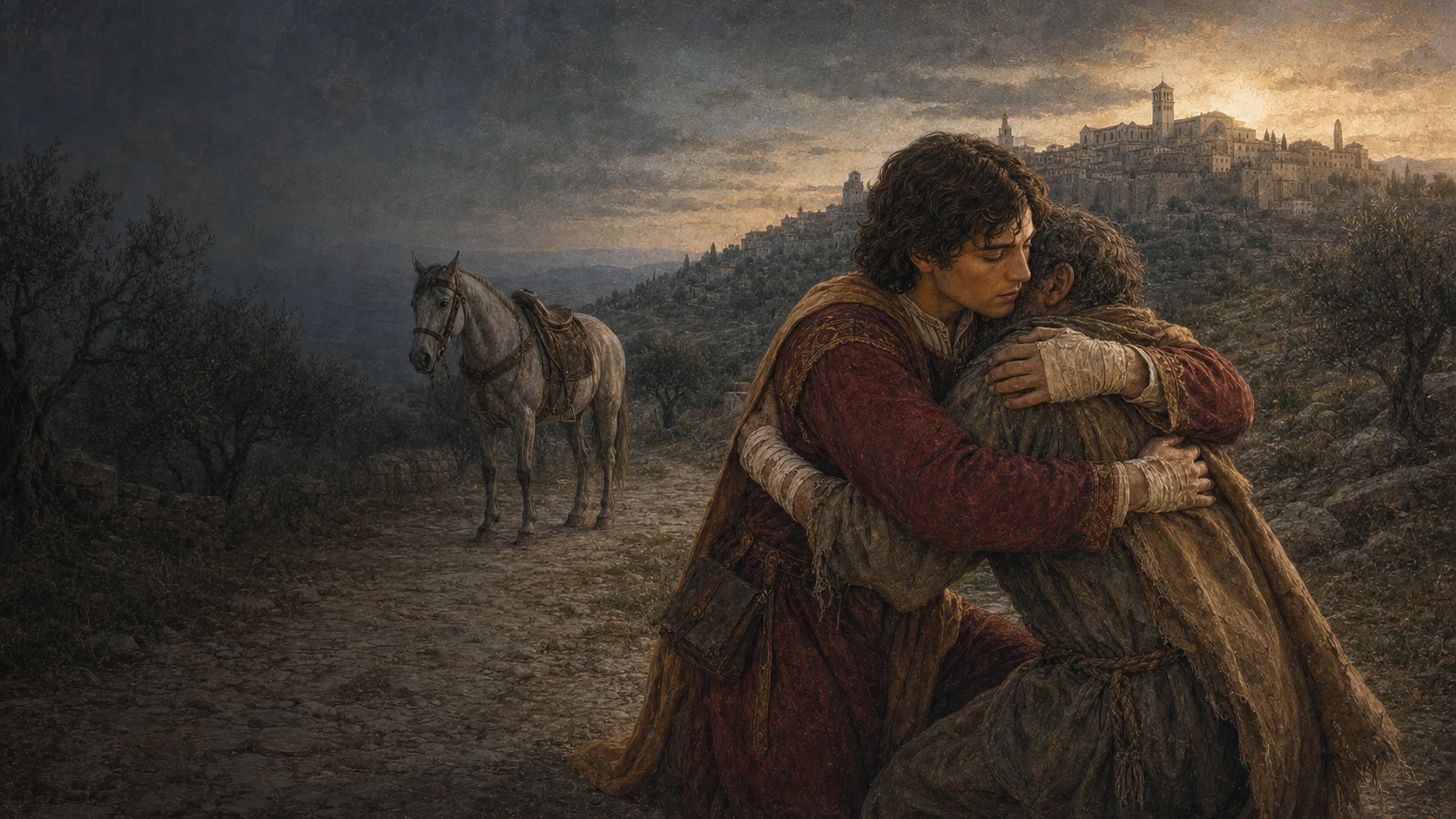
One day, while riding across the plain, Francis saw a person with leprosy coming toward him.
His body must have reacted before he could think. Fear does that: it tightens the chest, stiffens the arms, and looks for a way out. An open road suddenly seems narrow. The impulse is to turn aside, go back, or hurry past.
Francis could have continued on his way. No one in the city would have condemned him for it. Keeping a distance was considered normal.
But he stopped.
We do not know how long that pause lasted. Perhaps it was only an instant. Within him, however, it held two entire roads. One was the old road: protect yourself, do not look, and leave the other person alone. The other did not yet have a name.
Francis dismounted.
The early accounts say that he offered a coin and kissed the person. Tradition also describes the gesture as an embrace. We need not imagine a perfect scene without trembling. Courage is not the absence of fear. It is refusing to let fear decide by itself what we will do.
A face, not a disease
Up close, Francis could no longer see only “a leper.” He saw a person.
A person with eyes, a voice, memories, and a story. Someone who might know what it was to hear footsteps retreating. Someone who once had a home, games, and loved ones. Someone who remained worthy even when almost everyone acted as though he were not.
By touching his hands, Francis crossed a boundary the city had built.
The embrace did not magically cure the disease. Nor did it end, that day, the injustice suffered by all those who were rejected. But it undid a lie within him: the lie that it was possible to love God while refusing to see the person suffering before his eyes.
Mercy begins when we stop asking “how can I get away?” and start asking “how can I come closer without causing harm?”
Who received more in that encounter: the person who was touched with respect, or Francis, who discovered a new freedom? Perhaps both.
Bitterness became sweet
Near the end of his life, Francis remembered this time with an unforgettable phrase. What had once seemed bitter to him was transformed into sweetness of soul and body.
He did not say that the disease became beautiful. He did not say that suffering ceased to hurt. The sweetness came from mercy: from doing good where fear had taught him to flee.
Some joys come from comfort. A favorite meal, a song, or a long-awaited embrace can bring us joy. But there is also the joy of overcoming a small prison within ourselves. It is the joy of discovering that we do not have to obey our prejudices forever.
Francis left that encounter changed. The road was the same. Assisi still stood high on the hill. His horse still waited. Yet the world had grown larger: it now included people he had once tried to keep out of sight.
From that encounter to many others
The gesture did not remain an isolated, beautiful memory. Francis began visiting the places where sick people lived. Thomas of Celano, his first biographer, says that he began to serve them and help care for their bodies.
This required more than a sudden emotion. It required returning.
At a first encounter, someone may feel moved. The following week, the smell, weariness, and fear are still there. Francis’s mercy deepened because it became presence and work.
He washed wounds, shared what he had, and stayed close. For readers today, it is important to say that health care requires hygiene, knowledge, and protection. The lesson is not to ignore risks. It is never to use care as an excuse to abandon a person’s dignity.
Francis was beginning to perceive Jesus in a new way. The Christ he sought in prayer could also be found in those who were hungry, sick, or cast aside. The Gospel was no longer only a story heard in church. It became an encounter on the road.
An embrace does not erase boundaries
Loving someone does not mean allowing everything. Nor does it require a child to put themselves in danger or touch a stranger. There are many safe ways to draw near: look at someone with respect, call them by name, sit near someone who is alone, refuse to spread a cruel joke, or ask an adult for help when someone is suffering.
Francis’s gesture asks us where we have built unnecessary distances.
Is there someone everyone avoids at school? A person who speaks or moves differently? Someone who made a mistake and seems to have been turned forever into that mistake? Perhaps our first step is not a great embrace. Perhaps it is making room at the table, listening without laughing, or saying, “Would you like to stay with us?”
Small gestures can restore something enormous to a person: the feeling that they still belong in the world.
The victory no one applauded
When Francis dreamed of knighthood, he imagined a victory witnessed by many people. Banners, music, celebrated names.
On the road of encounter, there was no audience. The great battle took place within him. On one side was his old fear. On the other, mercy still taking its first steps.
Francis did not defeat a person. He defeated the distance that kept him from loving that person.
This was a far greater victory than those he had sought on the battlefield. A knight could conquer a city and remain a prisoner of his own heart. Francis began to become free when he knelt before someone the world told him to despise.
Later, he would understand the magnitude of that moment more fully. His conversion did not begin with a complicated idea. It began when his hand stopped pushing away and learned to care.
What the embrace teaches us
Not every fear is wrong. Some fears protect us and should be heeded. But other fears are fed by rumors, prejudice, and lack of contact. They diminish other people and also diminish our hearts.
We can ask:
- Am I seeing a whole person, or only a difference?
- Do I repeat a cruelty because everyone else repeats it?
- Can I draw near safely and respectfully?
- Does someone need companionship, protection, or a listening ear?
Francis did not change because he found a beautiful answer. He changed because his body made a gesture: he stopped, dismounted, and drew near.
Love also needs hands and feet.
The secret hidden on the road
Turn bitterness into sweetness.
Think of a distance born of fear. You do not have to overcome all of it now. Offer just one safe gesture of respect.
Sometimes sweetness waits on the other side of one small step.
For those who wish to go deeper
Sources for this chapter
- Testament of Saint FrancisFrancis himself recalls the bitterness he felt, the mercy he practiced, and the sweetness born from this encounter.
- Thomas of Celano — First Life of Saint FrancisAn early biographical account of the encounter, the kiss, and his service among people with leprosy.
- Seven Key Moments in the Life of Saint FrancisA contemporary Franciscan presentation of the significance of this event.
In his Testament, Francis confirms that he lived mercifully among people affected by leprosy. The encounter with one particular person, the horse, the kiss, and other details belong to the earliest biographical narratives and Franciscan tradition.
Historical note: we do not know the name of the person he encountered or the exact date. The medieval word translated as “leper” could include different diseases. Out of respect, this chapter does not reduce anyone to an illness and avoids graphic descriptions.