
The world lost its brightness
After his imprisonment in Perugia, Francis returned to Assisi very ill. His body needed to recover, but something had also changed within him.
When he was finally able to leave the house, he looked at the fields and hills he had always known. Before, that landscape might have filled him with joy. Now it seemed different. The colors were there. The sun kept rising. But Francis could no longer feel the same enthusiasm.
This happens to many people after a difficult experience. The world remains in place, but inwardly we are no longer in the same place.
He still could not explain what he was seeking. He knew only that parties, fabrics, and his old plans were no longer enough.
The dream that seemed like an answer
Francis did not immediately abandon the idea of becoming a knight. Perhaps he thought his first attempt had failed because he had chosen the wrong war. Perhaps a new mission could erase the shame of defeat.
At that time, an important commander named Walter of Brienne was gathering men to fight in southern Italy. Francis decided to join them.
The early accounts say that, before leaving, he dreamed of a palace filled with weapons, shields, and signs of knighthood. A voice said that all of it would belong to him and his companions.
Francis interpreted the dream in the way that best matched his desires:
— At last I will be a great prince.
It is easy to do this. When we want something deeply, we may hear only the part of a message that agrees with us.
Not every shining door takes us where we imagine. Sometimes the light is calling us to see differently.
A nobility already within him
Francis prepared expensive clothing, a horse, and equipment. He wanted to present himself as someone worthy of fighting alongside nobles.
But on the road he met an impoverished knight. The man had the title Francis desired, but lacked suitable clothing. Francis therefore gave him his own elegant garments.
The gesture matters. Even while he was still seeking glory, he could notice another person’s need. His transformation did not begin by erasing everything within him. It began by guiding his generosity in a new direction.
Francis thought nobility lay in a title. His gesture already revealed a deeper nobility.
A night in Spoleto
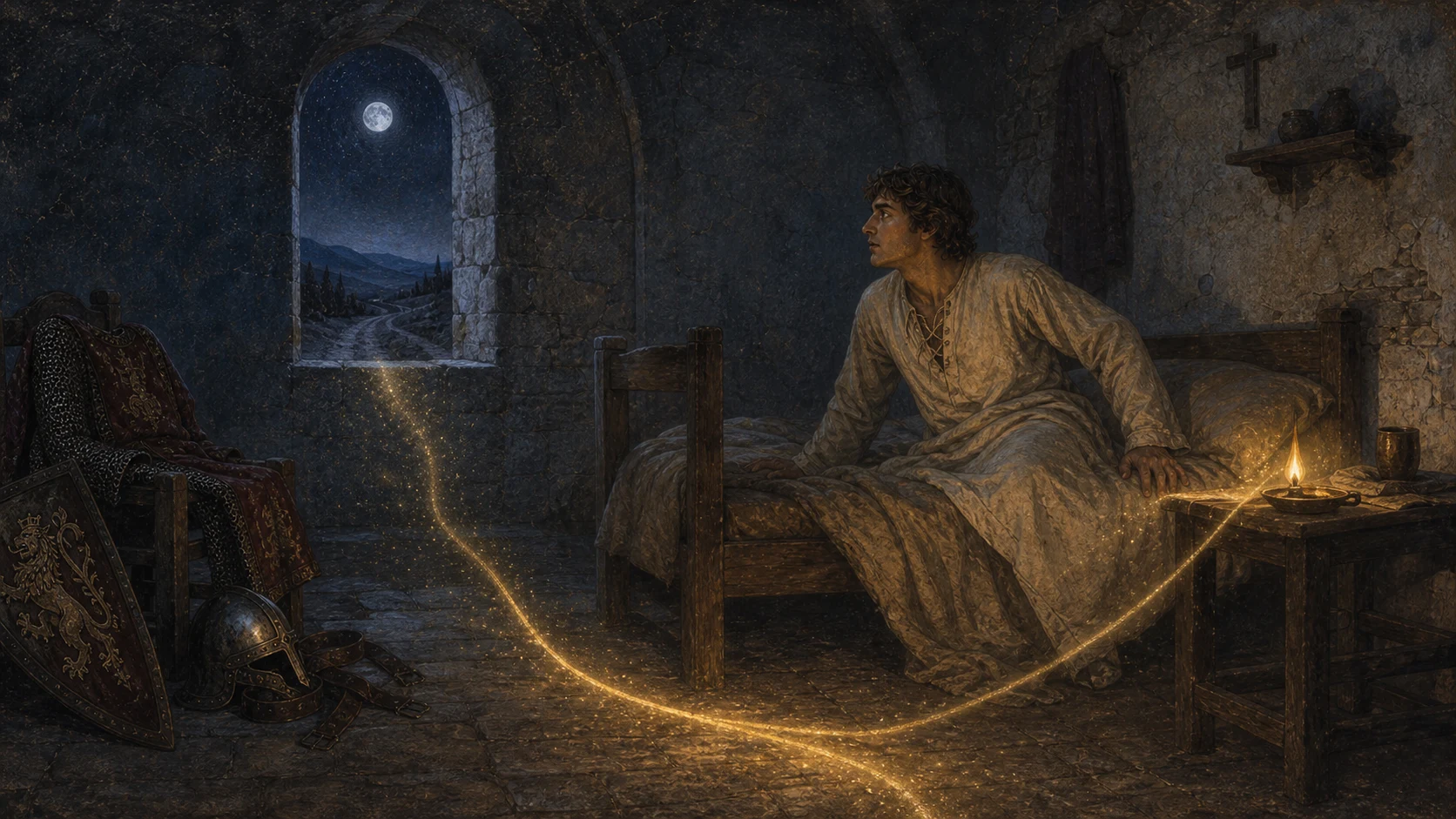
The journey continued as far as Spoleto, a city about fifty kilometers from Assisi. Francis began to feel unwell and stopped to rest.
Imagine a simple room. Stone walls. His armor set beside him. The horse resting in a courtyard. A small flame struggling against the darkness.
Francis was between sleep and waking when he heard a voice ask where he intended to go. He explained his plan: to travel to Apulia and win honor as a knight.
The voice then asked a question:
“Who can do more for you: the master or the servant?”
— The master, Francis replied.
And the voice continued:
“Then why do you abandon the master to follow the servant?”
At that moment Francis did not receive a complete map of his life. He received only enough light for the next step.
— Lord, what do you want me to do?
— Return to your own land. There you will be shown what you must do.
The courage to return
The next morning, Francis turned his horse toward Assisi.
Returning was not easy. He had announced his plans. He had bought equipment. He had said goodbye like someone setting out on a great conquest. Now he would arrive home before the battle had even begun.
Some people might think he had given up out of fear. Others might laugh. But there is a courage that moves forward, and there is a courage that changes direction upon realising it is on the wrong road.
The medieval accounts say Francis returned joyfully, waiting to discover what God would show him. This does not mean he understood everything already. Joy and uncertainty can live in the same heart.
He knew where to return. He still did not know what he was returning for.
Silence begins to speak
Back in Assisi, Francis tried to continue among his friends. At a party, he was once again chosen as the group’s leader. His companions went through the streets singing, but he fell behind, absorbed in thought.
When they asked whether he was thinking of marrying, he replied that he had found a bride more beautiful and noble than any other. His friends imagined a woman. Later, his biographers would understand this reply as a reference to the life of poverty he would embrace.
But Francis was still at the beginning.
He began seeking silent places. He prayed in caves and small churches near Assisi. Sometimes he took a friend, who waited outside while he entered alone.
There was no audience there. No music of troubadours. No certainty.
There was a person learning to listen.
What this night teaches us
Changing direction does not make the earlier steps useless. Prison taught Francis that war was not a song. Illness showed him that comfort could not answer every question. The road to Spoleto took him to the place where he was finally able to listen.
Sometimes recognizing a mistake is the beginning of a truer life.
We do not need to see the entire road. We need to be honest in the light we have already received.
The Spoleto vigil
Light the question.
Francis did not receive every answer that night. He received a question capable of lighting the next step.
Who can do more for you: the master or the servant?
The flame is waiting.
For those who want to go deeper
Sources for this chapter
- Legend of the Three CompanionsA medieval account of the dreams, the journey to Spoleto, and the return to Assisi.
- Francis and Clare: Where the Tradition BeginsFranciscan context for understanding the conversion accounts.
The accounts were written after the events and use religious language. When an inner motivation cannot be documented, we present it as interpretation, not fact.
Historical note: the dream at Spoleto is recounted in the earliest Franciscan biographical traditions. The words vary slightly among versions and translations, but preserve the same question about serving the master or the servant. The event is usually dated between 1204 and 1205.