
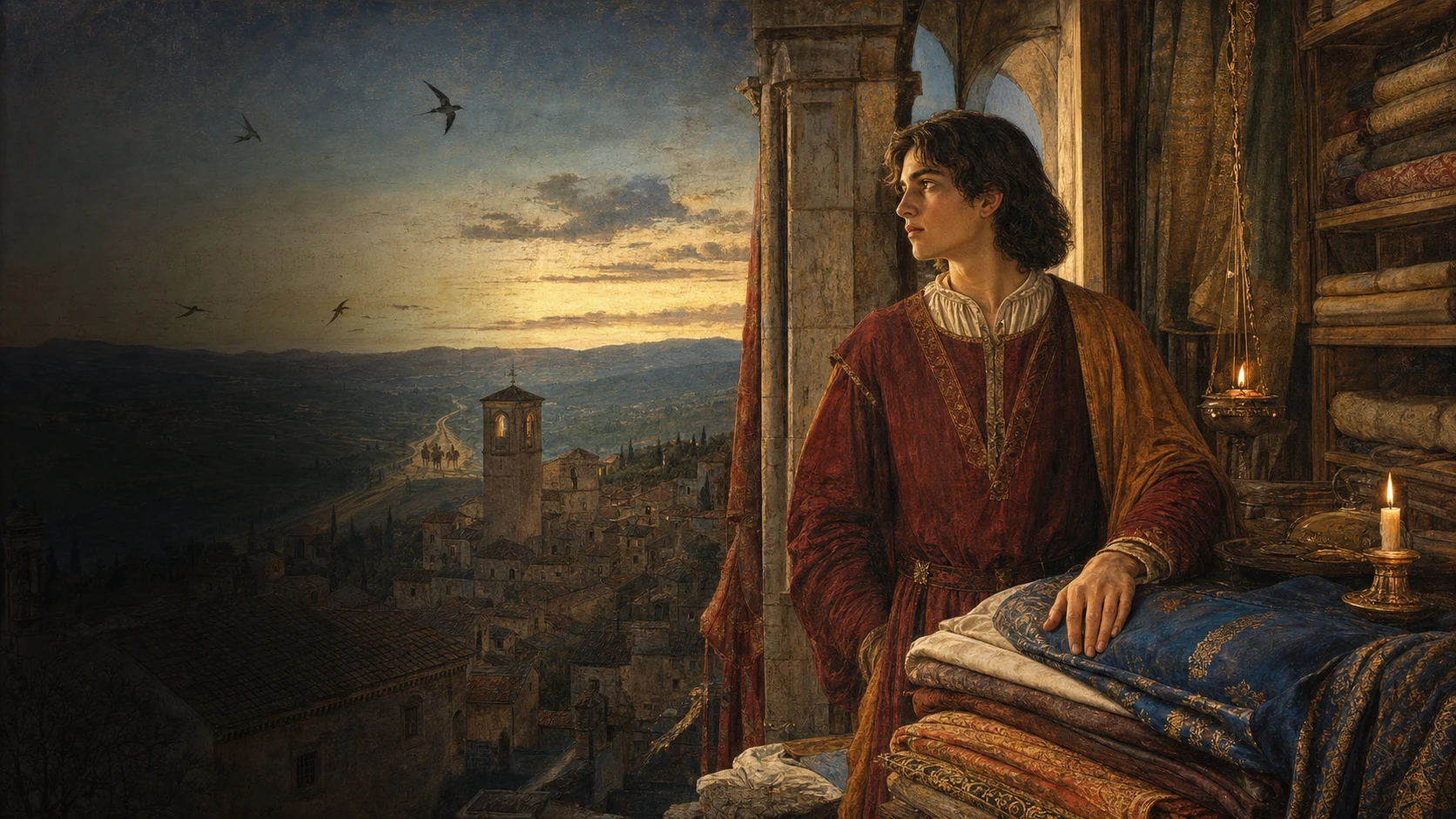
A walled city
Imagine a city built high on a hill. Its houses are made of pale stone. Narrow streets rise and fall between workshops, small churches, and squares filled with voices. From the city walls, you can see fields, olive trees, and mountains in the distance.
This city is Assisi, in the Italian region of Umbria. It was there, around 1181 or 1182, that the boy the world would come to know as Saint Francis of Assisi was born.
At that time, there was no electricity, no cars, and no telephones. News traveled slowly. Most people worked on the land or in workshops. Society was deeply unequal: some families had comfortable homes and thriving businesses; others barely had enough food for the next day.
Francis was born on the comfortable side of this city.
Giovanni or Francesco?
His mother named him Giovanni, the Italian form of John. His father, Pietro di Bernardone, was a cloth merchant. He traveled especially to France, bought valuable fabrics, and returned to Assisi to sell them.
When Pietro came back from a journey and met his newborn son, he began calling him Francesco, something like “the little Frenchman.” The nickname stayed. Giovanni almost disappeared, and Francesco became the name that would cross the centuries.
We do not know every detail of his childhood. No one was writing down each of the boy’s games or conversations. The earliest accounts were written after he had become well known. It is therefore important to separate what the documents actually say from scenes later added by the imagination.
What we do know is that his family had money and expected him to join the business.
Before wearing a simple habit, Francis knew expensive fabrics. Before choosing poverty, he knew what it was like to live in comfort.
His father’s shop
Francis probably learned to recognize fabrics, talk with customers, and keep accounts. A medieval shop was not quiet. People came in, debated prices, touched the cloth, and brought news from other cities.
Francis grew up hearing stories about distant places. He learned some French words and enjoyed the songs of the troubadours—poets who sang about courage, love, and great adventures.
He did not seem to dream of spending his life behind a counter. He wanted something greater. He wanted to be seen, admired, and remembered.
That desire did not make him a bad person. Almost every young person wants to discover their place in the world. The problem begins when we believe we will matter only if everyone is looking at us.
The king of the parties
The early accounts describe Francis as cheerful, generous, and fond of parties. He liked gathering friends and often paid the group’s expenses. He dressed well and wanted to be the center of attention.
Perhaps someone meeting him at the time would have said:
— That young man will become a wealthy merchant or a great knight.
No one would have said:
— That young man will give up everything, care for the sick, and call the sun his brother.
But Francis’s transformation would not completely erase the young man he had been. His joy would remain. His love of music would become prayer. The generosity he showed at parties would become care for the poor. Even his desire for adventure would find a new path.
God did not discard Francis’s personality. He helped him discover what his gifts were for.
Two worlds within Assisi
While Francis celebrated with his friends, the city was going through conflicts. The nobles, who owned land and castles, competed for power with merchants who were becoming wealthy. Assisi was also fighting neighbouring cities, especially Perugia.
Francis grew up between two worlds. On one side were wealth, parties, and dreams of knighthood. On the other were poor workers, beggars, people with illnesses, and wars that could erupt suddenly.
He was generous, but he still kept his distance from certain people. Those with the diseases society feared most were taken outside the city walls. Leprosy could disfigure the body, and fear caused those who had it to be treated as though they were no longer human.
Young Francis was not yet ready to draw near to them.
One day, that would change everything.
What this beginning teaches us
Sometimes we imagine that a saint is born already knowing exactly what to do. Francis’s life shows otherwise. He had doubts, vanity, fears, and dreams that did not work out.
His story begins with a search.
Perhaps that is why it still feels so close to us. We do not need to have all the answers before taking the first step. We need only pay attention when life begins asking new questions.
To keep in your heart
Your gift can become a gift to others.
What you love doing does not have to end with you. Your joy, your imagination, and even the way you listen can bring light to someone's life.
“How can what is within me help someone?”
Keep this question. It accompanied Giovanni too, even before he knew where his path would lead.
A gesture for today
Choose a gift.
Offer it.
Tap the quality you want to offer someone today.
Choose a word to begin.
Your gesture is sealed. Now turn this small promise into presence.
Historical note: the main information about Francis’s youth appears in medieval biographies, such as those by Thomas of Celano, and in his own Testament. Very early dates may vary among scholars. When a scene is not documented, this portal presents it as tradition or possibility, not certainty.