
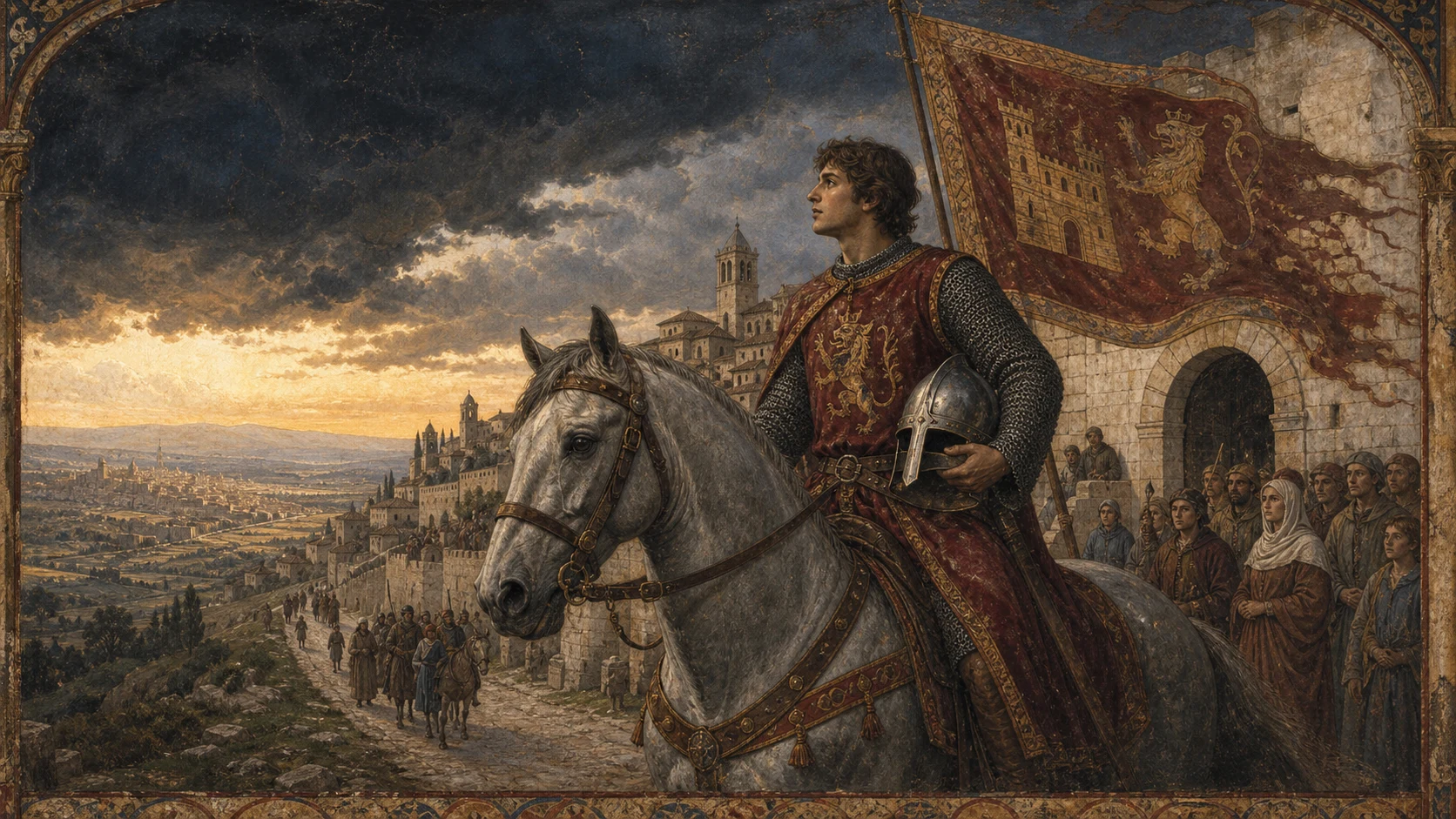
A dream dressed in metal
Francis loved the stories of the troubadours. In them, knights crossed forests, defeated enemies, and returned home covered in honor. Their armor gleamed. Their names were sung. It seemed like a life far greater than working every day in the family’s cloth shop.
For a young man like him, becoming a knight meant more than learning to fight. It meant rising in society.
Francis was the son of a wealthy merchant. He had money, fine clothes, and many friends. But money did not automatically make someone a nobleman. Knighthood seemed like a bridge between two worlds: on one side, his father’s counter; on the other, castles, coats of arms, and admiration.
He did not dream of the fear, mud, or wounds of war. He dreamed of the part that fit into songs.
Sometimes we desire something because we see only its brightness. We do not yet know the weight it carries.
A divided city
Assisi was changing. For a long time, noble families had controlled land, fortresses, and decisions. But merchants were becoming wealthy and wanted a part in governing the city.
The two groups came into conflict. Some nobles left Assisi and sought protection in Perugia, a powerful city just over twenty kilometers away. The distance was short, but the rivalry was immense.
In 1202, the forces of Assisi and Perugia faced one another. Francis was about twenty years old. To him, this seemed to be the opportunity he had been waiting for.
Imagine the morning of departure. Restless horses. Metal striking metal. Banners raised. Families watching from the gates. Perhaps someone shouted Francis’s name. Perhaps he believed he would return a hero.
We do not know what he said at that moment. But we know that he went.
When the song meets war
The battle is commonly associated with Collestrada, near Perugia. Assisi’s troops were defeated.
We do not need to imagine violent scenes to understand what this meant. People who had marched together did not return together. Cries replaced songs. The young man seeking adventure found confusion, fear, and loss.
Francis was captured.
Poor prisoners could face a terrible fate. But someone noticed that he came from a family with resources. A wealthy prisoner could be worth a ransom. Francis was therefore taken to a prison in Perugia with other men.
The war that was supposed to open the doors of nobility closed an iron door in front of him.
A year without a horizon
Medieval prisons were not like prisons today. They could be damp, dark rooms with little food, almost no comfort, and frequent disease. Prisoners waited until an agreement or payment decided their future.
Francis remained imprisoned for about a year.
An early tradition says that he tried to encourage his companions. This fits the cheerful young man we know, but it does not mean he was well. A person can tell a story, make someone smile, and still carry fear inside.
There were no elegant clothes to set him apart. There were no parties prepared by his friends. There was no audience for the courage he had imagined he possessed.
There was time.
Time to remember. Time to question. Time to discover that the glory promised by songs did not know how to heal a wound or bring a friend back.
The return to Assisi
Francis was finally released, probably after an agreement between the cities and payment of a ransom. He returned to his family’s home, but he did not return unchanged.
His health was fragile. He spent a long time ill. The parties, music, and landscapes that had once delighted him no longer seemed to have the same flavour.
Today we know that experiences of war and imprisonment can wound the body and the memory. We cannot diagnose with certainty someone who lived more than eight hundred years ago. We can, however, treat his suffering with respect. Francis had seen and endured things capable of shaking anyone.
His dream of becoming a knight had not yet disappeared completely. Later he would try to set out again. But a crack had appeared in the shining image he had built.
And sometimes it is through a crack that light finds its way in.
What defeat began to teach him
Francis wanted the world to know his name. Life began asking him another question: what kind of person would that name represent?
Perhaps greatness did not mean defeating someone. Perhaps it meant remaining human when fear told the heart to harden.
It would still take him time to understand this. A life rarely changes in a single instant. First, certain answers stop working. Then the courage to seek new answers is born.
The hidden map in this chapter
Two ideas of greatness.
Giovanni could see only the road lit by songs. Tap the banner to reveal the path Francis would still learn to walk.
The road he imagined
Be seenWin
Receive a title
Historical note: Assisi’s defeat, Francis’s capture, and his imprisonment in Perugia are described by the earliest Franciscan biographies. The exact duration of some events and details of the battle vary among accounts. This chapter does not turn possibilities into certainties.