
A community without a manual
When the first brothers arrived, Francis received each one as a gift. But the gifts began asking very concrete questions.
How should they live? What could they possess? How would they work? What would they do when someone treated them badly? Who would handle decisions? How would they keep the fraternity from drifting away from Jesus?
At first, there was no library of regulations. There was the Gospel.
At the Portiuncula, Francis had already heard Jesus’s instructions to the disciples sent on their way. Later, with Bernard, he recognized other invitations: share with the poor, carry little, and follow Jesus. These words were not decorations for a wall. They became daily choices.
The brothers needed to turn this inspiration into a form of life.
A few words for an entire life
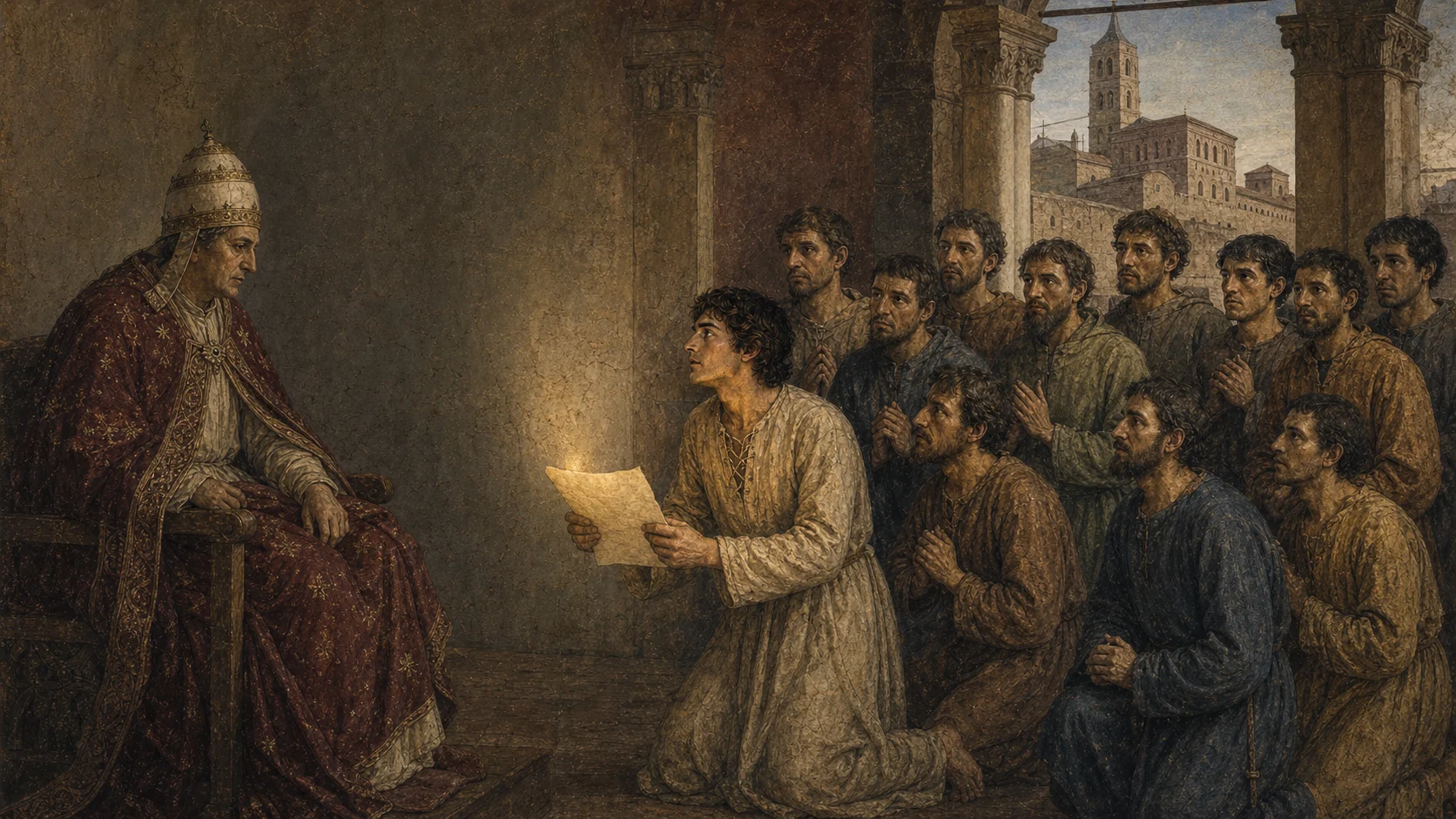
Around 1209, when the group may have reached twelve brothers, Francis gathered Gospel phrases and a few simple guidelines. The original text has not survived. The sources often call it the first rule or form of life.
It was probably much shorter than the Franciscan rules written later. It did not try to foresee every situation. In essence, it said: let us live in the footsteps of Jesus.
That sounds simple. And it is. But simple does not mean easy.
It is simple to say, “carry no riches.” It is difficult to trust when food is scarce.
It is simple to say, “announce peace.” It is difficult to answer peacefully when someone mocks you.
It is simple to say, “we are brothers.” It is difficult to share space, hear opposing opinions, and continue loving.
An evangelical rule was not a collection of beautiful phrases. It was a question repeated before every choice: what looks most like Jesus?
Why go to Rome?
At that time, religious groups walked through towns preaching and proposing change. Some came into conflict with the Church. Others were viewed suspiciously by the authorities.
Francis did not want the brothers to live apart from the community of the Church. He therefore decided to seek the pope’s approval.
Rome was far from Assisi. The journey was made on foot over difficult roads. They did not leave in luxurious carriages or carry a great document covered in seals. They took the small form of life and the hope of being heard.
Imagine twelve men in poor tunics entering a city filled with churches, pilgrims, merchants, and authorities. At the center of that world was Pope Innocent III, one of Europe’s most powerful leaders.
The contrast could not have been greater.
A door that did not open immediately
The earliest biographies tell the visit in different ways. They agree that Francis faced difficulties before being received. The way of life seemed severe. Could they live without property and still care for everyone? Would the group remain faithful? Would the proposal endure?
These doubts were not necessarily malicious. A responsible decision had to consider the consequences.
Cardinal John of Saint Paul, bishop of Sabina, is said to have helped Francis. He learned about the proposal, asked questions, and realized that forbidding that life might seem like rejecting the Gospel counsels themselves.
A famous tradition adds that the pope dreamed of the Basilica of Saint John Lateran leaning and almost falling. A small, poor man supported it on his shoulders. On recognizing Francis in that man, Innocent is said to have understood that the fraternity could help renew the Church.
We cannot verify a dream as we verify a letter. It belongs to the spiritual language of the biographies. Its image, however, preserves an important Franciscan truth: rebuilding the Church meant not conquering a throne, but supporting it with a humble life.
A spoken approval
Around 1209 or 1210, Innocent III gave oral approval to the brothers’ form of life. He also permitted them to preach conversion and peace within certain limits.
This was not yet the solemn confirmation the Rule would receive in 1223. Even so, it was a decisive moment.
Francis and the brothers did not leave Rome as rich or powerful men. They left authorized to continue a fragile experiment.
We sometimes imagine approval as a finish line. For them, it was the beginning of a greater responsibility. Now they had to live what they had promised.
A “yes” does not end the road. It makes room for the promise to become practice.
The Gospel gains feet
Back on the roads, the brothers worked, cared for people, and announced peace. They begged for food when work was not enough. They avoided keeping money. They tried not to dominate the homes that welcomed them.
They did not all do things in the same way. The group grew, and new problems arose. Remaining faithful to a small inspiration within an ever larger fraternity would require listening, correction, and patience.
In 1221, a longer rule recorded many teachings and situations accumulated over the years. It is called the Earlier Rule, or Rule Without a Papal Seal, because it did not receive a bull of solemn approval.
In 1223, another, shorter version was confirmed by Pope Honorius III through the bull Solet annuere. It is the Rule professed by the Friars Minor to this day.
Its opening preserves the heart of the first parchment:
“The rule and life of the Friars Minor is this: to observe the Holy Gospel of our Lord Jesus Christ.”
Many words were organized. A Person remained at the center.
A rule is not a prison
The word “rule” may bring to mind a sign saying “forbidden.” But its origin is also connected with something used to measure and guide a line. A ruler helps reveal when something has gone off course.
For Francis, the Rule was to protect a freedom: the freedom to live without turning money, prestige, or power into masters of the heart.
It also protected the brothers from one another. If no one could behave as the fraternity’s owner, the lesser brother should not be crushed by the stronger. If the minister was also a servant, leadership did not mean giving orders in order to feel important.
No text prevents every error. Franciscans had conflicts and passed through difficult disputes. But the Rule kept returning the same question: does this still look like the Gospel?
What does “without anything of one’s own” mean?
Franciscan poverty does not mean saying that food, shelter, and care do not matter. Francis knew hunger and understood that a sick brother needed treatment.
“Without anything of one’s own” meant not building life on possessing and controlling. Things should serve people, never turn people into the servants of things.
It remains a demanding idea today.
We may own an object and still use it to do good. We may also own few objects and spend the whole day wanting to be superior. Outward poverty finds meaning only when it makes room for generosity, trust, and justice.
Francis did not romanticize the abandonment of those who suffer. He wanted to bring the brothers close to the poor, not make the pain of poverty invisible.
A page still open
The small text taken to Rome was not preserved as an object. Perhaps that suits the story.
Its strength never depended on the parchment’s beauty. It depended on what happened when someone closed the book and began to walk.
A rule made of Gospel remains open because every generation encounters new situations. Francis did not know social media, cities of millions, or the environmental crisis as we know it. But his question remains alive.
How can we speak without humiliating? Use without wasting? Work without exploiting? Disagree without turning the other into an enemy? Allow the most vulnerable to occupy the center?
The letter offers a direction. Love must take the steps.
What the little parchment teaches us
Great changes can begin with a few words taken seriously.
You do not need to write a rule with twenty-three chapters to choose a direction. You can begin with a Gospel sentence, an honest promise, or a question that helps you decide.
A good rule does not exist to show that we are better. It reminds us who we wish to become when we forget.
Perhaps yours can fit on one line: today, no one will be too small for my attention.
The parchment opened only by living
Unroll the little Rule.
Francis's words were few. Their depth appeared when someone agreed to walk within them.
The parchment is closed. The first word awaits your steps.
For those who wish to go deeper
Sources for this chapter
- The Rule — Order of Friars MinorThe official text of the Rule confirmed by Honorius III in 1223 and its Gospel-centered opening.
- Lent with St. Francis: Take Up Your CrossPresents the tradition of the Gospel passages that guided Francis and Bernard.
- You Are All Brothers — Order of Friars MinorContext on the first fraternity, its evangelical form of life, and the journey to Rome.
The text of the first form of life presented to Innocent III has not survived. Its composition and the papal audience are reconstructed from later sources; the Rule of 1223, by contrast, has come down to us in a confirmed text.
Historical note: the oral approval is usually dated to 1209, although some studies suggest 1210. Innocent III’s dream about supporting the basilica belongs to hagiographic tradition and is presented here as a symbol narrated by the sources, not a verifiable fact.