
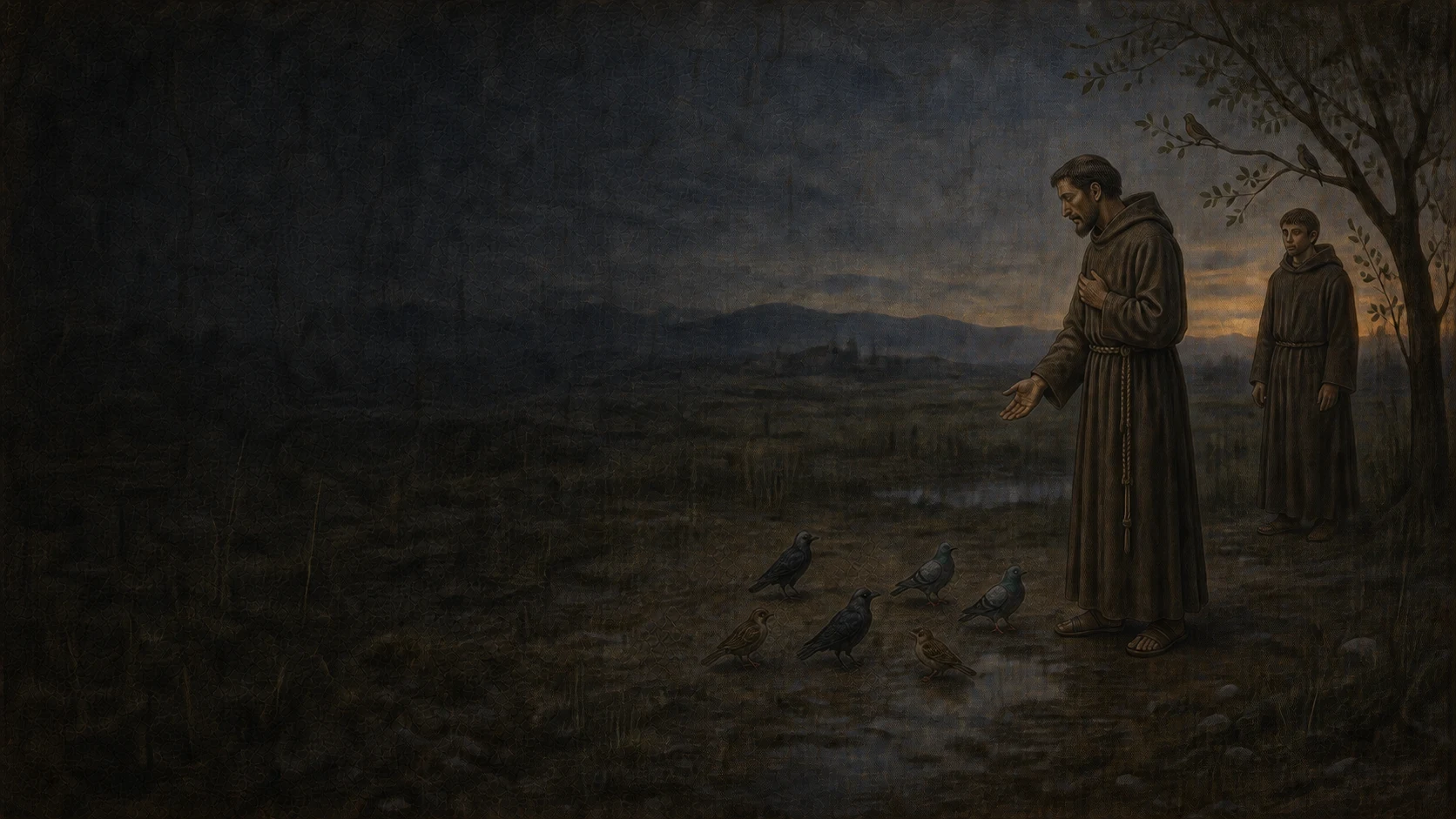
The field still holds the morning damp.
Francis walks with other brothers along a road in Umbria. There is mud on their sandals, and human voices await them in some town ahead. Then he sees birds gathered beside the road.
He leaves the road and goes to them.
He does not clap to make them fly. He does not try to catch them. He speaks.
The birds remain.
The scene seems to have been painted by memory itself: a poor man bending before small creatures while the whole world falls silent. But what has reached us is not an unframed memory. It is an account written by Thomas of Celano, later expanded by other authors and transformed into art.
The sermon to the birds does not occupy the same position as the wolf of Gubbio. The wolf first appears in writing more than a century after Francis. The birds appear only a few years after his death. Even so, proximity is not the same as a recording.
What we know
Francis died in 1226. Around 1228 or 1229, Thomas of Celano completed the first major biography of the new saint. He was a Franciscan and wrote within an Order that still included companions and witnesses from the early years.
Celano says that Francis was crossing the Spoleto Valley. Near Bevagna, he saw a great number of birds of different kinds, including doves, jackdaws and birds resembling crows. He ran joyfully toward them, leaving his companions on the road.
First, he greeted the birds. He was surprised that they did not flee. He asked them to listen to the word of God and explained that they should praise the Creator: they had been given feathers, wings and the air in which to fly. God cared for them without their sowing or reaping.
According to Celano, the birds stretched their necks, opened their beaks, spread their wings and looked at Francis. He walked among them, lightly touching them with the edge of his habit. Not one left until he blessed them and gave them permission to fly away.
Afterwards, Francis reproached himself for not having preached to creatures before. From that day onward, says the biographer, he exhorted birds, animals and even voiceless beings to love and praise the Creator.
This is the earliest known core: road, birds, word, attention and farewell.
We also possess writings by Francis himself that accord with the scene. In the Canticle of the Creatures, he calls the sun, wind, water, fire and earth brothers and sisters. He did not write the sermon to the birds, but he left a language in which creatures are not merely useful objects. They take part in praise.
Where the first account comes from
Celano’s First Life is a contemporary source. It was written only two or three years after Francis’s death, long before the Little Flowers. This gives it a historical weight that the wolf account does not possess.
But Celano was not a reporter hidden behind a tree. His work celebrated a recently canonised saint and taught readers how to understand his life. He selected scenes, arranged them and wrote in biblical language.
When he mentions birds that neither sow nor reap, medieval readers could recall Jesus’s words in the Gospel of Matthew. When creatures are summoned to praise, they could hear Psalm 148, which calls birds and all the beings of the earth to glorify God.
These biblical memories formed part of the medieval way of listening. Many people owned no books, and few could read. Scripture reached them through liturgy, sermons, stained glass and repeated stories. When Celano described the field, therefore, his readers did not separate the scene from the Bible as we might separate two books on a shelf. The birds’ flight and Jesus’s words seemed to belong to the same sky.
It is also important to recognize the scale of Francis’s gesture. A sermon usually took place where people could hear it: in a church, in a square or beside a crowd. Leaving the road to speak to animals changes the idea of an audience. In Celano’s narrative, the creatures are not decorations around the preacher; they become listeners. Francis, in turn, does not appear as their master. He approaches with joy, asks for their attention and then allows them to leave.
This literary form teaches without presenting an abstract debate. In a single image, a reader in 1229 could understand that preaching should not seek only applause and that the praise of God exceeded the human voice. The account is at once the memory of a gesture and a small theology lesson told with wings.
This does not mean that Celano invented everything. It means that he received or knew a memory and recounted it theologically. We do not have the name of the person who gave him the episode. We do not know whether he interviewed a companion who was present. No earlier notes survive.
Even the speech requires care. Celano offers a crafted summary, not a word-for-word transcript. The scene may be close to the event, but its sentences reached us through an author’s pen.
What changed over time
Other biographers retold the story. In the Major Legend, approved in 1263, Bonaventure preserved the encounter and made it part of the official image of Francis. Birds in the branches bow their heads; those on the ground wait. The saint walks among them like someone recognising a family.
At the end of the 13th century, the great fresco cycle in the Upper Basilica of Assisi gave the scene a body. In the painting traditionally associated with Giotto and his workshop, Francis bends down, a friar watches and the birds form a small assembly on the ground. The image helped generations to “remember” something they had never seen.
Art is not an eyewitness document. The painter chose the trees, gestures, colors and number of birds. But the painting shows that, only a few decades after Celano, the sermon was already central to the saint’s public memory.
Later, the Deeds of Blessed Francis and the Little Flowers added new details. The Little Flowers, translated and arranged late in the 14th century, name companions, describe a journey through Cannara and set the encounter between Cannara and Bevagna. The sermon becomes longer: it speaks of garments of feathers, the air, springs, trees and the preservation of the birds in Noah’s ark.
These additions are beautiful. They are also late. We should not place all of them in the historical Francis’s mouth with the same confidence as the core recounted by Celano.
The exact place also became a question. Celano says “near Bevagna.” Later tradition leads the road between Cannara and Bevagna. Piandarca, a field in that area, came to be venerated as the site of the sermon. There is a memorial stone and a much more recent small devotional building.
The tradition may have preserved the place. Or it may have sought an address in the landscape for an already beloved story. No 13th-century map marks, “Francis spoke to the birds here.”
What the scene seeks to teach
Francis does not speak to the birds because he imagines them as children in costume. He speaks because, for him, the whole world points toward the Creator.
The birds did not make their own wings. The friar did not make his own life either. Everything is received. The sermon is therefore, before all else, a lesson in gratitude.
There is also a lesson in humility. Preachers usually sought important people, full churches or busy squares. Francis interrupts his journey for creatures that cannot applaud, pay or confer prestige. He bends down. His audience is below his knees.
This does not mean that Francis understood ecology as we do today. He lived in a medieval world, where animals also served as religious symbols and as food. Turning him into a modern environmentalist would uproot him from his time.
Even so, his vision offers something powerful to the present. If a bird has value because it is a creature—and not merely because it serves us—then the world is not a warehouse assembled for human desires. Care for creation begins with learning to see.
The birds’ silence may also be the narrator’s language. Celano describes their necks, wings and beaks as responses. He does not need to make them speak in human words. The animal’s body is enough.
What remains a mystery
We do not know the day. We do not know exactly where. We do not know how many birds there were or which companions were present. We do not know the words Francis spoke.
We know that a Franciscan wrote the scene while the memory of Francis was still young. That makes the account historically important. It does not make it complete proof of every movement described.
The birds may have remained because they were feeding, because they felt safe or because their behaviour was embellished in the narrative. There may have been only a few. There may have been many. The event may have been simple: Francis spoke joyfully to creatures that did not flee. In memory, that simplicity acquired the form of a sermon by all creation.
Perhaps that is why the story never grows old.
In the damp field, the companion watches from a distance. Francis is not high in a pulpit. He is in profile, almost level with the birds. No ray descends from the sky. No bird receives a halo. There are only voice, feathers, earth and attention.
After the blessing, they fly in different directions. The story does not say that they became domesticated animals or followed Francis. They continued to be birds.
And the preacher returned to the road perhaps a little smaller than before—because for a few moments he accepted that he was not the only creature capable of praise.
Feathers on parchment
Sources for this story
- Thomas of Celano, First Life, chapter 21 — CapuchinsPortuguese translation of the earliest known account, written around 1228–1229.
- Francis, Canticle of the Creatures — Order of Friars MinorFrancis's own text, illuminating his language of kinship and praise with creation.
- Little Flowers of Saint Francis, chapter 16 — University of ChicagoThe later, expanded version, with the route between Cannara and Bevagna and a longer sermon.
- “Francesco d'Assisi” — Treccani Biographical DictionaryA critical overview of Celano, Bonaventure, the Actus, the Little Flowers and the formation of memory.
- “A portrait of central Italy's geology through Giotto's paintings” — Copernicus PublicationsAn academic study locating and analysing the sermon fresco in the Basilica of Assisi.
- Literary sources for PiandarcaA comparison of Celano, Bonaventure, the Actus, the Little Flowers and the local tradition of the field.
How we read the sources: Celano is close to the first generation and carries more weight than the later versions, but he wrote a saint's life in biblical language, not a transcript. Places, extended speeches and details added by later authors and artists have been identified as developments of the tradition.