A Shadow on the Wet Road
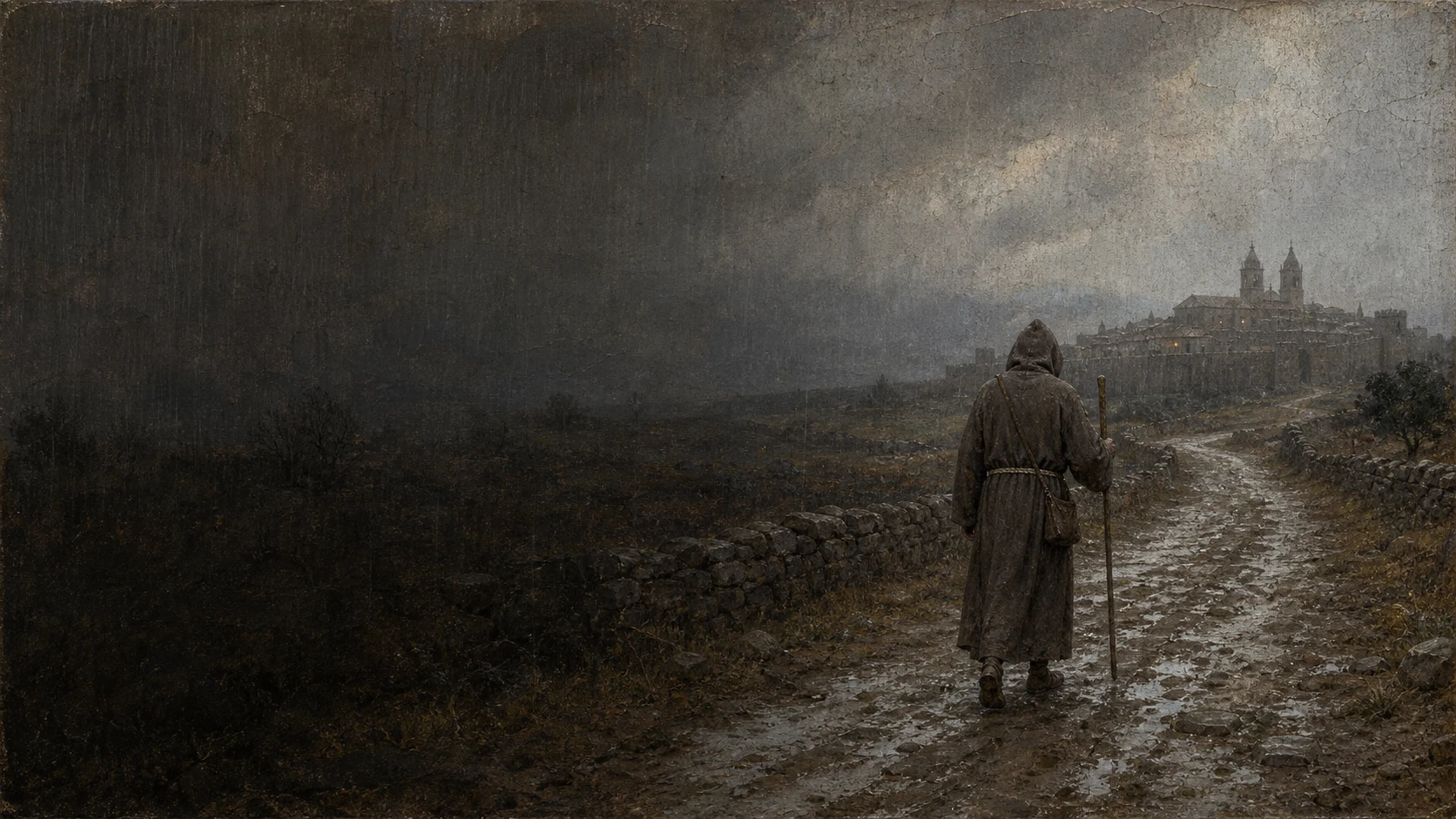
Rain darkens the earth. A traveler walks along the right side of the road, his back to us. The woolen habit weighs on his shoulders. He carries a staff in one hand and nothing in the other. Far away, towers emerge through the mist.
He may be a friar. He may be a pilgrim. We cannot see his face.
The painting was deliberately made this way. It does not claim that the man is Francis or that the city is Santiago de Compostela. It is an image for the question, not an answer in disguise.
For centuries, people have said Francis walked the Camino de Santiago. But when we approach the earliest sources, the road fills with fog.
Let us cross it without pretending to see more than is there.
What We Know
The closest account is in the First Life, written by Thomas of Celano in 1228–1229, only two years after Francis’s death.
Celano says Francis wanted to proclaim the Gospel to the Muslim ruler whom Latin Christians called the Miramolin, in Morocco. He set out, reached Spain, and became seriously ill. Because of the illness, he had to abandon the journey and return to Italy.
In the thirteenth century, “Spain” could mean the Iberian Peninsula, then divided among different kingdoms. Celano does not say which road Francis took, where he became ill, or how long he stayed.
Nor does he write the word Santiago in this episode.
Bonaventure’s Major Legend, completed in the 1260s, repeats the same core: the road toward Morocco, arrival in Spain, illness, and return. Again, Compostela does not appear.
These texts are not perfect diaries. Celano was writing a saint’s life; Bonaventure selected and reorganised traditions for the Order. Both omit many days of Francis’s life. Their silence does not mathematically prove that a pilgrimage never occurred.
But the silence carries weight. They knew of the Iberian journey and chose to narrate it. Had Francis reached the West’s greatest pilgrimage shrine, it would have been a noteworthy detail.
A Santiago That Appears Earlier—Without Francis
There is a still more curious clue.
When describing the first brothers sent out in pairs, Celano says Bernard of Quintavalle and Giles took the road to Santiago. Francis and his companion went in another direction.
The earliest source therefore knows of Franciscan pilgrims going to Compostela. It simply does not place Francis among them then.
Santiago already lay on the first brothers’ horizon. In the thirteenth century, its cathedral drew crowds. The Liber Sancti Iacobi, compiled in the twelfth century, described routes, shrines, dangers, and pilgrims’ customs.
Scallop shells were sold in Compostela and carried as signs of a completed pilgrimage. Our image gives the traveler no shell: the symbol might suggest a certainty we do not have.
Francis may have wished to visit Santiago. Other brothers certainly did. So far, however, possibility is not documentation.
Where the Tradition Begins
The first explicit claim appears in the Deeds of Blessed Francis and His Companions, the Actus, composed in the Italian Marches probably between 1327 and 1337. Much of this collection was translated into Italian in the Fioretti between about 1370 and 1390.
More than a hundred years had passed since the supposed journey.
The account says that when the Order was still small, Francis went “out of devotion” to Saint James of Galicia with several friars, including Bernard. On the way, they met a poor sick man. Francis asked Bernard to stay and care for him, then continued with the others.
According to the narrative, Francis spent the night praying in the apostle’s church at Santiago. There he supposedly received a revelation that the Order would grow and should accept places in many regions. Returning, he found Bernard and the sick man, now healed. He then allowed Bernard to complete his pilgrimage.
It is a beautiful story shaped by time: service to the sick, obedience, night prayer, revelation, and the founding of houses.
The Actus may preserve old memories transmitted orally. We need not call them lies. But their chronological distance prevents us from treating them as eyewitness testimony.
The Date That Looks Firm but Is Not
Many monuments and texts give 1214 as the year of the pilgrimage. That date is not written in the Fioretti. It was calculated from the available space in Francis’s life and the journey to Spain narrated by Celano.
Some scholars prefer 1213; others use 1214 or the period from 1213 to 1215. We cannot assemble a day-by-day calendar.
Nor is there a proven route. Devotional maps take Francis through cities in France, Aragon, Castile, Portugal, or Galicia. Many places preserve memories of his passage. Yet a local tradition repeated for centuries cannot by itself tell us which bridge he crossed.
If Morocco was the destination, Francis may have headed toward a Mediterranean port or the south of the peninsula. Santiago lies in the far northwest. A detour was possible, especially during a long recovery, but would have required time and strength. Celano says illness made him return, not that it sent him north.
The map remains blank.
How the Tradition Became Stone
Santiago has the friary of San Francisco do Val de Deus, outside the old walled center. Tradition says Francis was hosted by a poor charcoal burner named Cotolay. After praying on Mount Pedroso, he supposedly chose the valley for a friars’ house.
Cotolay had no money to build. In later versions, Francis revealed hidden treasure. The Benedictines supposedly ceded the land in exchange for an annual basket of fish. Delivering the fish became a ceremony and a subject in local art.
It is a perfect narrative for explaining a place, a relationship between communities, and a custom. But its detailed records are late. The story was carved into a sixteenth-century granite inscription and developed by Franciscan chroniclers of that period.
Documents and studies indicate an early Franciscan presence in Compostela, probably by the 1220s or 1230s. This proves that the Order quickly reached the city. It does not prove Francis personally founded the house in 1214.
A building may preserve a true tradition, enlarge a memory, or credit a founder with what followers did. Stones too tell interested stories.
How the Account Changed
In later centuries, other chroniclers repeated and expanded the pilgrimage. Francis became associated not only with Santiago but with a chain of friaries across the Iberian Peninsula. Many foundations wished to place their origins closer to the saint.
The growth was not only written. Sculptures, paintings, and ceremonies appeared. Compostela developed the distinctive image of Francisco foreiro, linked to the symbolic payment of the basket of fish to the Benedictines.
These works are important evidence—not necessarily of a journey in 1214, but of the strength the tradition acquired. They show what Galician communities believed, celebrated, and wished to transmit.
A legend can be historically late and culturally true. It changes a city, inspires hospitality, and shapes images. The mistake begins when we use that later strength to manufacture an earlier document.
What Research Allows Us to Say
We can organize the case in four lines:
- It is certain that Francis tried to reach Morocco and reached some part of the Iberian Peninsula before falling ill and returning.
- It is certain that close brothers, especially Bernard and Giles, made a pilgrimage to Santiago in the early years.
- The account is old but later that Francis himself reached Compostela: it appears explicitly in the Actus and Fioretti, more than a century afterwards.
- We have no contemporary confirmation, itinerary, letter, or Compostela record proving his presence in 1214.
Some historians therefore consider the pilgrimage possible; others think different traditions were probably merged. No careful researcher should say “it certainly happened” or “it is certainly impossible”.
The most honest state of the question is: Francis was on the Iberian Peninsula, but his arrival in Santiago cannot be confirmed from the available sources.
The Mystery That Remains
The rainy road remains before us.
Perhaps Francis saw Compostela’s towers. Perhaps illness forced him to turn back much earlier. Perhaps a fourteenth-century friar joined the saint’s Spanish journey to Bernard’s real pilgrimage. Perhaps he received a memory that did not reach the earliest biographers.
Not knowing can feel like defeat. For history, it is a form of respect.
We respect Francis when we do not need to increase his footsteps. We respect tradition when we ask in which century it began to speak. And we respect the reader when we leave a door open without painting a false certainty behind it.
In the image, the traveler does not turn. The city remains distant. Rain erases his footprints almost as soon as he passes.
We do not know his name.
We know only that someone walked.
At the roadside
Sources for This Notebook
- Thomas of Celano — First Life of Saint FrancisAn early biography written in 1228–1229. It records the journey to Spain bound for Morocco and the return because of illness; it also records Bernard and Giles's pilgrimage to Santiago, but not Francis's.
- Spirit + Life 136 — Francis's journeys outside ItalyA critical Franciscan overview. It compares Celano, Bonaventure, the Actus, and the Fioretti, concluding that there is no historical certainty about Compostela.
- Magazine of the Basilica of Assisi — Did Francis Really Go to Santiago?A survey of sources and traditions. It presents the silence of the early lives, the Fioretti text, the sixteenth-century inscription, and the legend of Cotolay.
- Ramón Yzquierdo Perrín — Franciscan iconography in SantiagoAn academic article from the University of Santiago de Compostela. It studies the traditions, the foundation attributed to the saint, the basket of fish, and their images without claiming certainty about the pilgrimage.
- Dizionario Biografico degli Italiani — Francis of AssisiA modern biographical study. It locates Celano, Bonaventure, and the late composition of the Actus-Fioretti within the transmission of memory.
- Xunta de Galicia — Codex CalixtinusDocumentary context for the Camino. It explains the twelfth-century manuscript and the world of routes, shrines, and dangers known to pilgrims before Francis's time.
- British Museum — medieval scallop-shell badgeAn archaeological object. It confirms the shell as a medieval emblem linked with Santiago, without proving that Francis wore one.
How to read this chapter: the opening and ending are literary scenes featuring an anonymous pilgrim. Francis's journey to Spain and return because of illness belong to the early documentary layer. The Santiago pilgrimage, revelation, Cotolay, treasure, and basket of fish belong to later traditions of different dates. They are narrated here as traditions, never as equally proven facts.