
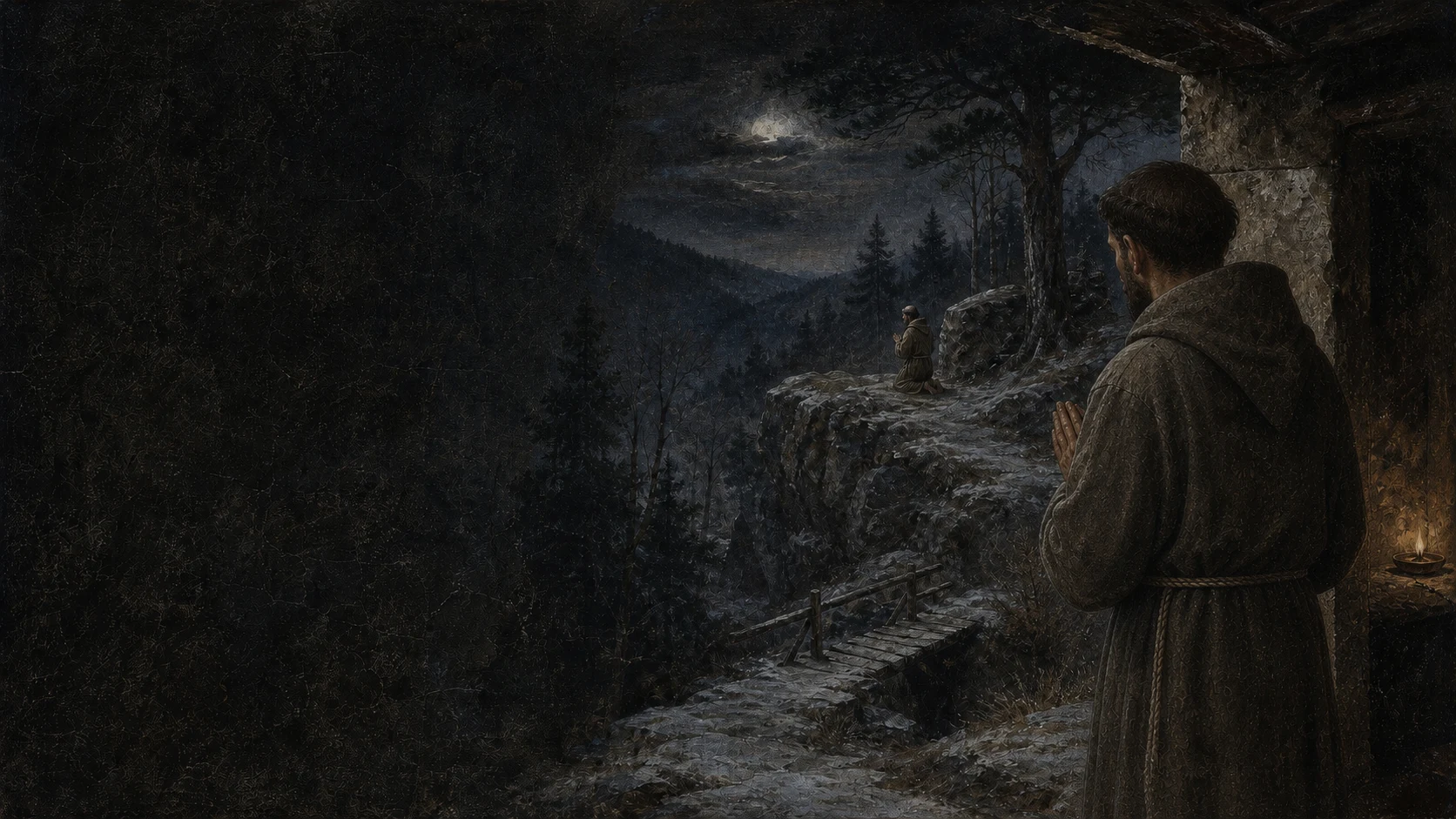
The wind passes through the clefts in the mountain.
Brother Leo waits by the stone entrance. It is time to pray Matins, the prayer said while almost everyone sleeps. Ahead are a narrow bridge, black trees and a path that the moonlight cannot fully illuminate.
Leo calls.
No answer.
He then crosses the bridge, looks into the empty cell and moves slowly through the wood. In the distance, he hears Francis’s voice. The brother is kneeling on the rock and repeats only two questions:
Who are you, my most gentle God? And who am I, your small and useless servant?
A twig snaps beneath Leo’s foot.
The voice stops.
This scene seems to hold the breath of La Verna. But it was written long after the night it describes. To listen honestly, we will have to distinguish a sheet that still exists from a conversation that arrived only by way of devotion.
What we know
Leo truly was close to Francis
Brother Leo is not a character invented to fill the landscape. He belonged to Francis’s close circle during the final years. He was a priest, could write and accompanied the brother at delicate moments. Francis entrusted him with words, corrections and objects.
An authentic letter, now kept in Spoleto, reveals their intimacy. Francis addresses Leo “as a mother” and summarises advice given on the road. At the end, he allows Leo to return if he still needs consolation.
This is not the speech of a distant superior. Nor is it a friendship without tension. Leo seems to have been an anxious person who wanted clarity; Francis loves him but tries to teach him to decide before God.
That bond is the first firm ground beneath the night.
The small sheet from La Verna
The most precious document of this friendship is the Chartula, a piece of parchment measuring approximately ten by thirteen centimetres and preserved in the Basilica of Saint Francis in Assisi.
On one side, Francis wrote the Praises of God Most High in his own hand. On the other, he wrote a blessing for Leo based on the biblical Book of Numbers, adding his friend’s name and the sign of the Tau.
Leo added notes in red ink. He identifies Francis’s hand and connects the composition with La Verna in 1224, after the experience of the seraph and the marks of the Passion.
The sheet is not a 14th-century copy. It is a 13th-century object, folded, carried and preserved. Francis’s writing and Leo’s notes can be examined.
It proves that the two were together at La Verna and that Francis gave Leo deeply personal words.
But the Chartula does not tell of the night walk. It records neither the bridge, the twig nor the two questions heard in the wood.
What the closest lives say
Thomas of Celano wrote the first life of Francis only a few years after his death. He described La Verna and the marks of Christ. In the second life, written around 1246–1247, he related that a companion wished to receive some written words from Francis to help him through an inner temptation. Without the brother asking, Francis called him, requested parchment and ink and wrote praises and a blessing.
Bonaventure returned to this memory in his Major Legend in the 1260s.
These sources agree with the surviving object. They do not, however, contain the episode in which Leo searches for Francis by moonlight and hears the questions.
The silence does not prove that a private conversation never took place. It shows only that its detailed form does not appear in the closest biographical testimony.
The story’s origin
The Acts, the Fioretti and a separate appendix
During the 14th century, friars in the Italian region of the Marches gathered stories about Francis and his companions. A Latin collection called the Actus beati Francisci et sociorum eius probably took shape between the 1320s and 1330s. Its principal compiler is traditionally identified as Brother Ugolino of Montegiorgio.
Some of these accounts were translated into Italian in the famous Fioretti, the “little flowers” of Saint Francis. The texts possess immense spiritual beauty, but they were composed about a century after the events.
Leo’s night appears in the Third Consideration on the Stigmata. The Considerations commonly accompany the Fioretti in manuscripts, but they are an independent work, written in the vernacular at the end of the 14th century. They combine Latin material, oral traditions and literary construction.
This prevents a frequent error: simply saying that “Brother Leo wrote in the Fioretti”. He did not write the book. His memory may be among its roots, but the text we possess passed through much later compilers.
The night as the account constructs it
In the Third Consideration, Leo would go at Matins and say the first verse of the prayer from the beginning of the bridge: “Lord, open my lips.” Francis had ordered that if he did not answer, his companion should return.
That night, Leo crosses anyway. He does not find Francis in the cell and searches for him in the wood by moonlight. At last, he sees him kneeling and hears the question about who God is and who the small human being before him is.
As Leo approaches, he makes a noise. Francis becomes aware of his presence, calls to him and asks what he saw. The brother delays answering, ashamed that he crossed the boundary. The narrative continues with the opening of a book of the Gospels and prepares the reader for the reception of the stigmata.
Every object serves a purpose: the bridge separates closeness from secrecy; the moon allows sight without revealing everything; the branch betrays the listener; the questions make Francis humble before the extraordinary event.
It is a carefully written scene, not a set of minutes.
A chain of voices that is difficult to measure
Some accounts connected with the Acts claim to have passed from Leo to Brother James of Massa and then to Ugolino. This chain may preserve early recollections. It also crosses decades of repetition, selection and interpretation.
We do not possess a note by Leo containing the scene or a 13th-century copy. The earliest dated manuscript of the Fioretti is from 1396, and the tradition of the Considerations belongs to the end of that century.
A voice can travel for a hundred years. As it travels, its timbre changes.
How the story changed
Two nights that became one
Another famous narrative from the Acts/Fioretti says that Bernard of Quintavalle welcomed Francis into his house, pretended to sleep and heard his guest repeat throughout the night: “My God and my all.” The scene takes place in Assisi, before Bernard joins the brothers.
It is not the night at La Verna. The listener is Bernard, not Leo. The prayer is different as well.
In popular memory, however, the two nights drew together. “Who are you and who am I?” came to be summarised alongside “My God and my all.” Both express wonder and surrender, but blending them erases the distinct paths of the texts.
The Notebook of the Half-Light keeps the two lamps separate.
The prayer that was heard and the praises that were written
It is also tempting to say that the words from the wood appear on the Chartula. They do not.
In the Praises of God Most High, Francis writes a sequence of affirmations: God is holy, strong, great, love, wisdom, humility, beauty, security and peace. It is an authentic prayer from La Verna.
The question “Who are you?” fits these answers very well. Preachers and readers therefore connected the texts. The spiritual connection is rich; the documentary identity is false.
We may imagine that the praises arose from similar questions. We cannot write that imagination in the margin of the parchment as though Leo had left it there.
From companion to witness of everything
Later narratives brought Leo ever closer to Francis’s secrets. He hears prayers, perceives ecstasies, helps care for the wounded body and preserves words that others do not receive.
Part of this image grows from facts: Leo accompanied Francis, received autographs and wrote notes on the Chartula. Part of it grows from the devotional need to have a reliable witness for scenes without an audience.
In the Middle Ages, “secretary” could suggest not only someone who wrote letters, but the keeper of secrets. Leo became the man placed at the boundary: close enough to hear, humble enough to withdraw.
This construction tells us as much about the love 14th-century Franciscans had for their origins as it does about the 13th-century Leo.
The mystery
What can be affirmed
We know that Leo and Francis were at La Verna in 1224. We know that Francis wrote the praises and blessing and gave them to his companion. We know that 13th-century sources speak of Leo’s need for consolation and Francis’s gentle response.
We also know that the detailed night scene arrived in a devotional work from the end of the 14th century.
We do not know whether Leo really stepped on a twig, whether there was a bridge in that form or whether he heard those exact two sentences. The literary precision belongs to the late text.
That does not turn the story into rubbish. It changes the question. Instead of asking, “Is there a recording of this night?”, we ask, “Why did the friars want to remember it in this way?”
Intimacy that does not require intrusion
Leo loves Francis and wants to be near him. But the narrative also has him cross a boundary. He is told to return, continues, listens and then feels ashamed.
The text does not celebrate unchecked curiosity. It teaches that even care can intrude. People we love have a right to silence, prayer and thoughts they are not yet able to share.
In the story, Francis does not humiliate Leo. He calls him tenderly and sends him back with a blessing. The friendship can bear a correction.
Perhaps this is the truest part of the scene, even if we cannot prove the twig: intimacy does not mean possessing all another person’s secrets.
To keep in your heart
The two questions attributed to Francis remain powerful because they open up space.
“Who are you?” prevents God from becoming a small idea under our control. “Who am I?” prevents our fear, success or mistake from being the only answer about our life.
You can keep them without pretending to possess a transcript from the mountain.
Today, listen to someone without interrupting and without seeking information they have not offered. If they need distance, respect it. If they ask for your presence, stay.
On the night at La Verna, the late source places one man in prayer and another learning not to come too close.
The moon does not confirm the words.
The Chartula confirms the affection.
Between the two, the wind still passes through the stone.
Sources and paths for further reading
Where the voice in the night comes from
- Third Consideration on the StigmataA translation of the devotional account with the bridge, Leo’s moonlit search and the two questions attributed to Francis.
- Nunzio Bianchi — Considerations on the StigmataA recent academic study dating the work to the end of the 14th century and distinguishing it from the Fioretti, although the texts circulated together.
- Biographical Dictionary of the Italians — Leo of AssisiA critical biography of Leo, covering the authentic letter, his presence at La Verna, the Chartula and his notes in red ink.
- L’Osservatore Romano — Memory of a great bondA presentation of the two autographs Francis gave Leo: the letter in Spoleto and the sheet with the Praises and Blessing preserved in Assisi.
- Paolo Natale — manuscript tradition of the FiorettiA philological study of the late dating of the Acts, the manuscript of 1396 and the independent circulation of the five Considerations.
- Biographical Dictionary of the Italians — Ugolino of MontegiorgioA critical discussion of the attribution of the Acts, their relationship with the Fioretti and the confusions created by later tradition.
The Chartula and the letter to Leo are 13th-century documents. The scene in the wood belongs to the Considerations on the Stigmata, an independent late-14th-century devotional work that circulated with the Fioretti and reused material close to the Acts. This chapter neither attributes the Considerations to Leo nor turns his prayer into text from the Chartula.
Historical note: Leo’s presence at La Verna and the gift of the Praises and Blessing are supported by the autograph parchment and 13th-century sources. The moonlit walk, the bridge, the snapping branch and the exact wording of the two questions appear in a late devotional elaboration. The phrase “My God and my all” belongs to another night in the Acts/Fioretti, heard by Bernard of Quintavalle in Assisi.