
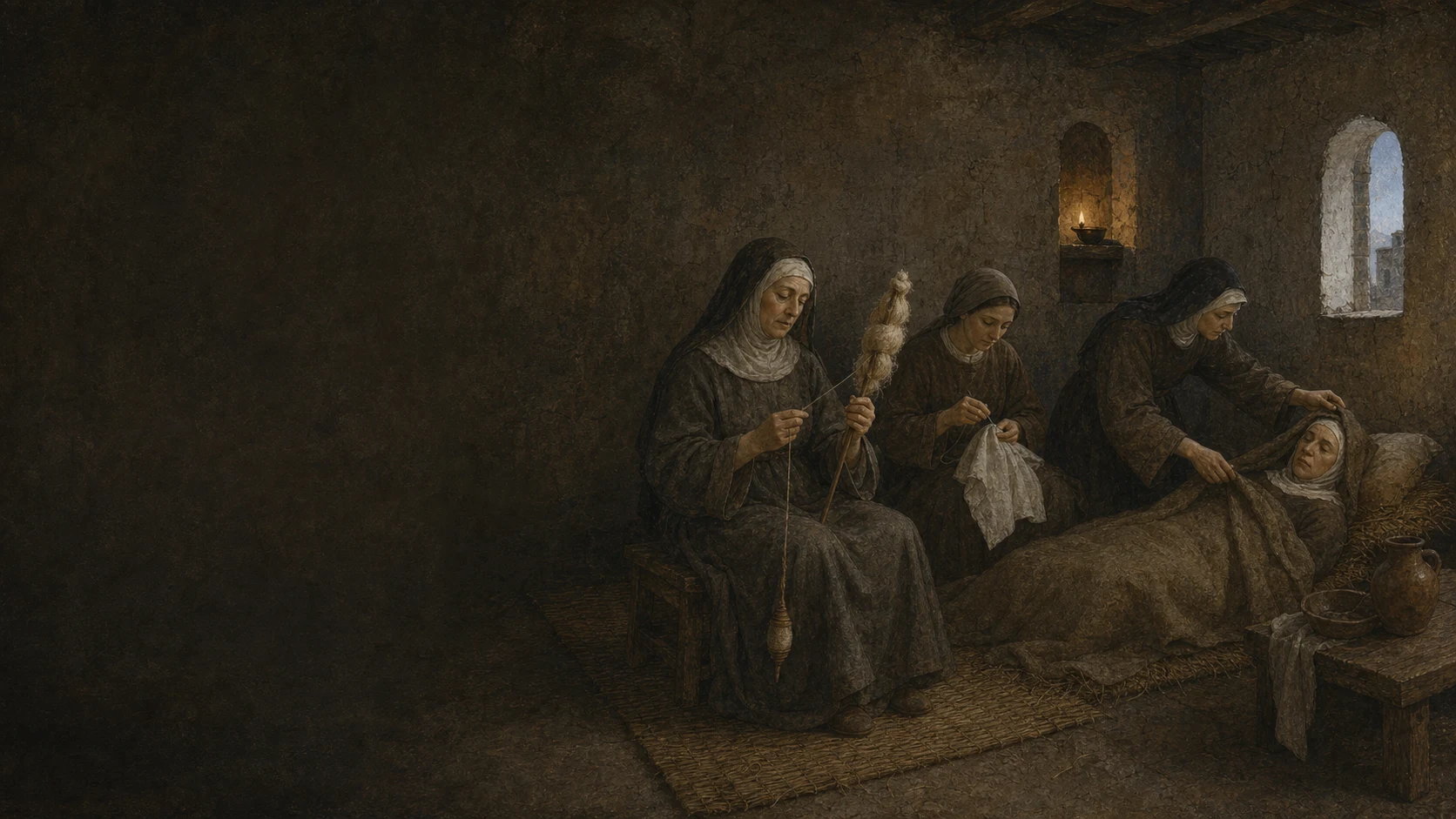
The House Wakes Before Sunrise
It is still dark when San Damiano begins to wake. The little church stands below Assisi’s walls. Its stones hold the night’s cold. One sister lights the lamp. Another settles a rough tunic over her shoulders. There is no noise of a city, only soft footsteps, wood, and voices beginning to pray.
Some sisters can read the Divine Office from small books. Others never learned to read and pray a sequence of Our Fathers. Clare’s own Rule provides for both. No one is considered less of a sister because she cannot recognize the letters on the parchment.
This opening is a reconstruction. No document describes an entire morning minute by minute. Yet the stones of San Damiano still stand, and the Rule Clare wrote reveals the rhythms of the house: prayer, fasting, work, silence, meetings, care for the sick, and decisions made in community.
We will not retell the night Clare left her family. That crossing has already been told. Now the door closes behind her and another adventure begins: living for decades with real people, in cramped rooms, on holy days and on days when someone wakes tired.
It Was Not a Castle of Perfect Women
The community was called the Poor Sisters. It would later be known as the Order of Saint Clare. Among the first were Clare’s sister Agnes and women named Pacifica, Benvenuta, Filippa, Cecilia, Amata, Balbina, and others whose voices have reached us.
We know their names because, a few months after Clare’s death in 1253, a commission heard people who had known her. Fifteen sisters from San Damiano and five residents of Assisi answered questions under oath. This Canonisation Process is an extraordinary window: the witnesses did not live centuries later; several shared the house with Clare for twenty, thirty, or more years.
Even so, it must be read carefully. They were testifying to show that Clare was holy. They recalled virtues, healings, and wondrous events, not each week’s shopping list. When several sisters repeat that Clare cared for the sick and performed humble tasks, we find a very strong community memory. When only one voice tells of a miracle, we know it is the testimony of her faith, not an experience history can test.
San Damiano was not a painting in which no one ever became irritated. The Rule tells a sister to ask forgiveness when a word or gesture hurts another and warns the abbess not to become upset by someone’s fault. Rules like these exist because conflicts exist.
Flax, Spindle, and Busy Hands
After morning prayer came work. Clare directed that every task be assigned in chapter, the community meeting, and performed for the common good. Work could not extinguish “the spirit of holy prayer and devotion”. Nor was it to allow one sister to accumulate possessions of her own.
The Process says that Clare spun thread. In that century, she did not sit before a modern machine. She used fibres, a distaff, and a spindle, drawing and twisting the thread with her hands. The sisters turned the material into corporals and cloths used at the altar. The friars carried them to churches in the hills and plain around Assisi.
It is a beautiful image, but not an easy one. Spinning demands repetition and attention. Fingers grow dry. Light is scarce. A thread breaks and must be joined again. Clare continued working even through long years of illness.
The sisters did not make luxuries for themselves. Something begun in a poor room reached small churches. Enclosure did not make their hands useless to the world.
The Sickroom
Clare fell ill while still relatively young and spent much of her final decades with limitations whose precise cause we do not know. The sources use general language; we cannot give her a modern diagnosis.
Her Rule, however, is very specific about illness. The abbess must ask what the sick sister needs, provide food and other necessities, and care for her kindly. A sick sister could use a straw mattress, feather pillow, woolen socks, and a blanket. She could be excused from fasting.
This corrects a dangerous idea: poverty is not the denial of care. The house may have had few resources, but one person’s weakness created an obligation for everyone.
Pacifica, Benvenuta, and Filippa testified that Clare washed vessels used by the sick, brought them water, and performed tasks a noblewoman of her time would have learned to leave to servants. They also remembered her crossing the dormitory at night to cover anyone who felt cold.
Perhaps no painting can show the full weight of those gestures. Water had to be fetched. Cloths had to be washed. The smell of sickness did not disappear because of beautiful words. The holiness described by the sisters had hands and knees.
When the Mother Is Also a Servant
Clare was called abbess, although she resisted the title for a time. When she accepted responsibility, she did not describe it as a place above the others.
In the Rule, the community takes part in choosing the abbess. If she ceases to serve the common good, another must be elected. The sister in charge must lead more by example than by office, console those who suffer, and be the final refuge of anyone in distress. Clare writes something more surprising still: the abbess must relate to the sisters as a servant to her ladies.
This does not mean no one was corrected. The house had discipline, fasts, and penances that may seem severe today. Authority, however, was not meant to grow from fear.
An early memory says that Clare washed the feet of sisters who served outside. Once, one of them drew back her foot in embarrassment and struck Clare’s face. The scene appears in the Process with small differences among the witnesses. Its core is close to the community: Clare took the foot again and completed the act of service.
We need not turn every detail into an exact photograph. The story was preserved because it showed the reversal the sisters recognized: the former nobleman’s daughter kneeling before a serving sister.
Walls That Did Not Erase the World
Life at San Damiano was enclosed. The Rule speaks of doors, keys, a portress, and permission to enter or leave. It would be wrong to imagine those provisions simply as a prison chosen by frail women. Enclosure formed part of the medieval religious life Clare wrote and defended, but it was also shaped by Church decisions concerning women’s communities. Freedom and limitation inhabited the same wall.
Not all sisters performed the same duties. Some served outside the enclosed area. Friars brought food, celebrated the liturgy, and preached. Messages traveled to Rome and Prague. Four surviving letters from Clare went to Agnes of Prague, a princess who had chosen a similar life.
When guiding sisters who went outside, Clare asked them to praise God when they saw trees, flowers, people, and other creatures. The garden and road continued to enter San Damiano through their eyes.
Silence was not the absence of the world. It was a way of listening without belonging to the struggle for prestige.
The Resistance of Parchment
Clare did not wield a sword. Her resistance consisted of requests, refusals, letters, and perseverance.
Church authorities wished to provide women’s communities with property and stable income. It seemed prudent: how would they be fed in the future? Clare feared that such security would destroy the form of poverty lived from the beginning. A papal document of 1228 confirmed for San Damiano the Privilege of Poverty, the right not to be forced to accept possessions. Tradition links an earlier grant to Pope Innocent III, but the secure text we possess comes from Gregory IX.
Clare did not say that hunger was good. Her Rule directs that needs be met and alms accepted. What she rejected was building the community’s security on property and control.
For years, different rules were proposed for communities of women connected with the Franciscan movement. Clare wrote her own form of life, drawing on Franciscan elements and giving legal form to San Damiano’s experience. Pope Innocent IV confirmed it in August 1253, only days before her death.
It was a rare achievement: a medieval woman gave the Church a Rule written for her sisters, and that Rule protected what they had learned by living together.
The secret of San Damiano
Stone Becomes a Home Only When Someone Cares.
Clare did not preserve poverty like an antique kept behind glass. She transformed it into relationships: no sister possessed another, authority served, work belonged to the common good, and a sick person could ask for what she needed.
The Things That Remained
In 1260, several years after Clare’s death, the community left San Damiano for the new monastery beside the basilica dedicated to her. The old house remained. The church, refectory, and spaces connected with the infirmary can still be seen, although parts of the complex changed in later centuries.
More important than the stones is the sisters’ testimony. Pacifica remembered the thread. Benvenuta remembered the feet being washed. Filippa remembered the care given at night. Clare left letters, a Testament, and a Rule.
We do not hear every voice. Some sisters appear only by name; others disappeared from the documents. But the little that remains is enough to open the door.
We enter expecting to find a solitary saint. We find a community: one sister reads, another prays from memory, another spins, one corrects, another asks forgiveness, one is ill, and someone rises to cover her.
Outside, the Middle Ages remain noisy. Inside, patient hands once again join the broken thread.
Documentary foundations
Sources for This Chapter
- Rule, Testament, and Letters of Saint Clare — Franciscans IrelandClare's writings. They establish the rhythms of prayer, work, care for the sick, community government, poverty, and her own words to the sisters.
- Joan Mueller — A Companion to Clare of Assisi (Brill)Academic study. It quotes and analyses testimony from the Canonisation Process concerning service, illness, work, and life together.
- L'Osservatore Romano — poverty and work in Clare's lifeIt connects the spinning of altar cloths, work for the common good, and Clare's resistance in defense of poverty.
- Benedict XVI — audience on Saint ClareIt presents the historical value of testimony given shortly after Clare's death and the exceptional character of her Rule.
- San Damiano Sanctuary — history of the spacesIt identifies the medieval structure, refectory, and area used as the sick sisters' dormitory, distinguishing them from later additions.
How to read this chapter: the opening morning and final scene are literary reconstructions based on the Rule's rhythms; they have not been presented as documented episodes. Actions attributed to Clare come from her writings or the close testimony identified in the text. Miracles remembered in the Process belong to the sisters' religious testimony and have not been used as historical proof of supernatural events.