Before sunrise, the field is already awake.
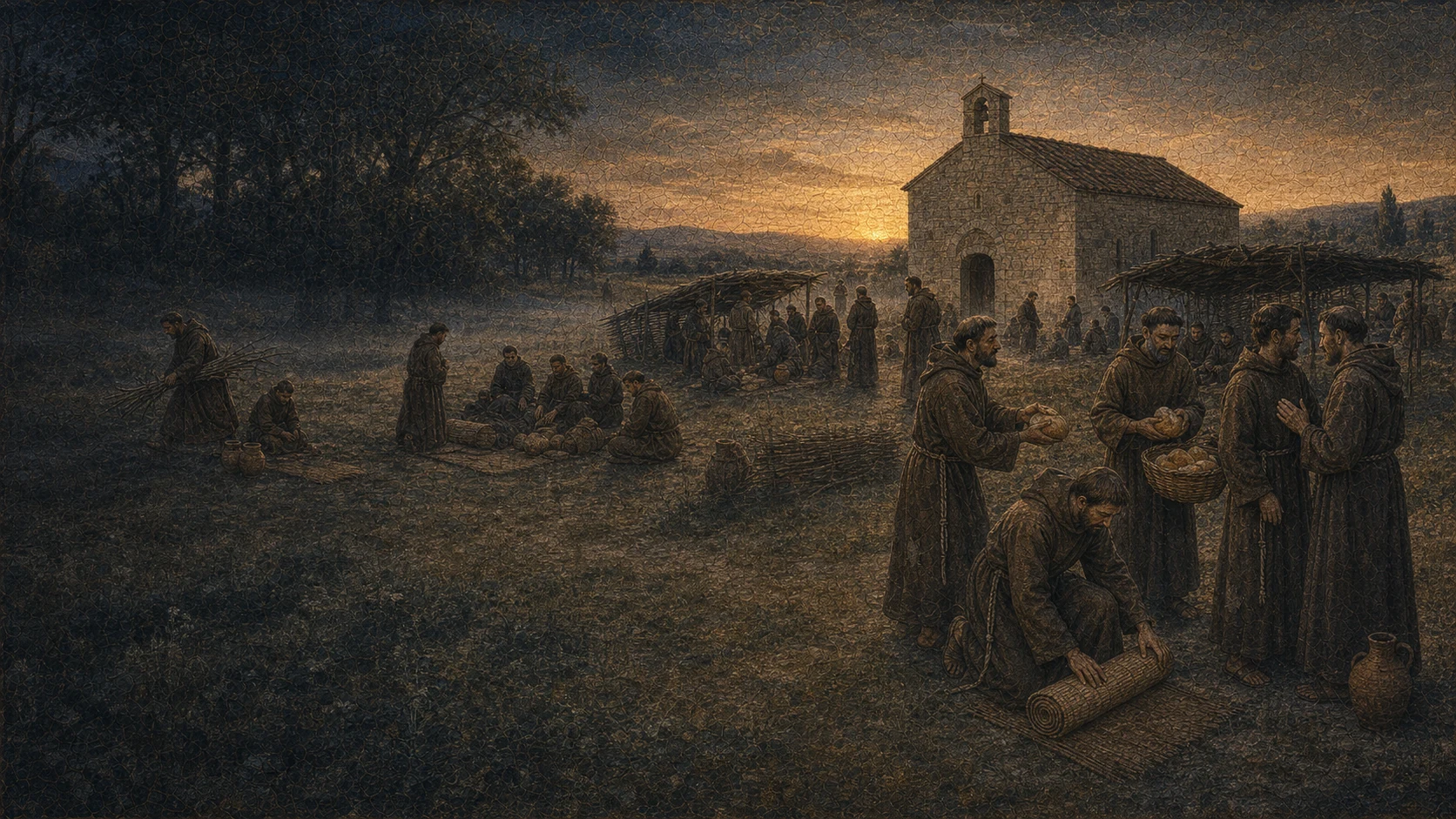
Some brothers emerge from shelters made of branches. Others roll up mats, look for water or share bread. There are different accents, patched habits and feet wounded by weeks on the road. At the center of everything stands a church so small that a large family could scarcely fit inside it: Saint Mary of the Portiuncula.
Around it are too many friars for any building.
Later, this gathering would be remembered as the Chapter of the Mats. The image seems to come from an old painting: a multitude without palaces, gathered beneath fragile huts. Yet as we approach the sources, we discover several gatherings, different numbers and accounts written at different times.
The event is real. The legend’s perfect form grew with memory.
“Chapter” was not part of a book
In medieval religious life, a chapter was an assembly. The name came from the monastic custom of reading a chapter of the Rule during meetings, but it came to mean the gathering itself. There, people prayed, corrected problems and decided on missions.
The first Franciscans lived scattered over a wide area. They walked through Italy, crossed mountains and began to reach other lands. Without rapid communications, an annual gathering was essential. Brothers who had spent months far away could tell what they had encountered, listen to Francis, ask for help and return to the roads with a mission.
In 1216, when the fraternity was still very young, the cleric Jacques de Vitry wrote about the Friars Minor. He did not belong to the group and is therefore a valuable outside witness. He said that the brothers met once a year at a designated place, rejoiced and ate together, drew up directives and then dispersed to different regions.
Jacques does not use the name “Chapter of the Mats”. But he confirms that large annual gatherings were already part of Franciscan life.
The Portiuncula as a heart
The Portiuncula stood on the plain below Assisi. It was a simple chapel restored by Francis and associated with the fraternity’s beginnings. It was not an immense church capable of receiving crowds. Its smallness said something: the brothers’ center was not a palace.
The Earlier Rule, a text completed in 1221, directs the ministers of nearby regions to attend the Pentecost chapter at the church every year. Ministers from beyond the Alps and the sea were to attend every three years, unless the minister general decided otherwise.
This passage is direct evidence. The gatherings were not merely a beautiful memory: they were already part of the fraternity’s organisation.
Pentecost also had meaning. According to the Acts of the Apostles, Jesus’s disciples were gathered when they received the Holy Spirit and began to speak to different peoples. By choosing this feast, the friars saw themselves as a fraternity called to gather and then go out.
The chapter breathed in two movements: coming home and setting out again.
The gathering of 1221
The most concrete description comes from Jordan of Giano, a friar who participated in the chapter of 1221 and was later sent to Germany. He wrote his chronicle decades later, around 1262, but he was narrating events he had lived through.
Jordan gives a date: 23 May, the feast of Pentecost. He says that professed friars and novices attended and that the multitude was estimated at about three thousand brothers. He also mentions Cardinal Rainier, bishops and other religious. A bishop celebrated Mass; Francis was believed to have read the Gospel.
Three thousand is already an extraordinary number, but we must preserve one of Jordan’s words: “estimated”. No one had turnstiles or digital lists. It was an estimate made at an enormous assembly. Later sources would speak of more than five thousand and may have blended memories of different chapters.
We therefore do not claim that there were exactly three thousand, still less five thousand. We can affirm that the gathering seemed immense to those who remembered it.
Jordan also says that there were not enough buildings. The friars occupied an enclosed field and slept beneath coverings of branches, organized into groups. Local people brought bread and wine in abundance. The account speaks of such generosity that, after a week, the brothers had to stop accepting offerings and spend another two days consuming what had already arrived.
It is a scene of poverty, but not abandonment. The fraternity survived because other people worked.
Where did the mats come from?
The famous name emerges strongly in later traditions. The Little Flowers of Saint Francis, written in Italian from 14th-century Latin accounts, describe a chapter with more than five thousand friars. In versions from this narrative world, the brothers shelter in fragile structures, divided into groups, while Providence sends food.
Saint Bonaventure, writing the Major Legend in the 1260s, also speaks of more than five thousand brothers and sufficient food despite the lack of resources. His purpose was not to produce an attendance spreadsheet. He wanted to show Francis’s trust and God’s care.
The mats fit this memory perfectly: simple materials of straw or rush used for sitting, sleeping or covering shelters. They may indeed have been there. But Jordan, our most concrete witness to 1221, emphasises coverings of branches and does not give the gathering this name.
Thus “Chapter of the Mats” is a traditional name for the great gathering—an image true to the spirit of the scene, but not necessarily its official title on that day.
How to feed a city of brothers
Every friar needed water, bread and a place to sleep. There were sick men, novices and weary travelers. Someone had to organize groups, care for hygiene and keep fire away from the dry shelters.
We do not know every detail. Jordan’s chronicle, however, prevents us from contemplating only a miracle without human hands. People from the region brought food joyfully. Farmers had planted and harvested. People baked loaves, filled containers and transported provisions. The friars’ poverty depended on the generosity of neighbors who had not taken a vow of poverty.
This raises a serious question. A simple life can free someone to serve, but it must not conceal the work of those who prepare that simplicity. Every piece of bread had a history.
The friars also organized themselves. The account mentions groups and tables. The fraternity no longer fitted into a small circle around Francis. It needed people in charge, timetables, rules and decisions. The more it grew, the harder it became to resemble the first household of brothers.
Joy and tension in the same field
The chapter was not a festival without problems. In 1221, the fraternity was changing. There were novices, ministers, distant missions and authorities of the Church in attendance. The Rule had to guide men living in very different regions.
The cardinal and bishops showed that this movement of poor men was already attracting institutional attention. That brought protection, but also new demands. How could they remain lesser when important people sat nearby? How could they obey the Church without losing evangelical freedom? How could they welcome thousands without owning large buildings?
An early tradition says that the town of Assisi had a house built near the Portiuncula for the chapters. On his return, Francis is said to have begun dismantling it, believing that the brothers were creating property. He stopped when it was explained that the building belonged to the municipality, not to the friars.
Thomas of Celano wrote this episode later, and other sources repeated it. Perhaps the gesture was enlarged to teach. Even so, it reveals a genuine tension: the simple poverty of the beginning had to coexist with practical needs.
A mat solves one night. It does not solve the administration of an order spread across Europe.
The field where the world opened
At the chapter of 1221, missionary decisions had lasting consequences. Jordan records the sending of brothers to Germany under the leadership of Caesarius of Speyer. The first Franciscan attempt in that region had failed; some friars were mistaken for heretics, mistreated and expelled. Now they had to try again with better preparation.
The chapter was not only for remembering. It was a crossroads of companions, regions and responsibilities. After the meal in the field, some would travel to towns whose language they did not understand.
This expansion also brought risks. A distant friar might interpret Franciscan life differently. A minister had to make decisions that Francis could not personally oversee. The fraternity increasingly depended on texts, structures and trust.
The fragile huts conceal an institution being born.
What we can see at dawn
If we remove the perfect numbers and added details, we are not left with a smaller story. We are left with a more human one.
We know that the friars met annually from the early years. We know that the Rule connected the Pentecost chapter with the Portiuncula. We know from Jordan that an enormous assembly took place in 1221, with improvised lodging, help from local people, worship, teaching and the sending of missionaries.
We do not know how many bodies exactly fitted into the field. We do not know whether every covering was made of mats, branches or a mixture. We should not gather into a single morning everything that Bonaventure, Celano and the Little Flowers said about different chapters.
But we can imagine responsibly.
The sky brightens over the chapel. Brothers wake in small groups. One offers water to someone who arrived late. Another looks for the delegation with which he will cross the Alps. Near the church, simple bread passes from hand to hand. There is joy, weariness and concern.
Amid this multitude, Francis must have recognized a difficult truth: the fraternity was already larger than his own voice.
The Chapter of the Mats endured because it brought difficult things together: thousands of roads and one small house; fragile shelters and weighty decisions; the desire to own nothing and the need to care.
At the end, the mats were rolled up. The branches dried. The field emptied.
What remained was the movement: brothers returning to one another so that they could set out again.
Touchstones
Sources for this story
- Letter of Jacques de Vitry, October 1216Close outside testimony describing the Friars Minor meeting once a year to rejoice, eat together and establish directives.
- Earlier Rule, Chapter XVIIIA Franciscan text from 1221 directing that the Pentecost chapter be held beside Saint Mary of the Portiuncula.
- Chronicle of Jordan of Giano, sections 16–25A participant’s account of the chapter of 23 May 1221, the shelters made of branches, the local population’s help and the mission to Germany.
- Chapters in the Franciscan Order — FranciscansBrings together passages from Jordan and Bonaventure and allows comparison of the estimates of three thousand and more than five thousand brothers.
- Saint Mary of the Angels: the Portiuncula — Franciscan DirectoryLocates the different chapters and the early sources connected with the chapel, including the tradition of the house built by the municipality.
How we read the sources: the annual assemblies, their connection with Pentecost and the great gathering of 1221 are well documented. The numbers are different estimates. “Chapter of the Mats” is the name established by tradition, and the details in the Little Flowers do not carry the same weight as Jordan’s testimony.