
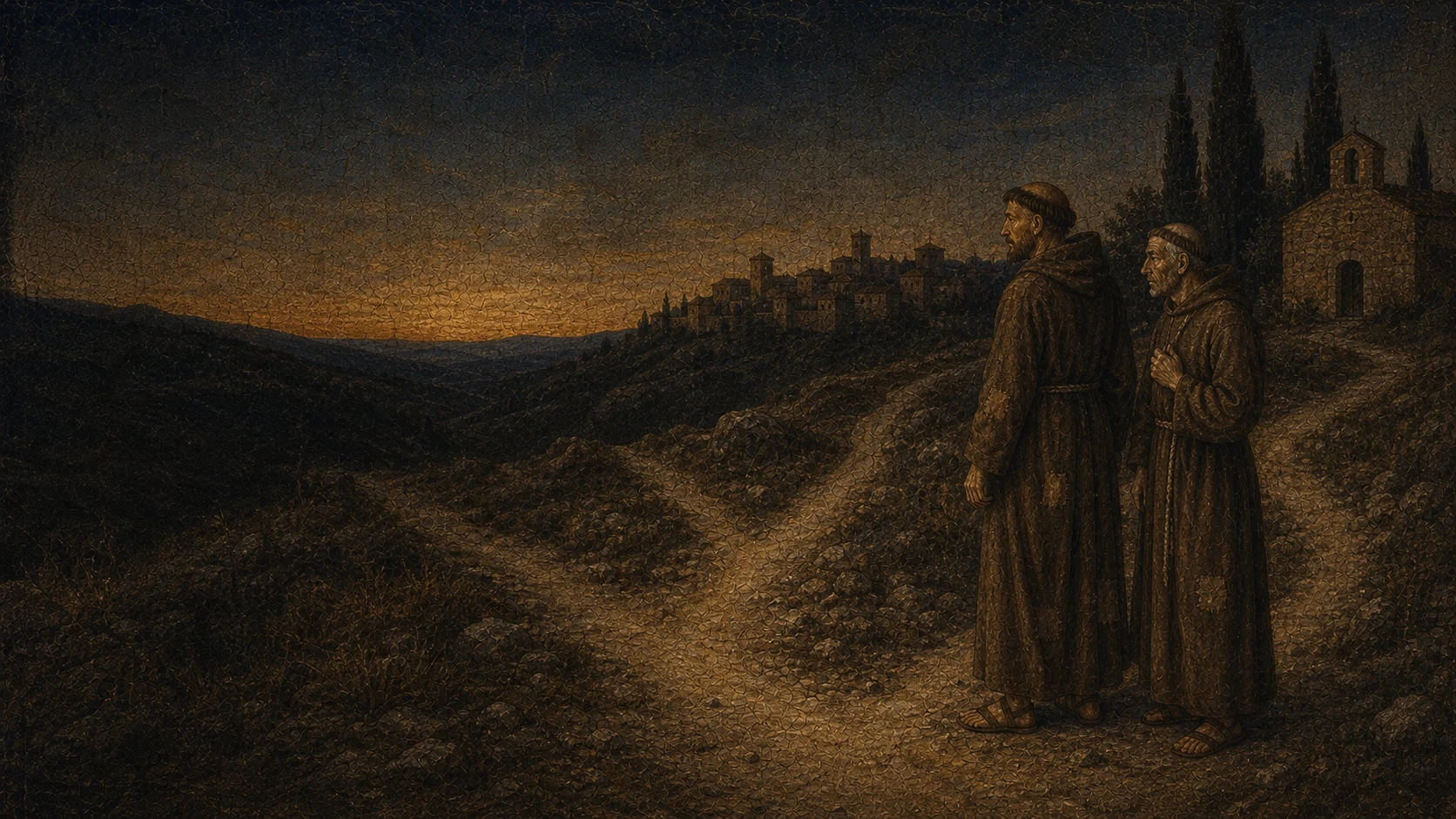
The road splits in three.
One way leads to Florence, another to Siena and another to Arezzo. There are no modern signs, folding maps or voices telling them where to turn. There is dust, stone, open country and two figures in worn habits. Brother Masseo looks at Francis and asks the most ordinary question on any journey:
— Which road should we take?
In the Little Flowers of Saint Francis, Francis tells Masseo to spin around at the crossroads until he falls from dizziness. When the friar comes to a stop facing Siena, they set off in that direction.
It is a funny, strange and dangerous scene. Did it happen that way? We do not know. Someone, however, considered it important enough to write down almost a hundred years later.
This is how Brother Masseo comes to us: walking inside stories.
A real man surrounded by flowers
Masseo, or Masseu in some translations, came from Marignano, near Assisi. We do not know the year of his birth or when he joined the brothers. His name, however, is associated with the group of early companions, and the letter sent from Greccio in 1246 remembers Masseo among the friars from whom recollections about Francis had been received.
This is important historical ground: Masseo existed, knew Francis and was remembered by the early companions as a witness.
Then the ground is covered with flowers.
The best-known stories about him are found in the Little Flowers, the Italian translation and adaptation of the Acts of Blessed Francis and His Companions. The Acts were probably gathered between 1327 and 1337 in the Marches, about a century after the events they describe. The Little Flowers selected and retold some of this material in Italian.
In the medieval world, a “flower” could be a beautiful example gathered from someone’s life. The book combines oral memory, teaching, humour, miracle and devotion. Some pages may preserve genuine echoes; others were shaped to teach. We cannot give every conversation the certainty of official minutes.
Masseo is real. The exact dialogues, gestures and details belong to the garden of tradition.
“Why does everyone follow you?”
The Little Flowers describe Masseo as a man of good sense and holiness who spoke easily about God. Other portraits say that he was tall, strong and handsome. We have no portrait or document to confirm his appearance. This beauty belongs chiefly to the construction of his character.
One day, the book says, Francis returns from the woods where he had been praying. Masseo runs to meet him and asks, almost jokingly:
— Why you? Why you? Why you?
Francis wants to know what this means. Masseo explains: why do so many people wish to see him, hear him and obey him? He is not handsome, learned or noble. Why, then, does the whole world seem to run after him?
Francis does not take offence. The narrative says that he rejoices, thanks God and replies that the Lord did not choose him for his greatness. He chose someone small so that everyone would understand that goodness comes from God.
Perhaps the dialogue preserves the direct manner of the first brothers. Perhaps preachers polished it over decades. Either way, its question is deeper than a joke.
Masseo notices a danger that follows every admired person: confusing the messenger with the message. Francis does not answer, “Because I am special.” He returns the admiration to its source. In the account, Masseo is the one who opens a window through which Francis’s humility can be seen.
The handsome friar who received the better bread
Another story places the two before unfamiliar doors. The friars lived by their work and, when necessary, begged for food. Because Masseo looked strong and distinguished, people gave him larger and better loaves. Francis, frailer in appearance and poorly dressed, received small, hard pieces.
The two meet beside a spring and place what they have received on a stone. Francis contemplates the table without cloth, plates or house. According to tradition, he calls it a great treasure: bread freely given, clear water and poverty lived without reserve.
We must not use this scene to romanticise someone going hungry. Involuntary poverty harms people and must be opposed. The account is about two adults who chose an itinerant life and received bread in a world where hospitality was essential. Even so, the real lives of the medieval poor were harsh, and no literary glow should conceal that.
The contrast between the loaves also speaks about appearance. A door opens more readily to someone who looks handsome and trustworthy. Some people are welcomed before saying a word; others must prove that they deserve respect.
The narrator asks: what do we do when we receive more because of our face, our clothes or our ease of speech? The Franciscan answer is to turn advantage into sharing.
The friar who stayed at the door
The Little Flowers say that Francis sometimes assigned Masseo simple duties: answering the door, looking after the food and begging for alms while other brothers remained in prayer. The reason given was to protect Masseo from vanity, since he had gifts that attracted people.
For a reader today, the scene requires care. Humility does not mean humiliating someone in front of a group. Obedience does not permit dangerous jokes or abuse. A healthy community does not break a person’s dignity in order to teach a lesson.
The medieval tale wants to show something else: no gift makes anyone too important to serve. The fine voice that preaches can also answer a knock. Admired hands can prepare bread. The brother joyfully welcomed in towns still belongs in the kitchen, at the door and in the dust.
In the account, Masseo begins to wonder why he is always given ordinary work. He soon recognises the pride hidden in that question. He then performs his service simply. The main transformation lies not in the task, but in the way he stops measuring his worth by the place he occupies.
Fraternities depended on these services. Without fetching water, sharing food, caring for the sick and welcoming arrivals, there could be no communal prayer. Hidden work sustained the hermitage.
Spinning among the possibilities
Let us return to the crossroads.
After Masseo falls pointing toward Siena, the Little Flowers say that the two arrive in the city. There is a conflict, and Francis helps restore peace. The absurd spinning ends in a serious mission.
It is not wise to repeat the experiment. Spinning until you fall can cause injury and is not a Christian method of making decisions. The narrative uses exaggeration and humour, common devices in medieval examples. Its teaching does not depend on copying the gesture.
Masseo is the ideal character for the scene because he wants a clear answer. Florence, Siena or Arezzo? In the tale, Francis refuses to control everything. The chosen road does not emerge from prestige, comfort or planning. It represents openness.
Thinking is not a lack of faith. The friars had to plan journeys, find shelter and avoid danger. The little flower asks whether we are still able to change direction when goodness calls us down another road.
The spinning dismantles Masseo’s elegant image. The respected man falls into the dust like a child. Medieval holiness did not always need a solemn face.
Between solitude and the town square
In another famous episode, Francis does not know whether he should devote himself to prayer or go out to preach. He sends Masseo to consult Clare and Brother Sylvester. The answer he brings back is that Francis must proclaim the Word throughout the world, for he was not called for himself alone.
The text brings great figures together in a decision too perfect for every detail to be verified. But it shows Masseo in a role consistent with his remembered character: he is a trusted man of the road, able to carry a question, listen to answers and return without taking center stage.
Being a messenger requires a particular humility. One must carry a word without replacing it with one’s own. Masseo often appears in this way: between Francis and a city, between the hermitage and the square, between a door and the person knocking.
Perhaps that is why the Little Flowers like him so much. Leo preserves papers and memories. Giles offers sharp sayings. Masseo sets the stories in motion. When he enters, someone walks, asks, serves, looks for bread or changes direction.
What remained when the footsteps ceased
Traditions say that Masseo lived to an advanced age and was buried near Francis in the basilica in Assisi. The dates and details of his later years are not all equally secure. The historical man remains unobtrusive.
The literary character kept walking. Readers found in him the friend able to ask questions without ceasing to love, the admired friar who served and the companion on an unexpected road.
There is one risk in loving these stories: wanting everything to have happened word for word. But there is another risk: rejecting them because they are not immediate documents. The Little Flowers are not a transparent window onto 1220. They are a stained-glass window created in the 14th century from pieces of memory, preaching and hope. The light that passes through it has colors.
To read well is to see both the glass and the light.
Perhaps Masseo did not spin at that crossroads. Perhaps Francis never uttered the exact answer preserved in the book. Even so, medieval brothers believed that these scenes revealed something true about the Franciscan way: gifts do not excuse us from service, admiration belongs to God, and no one knows beforehand on which road a task of peace will be found.
In the final image, we need not make him spin. It is enough to see him standing there, dust on his sandals, looking at three roads. Beside him, Francis waits. Neither of them has a complete map.
Masseo became known not for building a friary, writing a treatise or governing the Order, but for walking beside someone—and because old stories found in his steps a human way to learn how to be lesser.
Touchstones
Sources for this story
- Introduction to the Little Flowers of Saint Francis — CapuchinsExplains the meaning of the title, the work’s organisation, its Franciscan context and the chapters in which Brother Masseo appears.
- Jacques Dalarun and others, À l’origine des Fioretti — PerséePresents the Acts as the Latin text preceding the Little Flowers, probably composed between 1327 and 1337, and discusses its genre and oral transmission.
- Fioretti di San Francesco — bilingual Italian and English editionThe text of the traditional episodes, including the crossroads, the question “Why you?”, humble service and the mission entrusted to Masseo.
- Franciscan Sources — Franciscan Province of the Immaculate Conception of BrazilA portal for the early biographies, writings and compilations needed to compare the proximity and character of the sources.
- Masseo of Marignano — Franciscan DirectoryBrings together the early references and later traditions concerning the companion, making it possible to identify what depends on the Little Flowers.
How we read the sources: Masseo’s existence and his connection with the earliest companions belong to the historical core. His appearance, the full dialogues and the detailed episodes come chiefly from the Acts and the Little Flowers, written about a century later; they are therefore treated as edifying accounts, not literal transcripts.