
The road climbs into the cold
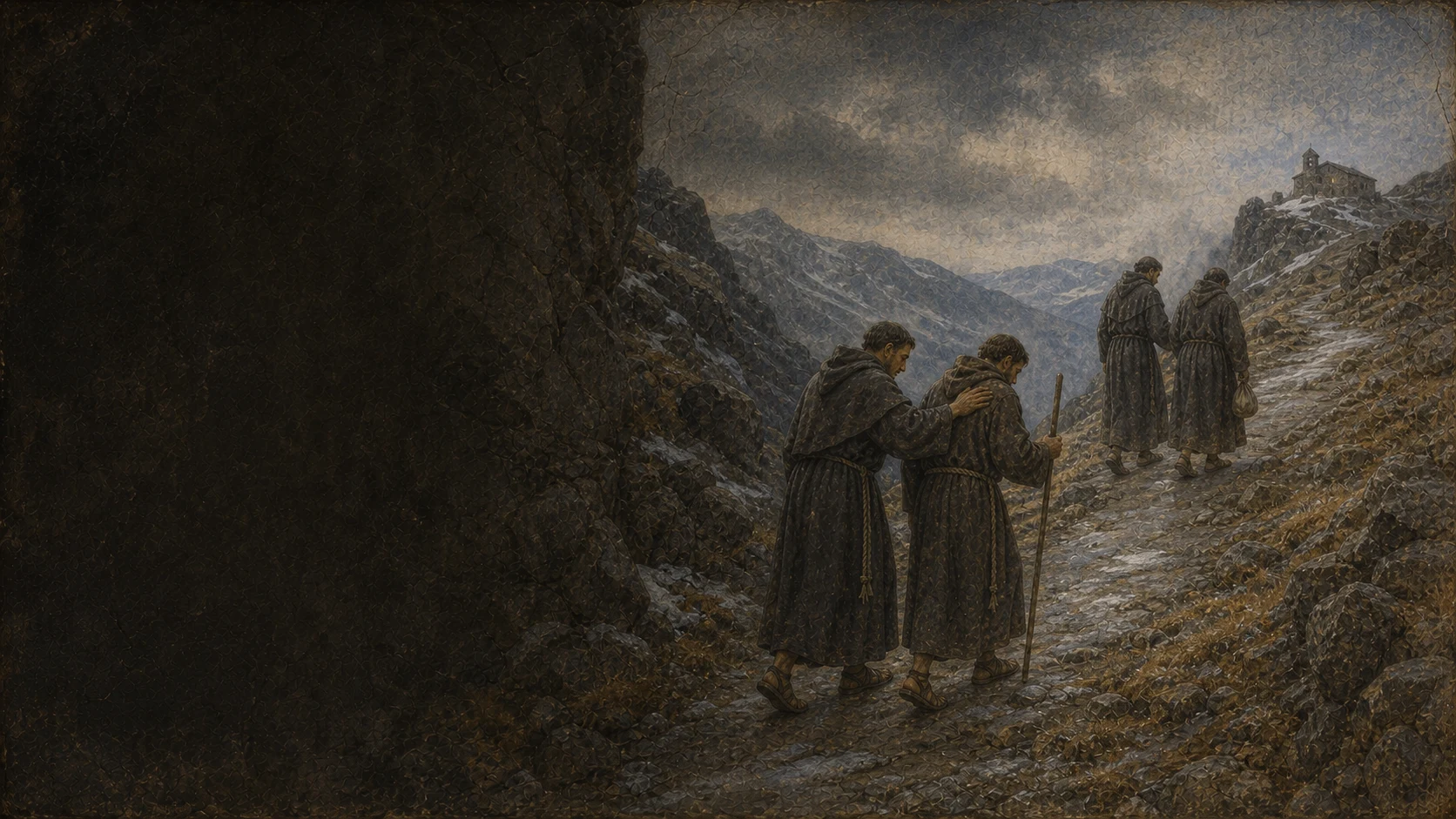
The path narrows among the stones. To the right, three friars move slowly onward. Their dark woolen habits are damp. One rests a hand on another’s shoulder to cross a slippery stretch. They carry no mountaineering boots, tents or modern equipment. They have very little with them.
Snow lies ahead, but not the beautiful snow that decorates postcards. It is ice gathered in the shadows and cold water seeping into sandals. Far below, the road disappears into the valley. In the distance, a stone house offers the hope of fire, bread and shelter.
This scene is a reconstruction. No chronicle describes the position of every foot on an Alpine pass. We do know, however, that groups of friars left Italy, passed through Trent, Bolzano and Brixen, then continued through the mountains toward the north. We also know that they were poor and depended on the hospitality they found along the way.
For them, the Alps were not scenery to admire. They were the great stone gateway between worlds that did not speak the same language.
“Beyond the mountains”
Medieval documents call the lands on the far side of the Alps ultra montes: beyond the mountains. Today we can cross borders by following signs. In the 13th century, a journey meant finding bridges, ancient roads, inns, monasteries and people willing to guide strangers.
At the great chapter of 1217, the fraternity began to organize missions outside Italy. The dates of the first departures are not perfectly clear. The Chronicle of Jordan of Giano places certain missions in 1219; historical studies connect them with the decisions of 1217 and renewed attempts in the following years. Jordan dictated his recollections in 1262, when he was already old. He knew many events from experience, but he did not have an open calendar before him.
The desire was immense. The preparation was not always equal to it.
Francis wanted the brothers to live the Gospel among different peoples. Some would cross the sea. Others would go to France, Spain, Hungary and German-speaking regions. They departed without an army and without a network of large houses of their own.
Nor did they yet understand how deeply a message of peace depends on intelligible words.
A word that seemed to open doors
Jordan of Giano tells the most famous story about the first attempt in Germany. About sixty brothers were said to have been sent under the leadership of John of Penna. They did not know the local language.
At some point, they learned one word: “ja,” meaning “yes.” When someone asked whether they wanted food or lodging, they replied “ja.” The word obtained bread, shelter and smiles. The travelers concluded that it was a kind of key and began using it to answer every question.
Then someone asked whether they were heretics and whether they had come to spread the same religious errors feared in Lombardy. Once again, the friars answered, “ja.”
According to the chronicle, some were beaten, others imprisoned, and still others stripped and exposed to ridicule. The group abandoned the mission and returned to Italy. For a time, Jordan said, Germany seemed to the brothers so cruel a place that only someone seeking martyrdom would dare return.
The story is funny for an instant and terrible immediately afterwards. It must also be read according to the kind of source it is. Jordan wrote decades later, drawing on memory and on the lively storytelling of the early friars. The failure and the linguistic difficulty are historically solid. We cannot prove that every person repeated exactly the same word in every encounter.
Why did they look like heretics?
Medieval Europe was full of religious movements. Some had been condemned by the Church; others were being investigated. Certain groups preached on the roads, dressed poorly and criticised the wealth of the clergy. Seen from a distance, the Friars Minor could look like one more such group.
In France, the first brothers were also asked whether they were Albigensians, the name associated with a heresy fiercely opposed at the time. Again, according to Jordan, their lack of understanding produced a dangerous answer.
This time, authorities and masters examined the friars’ way of life. They judged it evangelical and Catholic, but sought confirmation from Pope Honorius III. Papal letters of 1219 and 1220 presented the Friars Minor as Catholic men and recommended that they be received.
This reveals an important change. Poverty alone did not explain who they were. They needed to communicate their identity, respect local bishops and carry documents that people in distant places could recognize.
Before calling other people’s mistrust ignorance, the friars had to recognize their own lack of preparation.
The second crossing
In 1221, the fraternity tried once more to establish itself in German-speaking lands. This time, the mission was entrusted to Caesarius of Speyer, a brother born north of the Alps who knew the language and the region. The group included Italian and German brothers, clerics and laymen. Thomas of Celano and Jordan of Giano were among them.
Jordan does not present himself as a hero. He says that he did not want to go and was afraid. This small confession makes the chronicle more human. Some people crossed the mountains enthusiastically; others went in obedience while their hearts still trembled.
The brothers assembled in Trent. Caesarius sent them onward in groups of two or three, making provision for responsibility over their material and spiritual needs. Brothers able to preach in the local language prepared the way. Bishops in Trent and Brixen welcomed them.
The contrast with the first attempt is clear. The faith was the same; their prudence had grown.
Two loaves and seven turnips
Beyond Brixen, the road entered the high country. Jordan recalls that one group reached a settlement late in the day. The friars did not know how to ask for bread. They found only two pieces of bread and seven turnips to share.
The chronicler turns hunger into a story of joy. We do not have to pretend that seven turnips were a feast. They were little food for tired men. Poor hospitality does not remove the cold, but it can keep a night from becoming abandonment.
There is a curious uncertainty: scholars note that Jordan may have confused the place-name. The general route—Trent, Bolzano, Brixen and the ancient road north—is recognisable; every stopping place is not. Memory preserved the bread and turnips better than it preserved the map.
Perhaps the same happens to us. We forget the street name but remember who shared food with us.
Augsburg opens the door
Around 16 October 1221, about a month after leaving Trent, the brothers gathered in Augsburg. There they celebrated the first chapter of the new mission and were sent in small groups to other towns.
John of Pian del Carpine and Barnabas, who could preach, went ahead. Others continued to Würzburg, Mainz, Worms, Speyer, Strasbourg, Salzburg and different regions. They did not arrive by building large friaries. In Speyer, for example, one of their first homes stood outside the walls near people affected by leprosy.
Shelter might come from a bishop, clergy, a hospital or local residents. The same Europe that had beaten strangers also set bread before them. No people can be contained within a single scene.
What failure taught them
Listening is also part of proclamation.
The brothers returned with interpreters, documents and better organisation. They did not abandon simplicity; they abandoned the idea that good intentions are enough. Anyone who wants to approach another people must learn their language, their fears and the respectful way to knock at their door.
Nine men before the sea
Three years later, in September 1224, nine friars landed at Dover in England: four clerics and five laymen, led by Agnellus of Pisa. This information opens the chronicle of Thomas of Eccleston, written by an English friar who gathered the memories of the first generation over several decades.
The monks of Fécamp helped the group cross the English Channel. In Canterbury, they received food and lodging, after which some stayed at the Hospital of Poor Priests. Others went on to London, where the Dominicans hosted them. Later they reached Oxford.
Not every door opened. Food could be scarce, accommodation temporary, and the friars’ appearance aroused curiosity. But Eccleston preserves many scenes of hospitality: one religious order receiving another, a town offering land, ordinary people helping travelers who could not pay.
His chronicle was written between the 1250s and the beginning of the 1260s. It is close to the English community and draws on participants’ testimony, but it also praises the Order to which its author belonged. Like Jordan, Eccleston deserves to be heard with gratitude and critical attention.
The map made of doors
A few years earlier, Jacques de Vitry had observed the brothers in Italy. In a letter of 1216, he wrote that during the day they entered towns and villages and at night returned to solitary places. This is the earliest known testimony by someone outside the movement.
Across the Alps, that rhythm brought new risks. Solitude could mean freezing. A town could be suspicious. An accent could end a conversation. A religious house could save the journey.
The friars did not carry a ready-made Italy into other peoples’ lands. Gradually, local brothers entered the fraternity and gave new voices to the same path. Expansion was not a line drawn by Francis on a map. It was a chain of encounters, mistakes, corrections and welcomes.
In the painting, the travelers have not yet arrived. Shelter remains distant and their feet hurt. Even so, they move onward together.
Crossing the Alps did not mean conquering the mountain. It meant accepting that on the other side they, too, had much to learn.
Documentary stones
Sources for this chapter
- Jordan of Giano — Chronicle, part oneContemporary Franciscan chronicle, dictated in 1262. The main source for the missions to France and Germany, the “ja” episode, the second expedition and its route.
- Spirit + Life 137 — history of the Franciscan movementModern translation and critical synthesis. It reproduces Jordan's narrative and provides context for the failure of the first mission.
- Thomas of Eccleston — the arrival of the Friars Minor in EnglandInternal chronicle, written around 1257–1258. It records the nine travelers who reached Dover in 1224.
- Michael Robson — study of Eccleston's chronicleModern academic study. An analysis of the formation of the first communities in Canterbury, London and Oxford.
- Jacques de Vitry — letter of October 1216Contemporary external testimony. A description of the Friars and Lesser Sisters before the great missions beyond the Alps.
- German Franciscans — the first brothers north of the AlpsConfirmation of the international composition of the 1221 group and the crossing organized by Caesarius of Speyer.
How to read this chapter: the Alpine opening is an artistic reconstruction based on the route and material conditions, not a scene described by a witness. Jordan took part in the 1221 expedition but dictated his chronicle four decades later and sometimes confuses dates or places. The “ja” episode preserves the linguistic failure; its dialogue and numbers should be read as chronicle narrative, not a transcript.