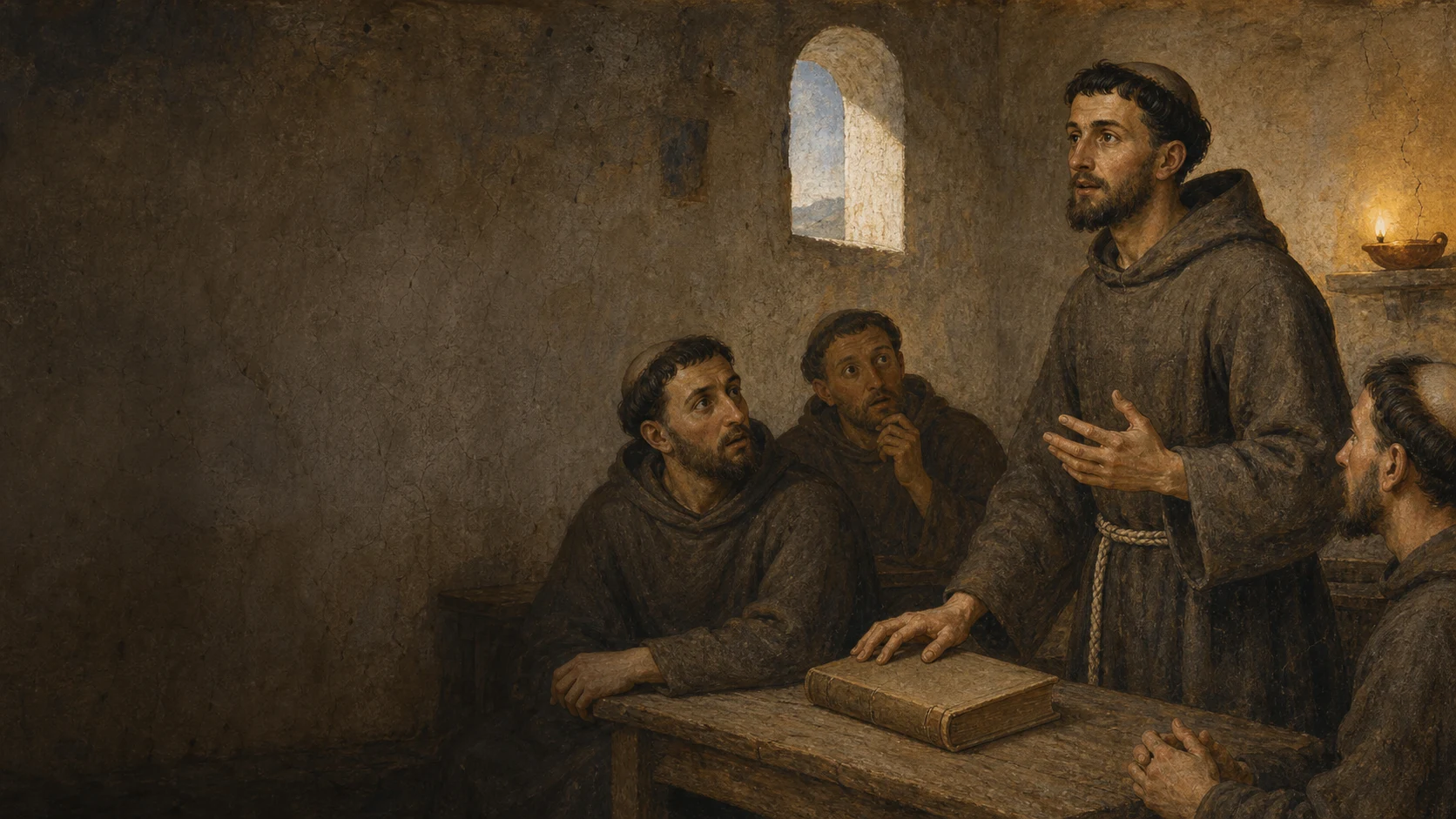
The manuscript is closed.
On the wooden table, it seems to be guarding a secret. The friars gathered for an ordination near the Italian city of Forlì need to hear a sermon. But no one has prepared. Who will speak?
Then the friar in charge tells Anthony to say something.
Until that day, almost everyone had known the Portuguese friar as a quiet, helpful brother. He worked and prayed at a small retreat called Montepaolo. He did not display his learning. Perhaps some imagined that he knew very little.
Anthony begins simply. Then his ideas find their way. The Bible, studied for years, seems to kindle within him. His listeners realize that the silent brother possesses an extraordinary mind.
The book remained closed. The word was already stored in his heart.
Before Anthony, Fernando
Anthony’s baptismal name was Fernando. He was born in Lisbon, probably around 1195, although the year is not entirely certain. His first biography, known as the Assidua, was written shortly after his death, around 1232, but gives few details about his childhood.
We therefore need to proceed carefully. Tradition says that his family held an important position. Later stories add names and even the exact day of his birth, details that the early documents do not confirm.
Fernando’s Lisbon looked out over the Tagus. Ships brought goods, people, and news. Memories, languages, and tensions among Christians, Jews, and Muslims coexisted in the city.
The boy grew up in a world larger than the walls of his home. But his first great journey did not cross the ocean. It took him into books.
An Augustinian Canon
Fernando did not begin his religious life as a Franciscan. While still young, he entered the community of São Vicente de Fora in Lisbon. Its members were Canons Regular of Saint Augustine.
A canon regular was not simply a monk by another name. He lived in community under the Rule of Saint Augustine, prayed, and prepared to serve the Church.
At São Vicente, Fernando still received many visits from people he knew. Seeking greater seclusion, he asked to move to the monastery of Santa Cruz in Coimbra, one of the most important centers of learning in the Portuguese kingdom.
He spent years studying there. He read Scripture and the ancient Christian teachers. He acquired a rare command of the Bible and an exceptional theological education.
Every sheet of parchment required labor; every line was copied by hand. To read meant to dwell on a sentence and let it descend from the mind into the heart.
Fernando could not yet imagine where all those words would be needed.
Five Coffins Arrive in Coimbra
In 1220, news traveled across Portugal. Five Friars Minor had been killed in Morocco after trying to preach among Muslims. Their remains were brought to Coimbra, and Fernando either saw them or learned of their arrival at the monastery.
The event shook him. Those men belonged to the new fraternity of Francis of Assisi. They dressed poorly and wanted to proclaim the Gospel.
Fernando wished to join them and leave for Morocco. He asked permission to leave the canons and received the habit of the Friars Minor. He also received a new name: Anthony, probably connected with the hermitage of Santo Antão dos Olivais, where the friars lived near Coimbra.
His desire for martyrdom needs to be understood within the thirteenth century. At that time, many Christians saw dying for the faith as the fullest possible self-offering. Today, we need neither turn that desire into contempt for another religion nor conceal that the encounter took place in a period of conflict. Anthony’s courage was real; his knowledge of the people to whom he intended to speak was probably limited.
He planned to offer his life. He would discover that he did not control the first step.
The Journey His Body Interrupted
Anthony reached Morocco but became seriously ill. Instead of preaching, he needed care. After a few months, he accepted that he had to return to the Iberian Peninsula.
At sea, contrary winds drove the ship far off course. The vessel ended up in Sicily, in southern Italy.
Many modern accounts call this journey a “shipwreck”. The image is dramatic, but the Assidua speaks of winds that drove the ship to Sicily; it does not describe a detailed scene of a wrecked vessel. It is more accurate to imagine a dangerous, diverted voyage than to state a shipwreck as certain fact.
Anthony must have disembarked weak, in a country whose language was not his own, without the purpose that had led him to leave Portugal.
It seemed a complete failure.
Yet the story of his life changed precisely because the wind did not obey him.
Among Thousands of Reed Mats
In Sicily, the friars welcomed the traveler. Anthony learned that a great gathering of the brothers would take place in Assisi at Pentecost in 1221. He went there.
This gathering became known as the Chapter of Mats, after its very simple shelters. Anthony probably saw Francis. We have no record, however, of a conversation between the two.
At the end of the chapter, ministers took brothers to different regions. No one seemed to ask for the unknown Portuguese friar. Anthony then made himself available to Brother Gratian, who was responsible for Romagna in northern Italy.
He was sent to the hermitage of Montepaolo, near Forlì. There he prayed, helped with daily tasks, and lived out of sight. His companions did not know the extent of his education.
He did not pretend to be ignorant: he simply did not use his knowledge to demand special treatment. After so many years among books, he accepted being the brother who was simply present.
The Voice Discovered in Forlì
Around 1222, Franciscan and Dominican friars gathered in Forlì for an ordination. When the time came for the sermon, none of the visitors wished to speak without preparation. The superior asked Anthony to do it.
The Assidua, our earliest biography, says that he began hesitantly and then spoke with clarity, depth, and grace. The account was written to demonstrate its subject’s holiness, as was common in medieval saints’ lives. Even so, the unexpected discovery of his ability belongs to the oldest core of Anthony’s remembered story.
From then on, those responsible for him gave him the mission of preaching.
Anthony traveled through northern Italy and southern France. He challenged ideas he considered mistaken, but he also denounced greed, injustice, and inconsistency among Christians.
He knew how to organize a line of thought so that an ordinary person could find a way into it. His preaching grew from study, observation, and prayer.
A Teacher Who Did Not Extinguish the Flame
Anthony also became one of the first theology teachers among the Friars Minor, teaching the brothers in Bologna.
Francis sent him a short letter, preserved among his writings. He calls Anthony “my bishop”, an affectionate way of recognising his teaching mission. Francis approves the lessons but sets one condition: study must not extinguish the spirit of prayer and devotion.
This letter is precious: a documented point of contact between the two men.
Anthony took that balance seriously. His Sermons, the major work he left behind, are not exact notes of what crowds heard in public squares. They are scholarly materials for preparing preachers: pages filled with the Bible, interpretations, images from nature, and moral guidance.
The former canon did not disappear beneath the Franciscan habit. The discipline he learned in Coimbra made his later service possible.
His life brings together two truths we sometimes separate: a person can study deeply and remain humble; a person can pray sincerely and continue asking difficult questions.
What About the Fish, the Child, and the Lost Book?
Wonderful stories grew around Anthony. He is said to have preached to fish, made a mule kneel, and held the Child Jesus in his arms. These scenes are important in devotion, but many appear in later collections, not in the earliest layer of the Assidua.
A medieval legend is not necessarily a lie. It can teach poetically that creation listens to the good news or that faith is worth more than pride. But it is not a recording of the event.
Anthony is also invoked when people seek lost objects. This popular devotion is dear to millions and deserves respect. One common explanation connects it to the disappearance of a book of psalms containing his notes, which was supposedly returned after his prayer. The episode, however, is absent from the earliest biography and was passed down in later traditions.
To reduce Anthony to the “patron saint of lost things” would be to lose almost everything about him.
Before he looked for keys, he looked for words that could open consciences. He defended the poor against exploitation, called the powerful to conversion, and taught friars to think without ceasing to pray.
The Foreigner Who Found a Home
Anthony lived for only about ten years as a Franciscan. They were intense years. He preached, taught, wrote, and served in positions of responsibility within the Order. In the end, he became associated with the city of Padua, where he died in 1231.
His fame spread with astonishing speed. He was canonised in 1232, less than a year after his death. Centuries later, in 1946, the Church declared him a Doctor of the Church and gave him the title Evangelical Doctor.
Portugal calls him Anthony of Lisbon. Much of the world calls him Anthony of Padua. Both names tell the truth: Lisbon was his beginning; Padua kept his memory. Between one city and the other lay Coimbra, Morocco, Sicily, Assisi, Montepaolo, Forlì, Bologna, and many roads.
The man celebrated in so many countries began his Franciscan life with no homeland around him, ill and unknown.
Perhaps that is why his story reaches those who have ever felt out of place.
To Keep in Your Heart
Anthony did not become valuable on the day others discovered his intelligence. He already had value when he was ill on the ship, when no one chose him at the chapter, and when he carried out hidden tasks at Montepaolo.
The sermon at Forlì merely revealed something that had been prepared in silence.
You too have gifts that may not yet have found their occasion. You do not need to push them in front of everyone, but you do need to care for them. Study. Ask questions. Learn to listen. Accept simple tasks. And when the time comes to serve, do not hide what you can do for someone else’s good.
If a plan goes off course, remember Anthony’s ship. The detour does not make the pain pleasant or guarantee an easy ending. It simply teaches us that an interrupted path can still lead to a whole life of meaning.
Today, choose one thing you know how to do and use it without seeking applause: explain a subject patiently, listen to someone who is lonely, read to a child, or organize a task everyone avoids.
Then close the book for a moment.
Ask whether what you have learned has already begun to turn into love.
Sources and paths for further reading
How We Know Anthony
- Assidua — the first Life of Saint AnthonyThe Centro Studi Antoniani presents the biography composed around 1232, an early source for his education, journey, life at Montepaolo, preaching, and death.
- Writings of Saint Francis — Letter to Brother AnthonyA short, authentic text in which Francis approves the teaching of theology, provided that it does not extinguish prayer and devotion.
- Benedict XVI — audience on Saint AnthonyA documented overview of his time with the Augustinian canons, entry among the Franciscans, journey, preaching, teaching, and writings.
- Basilica of Saint Anthony — life and chronologyAn institutional website with chapters on Lisbon, Coimbra, Morocco, Sicily, Assisi, Forlì, his teaching, and his work as a preacher.
- Dominic V. Monti, OFM — Saint Anthony of PaduaA contemporary Franciscan study that reviews his Portuguese education and identifies uncertainties about his age, family, and biographical details.
The Assidua was written about a year after Anthony's death, but it is a hagiographical work: it aims to tell the story of a holy life, not to produce a modern biography. Francis's letter is the most direct documentary contact. Famous miracles and the story of the lost book belong to later devotional layers and have been presented here as tradition, not as equally well-documented facts.
Historical note: the traditional chronology places Anthony’s birth in 1195, but the year remains debated. The early source describes illness in Morocco and contrary winds that drove the ship to Sicily, so this chapter does not claim that a shipwreck occurred. His presence at the Chapter of 1221 and his meeting with Francis are accepted in Franciscan chronology, although no record exists of a conversation between them.