
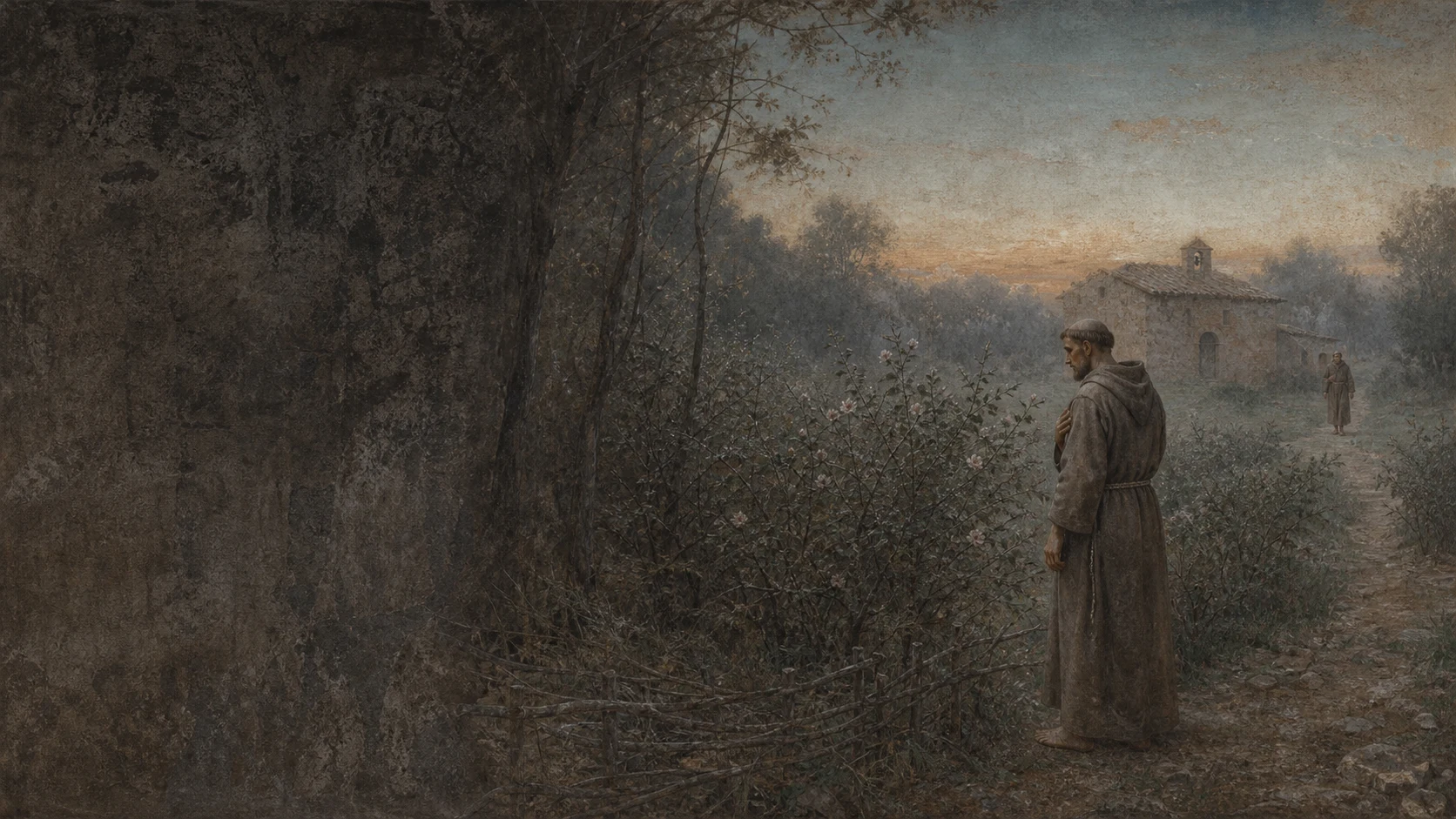
The sun has not yet risen.
On the plain below Assisi, a friar walks among the bushes. The little church of the Portiuncula seems almost asleep. There is dew on the leaves, damp earth and thorns catching scraps of mist.
Centuries later, pilgrims will enter that place to see thornless rose bushes. They will hear that Francis, tormented by temptation, threw himself among the branches. The plants are said to have stopped wounding him and produced roses.
It is one of the sanctuary’s best-known stories.
It is also a story that the earliest lives of Francis do not tell.
What should we do when a garden exists, a tradition moves people and the early documents remain silent?
In this notebook, we will not uproot the rose to discover its secret. We will merely draw aside, with care, the leaves covering the path.
What we know
A small portion that is real
The Portiuncula is not an invention. Francis repaired the little chapel of Saint Mary of the Angels, and it became one of the centers of the first fraternity. The brothers gathered there; Clare began her new life there; and Francis died nearby in 1226.
At the time, the building stood on a plain with woods, clearings, paths and very simple shelters. The enormous basilica that now encloses the chapel was begun only in 1569. The landscape has changed profoundly.
Behind the present basilica is the Roseto, a rose garden associated with Francis’s memory. The sanctuary presents the area as a fragment of the old woodland where the first brothers lived. It also preserves a Chapel of the Roses and a courtyard built in 1882 to connect the spaces visited by pilgrims.
The physical place is real. Its present form, however, has passed through building work, gardens, restorations and centuries of human care.
The plant that can be seen
The garden contains a rose known as Rosa canina ‘Assisiensis’, described in local tradition as a thornless variety. Visitors can observe its branches and flowers.
This proves that plants with this feature exist there. It does not prove when the feature appeared or which branch descends from which medieval plant.
Rose bushes can be pruned, transplanted and propagated from cuttings. Gardeners can preserve a characteristic for generations. Botany can examine the living plant; it cannot look at the stem and find the date of an event eight hundred years ago engraved upon it.
There is, then, a present rose bush. There is a preserved garden. There is an old devotional connection.
We have not yet reached the miracle.
The silence of the earliest lives
Francis did not write about rose bushes losing their thorns. Thomas of Celano, author of the first life in 1228–1229 and a second around 1246–1247, does not recount the episode either. The Legend of the Three Companions does not include it. Bonaventure, whose Major Legend was approved in the 13th century, likewise says nothing about the transformation of the roses at the Portiuncula.
These authors recorded many trials, prayers and wondrous events. Their silence is not mathematical proof that nothing happened. A biographer always selects. Even so, when several contemporary sources fail to mention so striking a scene, historians must raise a caution flag.
The early sources know a different story. In the Second Life, Celano says that during a temptation Francis left a cell, went naked into the snow and shaped seven figures: a wife, children and servants. Bonaventure repeated the episode. There is bodily severity, night and temptation—but no rose bushes, blood or Portiuncula.
The earliest documented branch leads to the snow.
The story’s origin
A text written more than a hundred years later
The detailed rose narrative appears in the Tractatus de indulgentia Sanctae Mariae de Portiuncula by Brother Francesco Bartholi of Assisi. The treatise was composed around 1334–1335, more than a century after Francis’s death.
Bartholi gathered documents, testimony and popular traditions concerning the Pardon of the Portiuncula. His work is important evidence for what 14th-century Franciscans were saying. It does not automatically turn every detail into 13th-century testimony.
In chapter 8, the story acquires setting and movement. On a January night, Francis is said to have been praying in a cell near the church. Faced with temptation, he supposedly went outside naked and entered thorny bushes. Light, fragrance and white and red roses then appeared. The narrative continues to a vision of Christ and Mary and connects the scene with the granting of the Portiuncula indulgence.
The account does not merely say that a shrub changed. It constructs an entire passage: temptation, penance, flowers, vision and pardon.
This is our first secure textual ground for the developed form of the story: the first half of the 14th century.
Was the memory already circulating?
Bartholi may have gathered an older oral story. Traditions do not necessarily begin on the day someone writes them down. They may circulate for years around a table, in a sermon or among pilgrims.
But “it may be older” does not mean “it certainly comes from Francis.” A century of documentary darkness lies between those two statements.
Some texts connected with the Pardon appear late in the 13th century. They help reveal the growth of devotion to the indulgence, but the extended rose narrative is associated above all with Bartholi’s treatise and related 14th-century accounts.
Historians must not fill the gap with what they hope to find.
Stories that may have lent their shapes
The medieval world already knew saints who confronted temptation among hostile plants. In Gregory the Great’s Dialogues, Saint Benedict throws himself into nettles and thorns. The early life of Francis contained the episode of the seven snow figures.
Researchers compare these scenes with the account of the Roseto. The later story may have joined familiar forms: Benedict’s bodily struggle, Francis’s temptation and devotion to the Portiuncula.
This is a literary hypothesis, not an accusation of fraud. Medieval authors did not think about originality as we do. An old image could reappear to explain a new memory.
Perhaps the thorns entered the text along more than one path.
How the story changed
From an unnamed temptation to modern explanations
In the medieval treatise, temptation has the character of enticement by the enemy and an inner struggle. In recent versions, it may become sexual temptation, doubt, a desire to leave the Order or simple discouragement.
These explanations are not the same. Every age has chosen what it wished to teach.
The roses change too. Some accounts include twelve white and twelve red roses. In others, every bush loses its thorns. Some versions say that blood coloured the petals; others remove the blood and leave only flowers. Sometimes Francis takes roses to the chapel; sometimes they remain in the garden.
A living tradition is not an object locked in a box. It grows, loses branches and receives grafts.
When painting gave the account a face
In 1393, Prete Ilario da Viterbo painted a large altarpiece for the Portiuncula. In it, the miracle of the roses forms part of the visual path toward the vision and proclamation of the Pardon.
The painting is a precious witness—not to what happened in 1216, but to what already mattered to the community at the end of the 14th century.
From the 16th century onward, new frescoes and paintings gave color to the scene. The Chapel of the Roses received paintings by Tiberio d’Assisi early in the 16th century. In 1829, Friedrich Overbeck made another famous image on the façade of the Portiuncula.
Many pilgrims began to “remember” the event with details taken from these works. Art did not merely illustrate the tradition; it helped shape it.
When the garden became a witness
Over time, petals and leaves were kept as mementoes. The Roseto became a stop on the pilgrimage route. The thornless variety was given a name linked to Assisi and presented as a living continuation of the marvel.
This made the story more powerful: people looked not only at a painting but at a plant.
A living organism, however, is not a signed document. Even if a lineage has been carefully preserved, we do not possess a recorded botanical sequence extending back to the 13th century. Its present appearance does not resolve the absence of early texts.
The garden certainly bears witness to the devotion of generations who protected it.
About Francis’s night, it remains silent.
The mystery
Three things that do not need to pretend they are one
We can separate three questions.
Is there a thornless rose associated with the Portiuncula? Yes. The sanctuary preserves and identifies such a plant.
Is there a medieval tradition of the miracle? Yes. It is documented in developed form in the 14th century and appears in art from 1393.
Can we prove that the thorns disappeared when they touched Francis? No. Contemporary sources do not tell the episode, and the present plant does not record its own origin.
Answering “we cannot prove it” does not destroy the garden. It merely keeps devotion and research from wearing the same clothes.
Absence speaks too
Some people see the silence of the earliest lives and immediately conclude that everything was invented. Others see the present rose bush and conclude that the miracle has been scientifically proven. Both answers close the door too soon.
The early silence weighs against historical certainty. The later tradition is real as tradition. Botany describes a present feature. None of these statements needs to swallow the others.
We may never know how the first oral version began. It may have preserved a lost memory. It may have grown from a combination of other stories. It may have turned into a flower an inner experience impossible to narrate directly.
Honest mystery is not mist used to hide a trick. It is the space between what we know and what we long to know.
To keep in your heart
Do not imitate the bodily penances described in medieval texts. Hurting the body does not prove faith, and seeking help when faced with persistent thoughts or suffering is an act of courage.
Keep something else from the rose bush: an ordeal can lose its power to command our life without our having to deny that it has thorns.
Today, look closely at a story you love. Ask where it came from, who wrote it and what changed as it was repeated. If you discover that part of it is tradition, do not mock it. If you discover that it cannot be proved, do not feign certainty.
Dawn comes to the Portiuncula.
The roses do not shine. No angel moves the branches.
A friar looks at the garden, and the garden does not answer.
Even so, it remains.
Sources and paths for further reading
Where the thorns come from
- Portiuncula Sanctuary — Il RosetoThe official presentation of the present garden, the Chapel of the Roses, the variety called Rosa canina ‘Assisiensis’ and the devotional interpretation of the miracle.
- Noel Muscat — In defense of the Portiuncula IndulgenceA translation and study of Francesco Bartholi's Tractatus, composed around 1334–1335; the account of the roses appears in chapter 8.
- Thomas of Celano — Second Life of Saint Francis, 117The text of the early tradition about Francis, temptation and the seven snow figures, without any transformation of rose bushes.
- Bonaventure — Major Legend of Saint FrancisThe official 13th-century biography, which repeats the snow episode but does not recount the miracle of the Roseto.
- San Paolo Patrimonio — the Portiuncula altarpieceAn art-historical reading of Prete Ilario da Viterbo's work, dated 1393, a visual witness to the tradition at the end of the 14th century.
- Jung Hwan Kyou — textual study of the temptation at the PortiunculaAn academic analysis comparing chapter 8 of Bartholi with stories of temptation in Celano, Bonaventure and Gregory the Great.
The episode's absence from the earliest lives does not prove impossibility, but it prevents us from treating it as a well-attested fact. Secure testimony begins with a written 14th-century tradition and its artistic reception. The present plant confirms a current botanical characteristic; by itself, it supplies neither a medieval chronology nor a verifiable supernatural cause.
Historical note: the year 1216 belongs to the traditional connection between the roses and the Pardon of the Portiuncula. The developed narrative appears in Francesco Bartholi’s treatise around 1334–1335. Thomas of Celano and Bonaventure recount a temptation overcome in the snow, not among rose bushes. The physical continuity of a single plant from Francis’s lifetime cannot be demonstrated from the available documentation.